How Rapid City, South Dakota Got Its Name
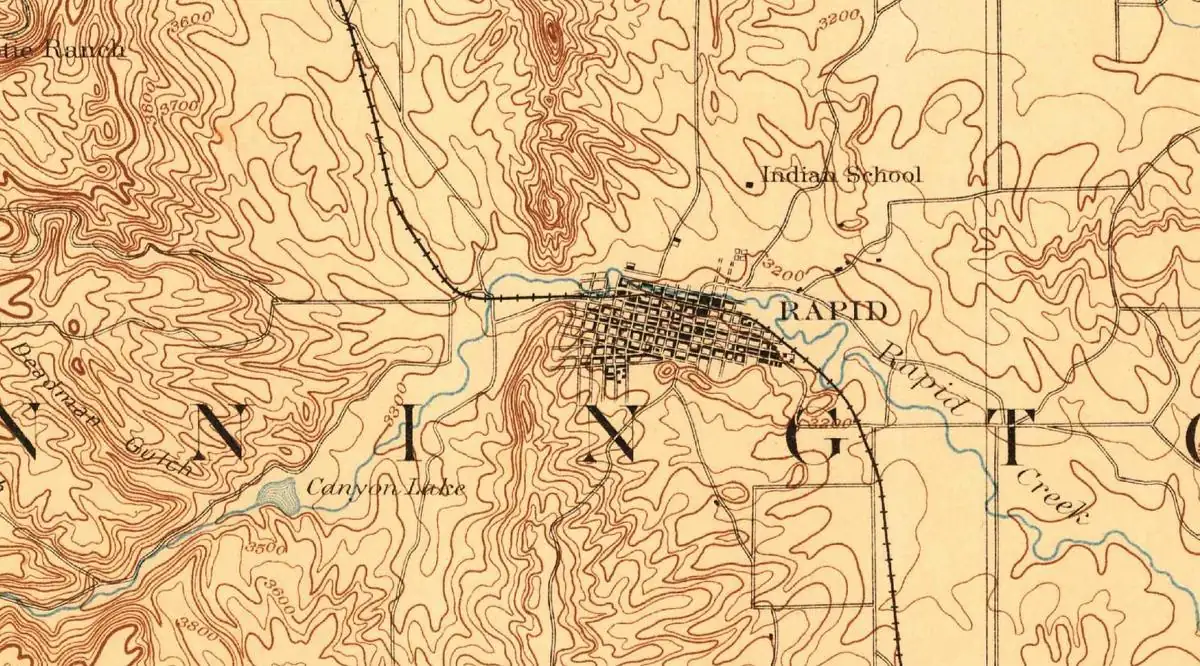
Rapid City, South Dakota, is named after Rapid Creek, the fast, spring-fed stream that runs through town. The name goes back to February 1876, when a small party of men who’d come to the Black Hills for gold decided to build a town instead.
Where the name comes from
Rapid Creek runs out of the Black Hills and straight through the city. The Bureau of Land Management describes the city as “named for the limestone spring stream that passes through it.” The founders didn’t reach for anything fancier. They named the town after the creek.
The creek had a name long before that. The city’s visitor bureau gives its Lakota name as Mni Luzahan and translates it as “fast water.” We haven’t yet confirmed that translation in a Lakota dictionary, so take the exact wording as the bureau’s, not ours.
Who named it, and when
According to the U.S. Geological Survey’s place-name record, the town was “named on February 25, 1876, by John R. Brennan,” with the name “taken from Rapid Creek that ran through the location.” That line comes from a 1908 railroad guide to place names, and the same book adds two details. Its county entry says the name was chosen “by vote of a meeting of the early settlers,” on the suggestion of J. R. Brennan and W. P. Martin. And it says the creek itself had been named by trappers and hunters for its many “rapids.”
There’s a bonus in there, too. The 1908 book says the town builders expected the place to have “a very rapid growth,” so the name seemed appropriate for that reason as well. Rapid City was a pun with a sales pitch built in.
Brennan and Samuel Scott led the group. The Rapid City Public Library says they took a small party to the banks of Rapid Creek in February 1876, and the BLM says they laid out the site of the city there. Their plan wasn’t mining. The BLM calls them “disheartened prospectors,” and the city’s visitor bureau says they turned their attention from searching for gold to building a community.
What it was called before
Before it was Rapid City, the settlement went by Hay Camp, according to the city library. Nobody we found explains the nickname in a record from the time, so we won’t guess. Within six months, the library says, more than a hundred people called Rapid City home.
Like Deadwood and Lead, Rapid City took its name from the land itself, in this case the water running through it.
Sources & further reading
- W. H. Stennett, A History of the Origin of the Place Names Connected with the Chicago & North Western and Chicago, St. Paul, Minneapolis & Omaha Railways (1908). Gives the naming date, the settlers’ vote, Brennan and W. P. Martin’s suggestion, the creek’s “rapids,” and the hope for “rapid growth.”
- GNIS feature 1265333 (U.S. Geological Survey). The federal record for Rapid City. Its history note quotes Stennett’s date, credits John R. Brennan, and ties the name to Rapid Creek.
- Bureau of Land Management, “Rapid City, South Dakota” (2021). Describes the city as named for the limestone spring stream that runs through it and names Brennan and Scott as the men who laid it out.
- Rapid City Public Library, “History of Rapid City.” Covers the Hay Camp name, the February 1876 party led by Brennan and Scott, and the town’s growth in its first six months.
- Visit Rapid City, “History & Facts.” The city visitor bureau’s page, the source for the creek’s Lakota name, Mni Luzahan, and its translation as “fast water.” Not yet confirmed in a Lakota dictionary.
Spot something wrong? Corrections are noted here with their date, never made silently.