How Lead, South Dakota Got Its Name (and Why It Rhymes with 'Seed')
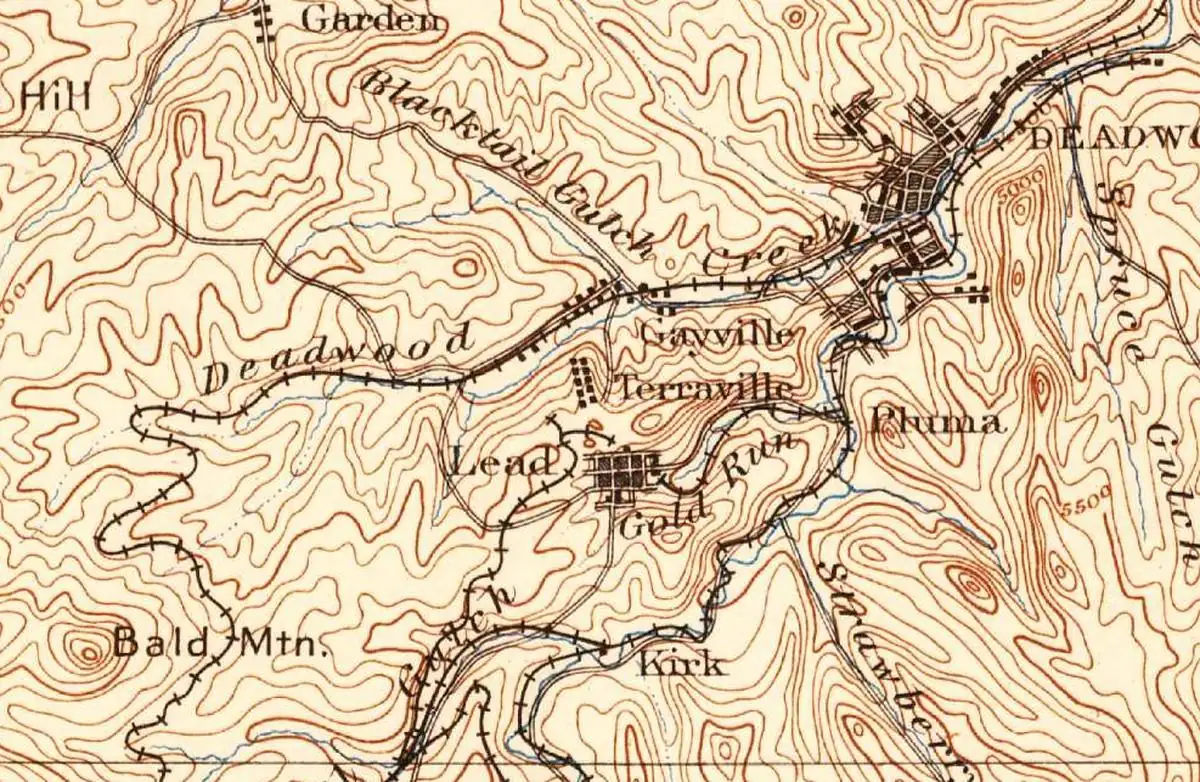
Lead, South Dakota, takes its name from an old miners’ word: a “lead” is a ledge or vein of ore, and the hills around town were full of them. It has nothing to do with the heavy gray metal. Say it “leed,” like the lead in a story or the lead dog on a sled team, and you’ll sound like you’re from there.
Where the name comes from
In mining country, a lead was the visible trail of a deposit: an outcrop of ore you could follow into the rock. Encyclopaedia Britannica says the town’s name “was inspired by the lode mines in the area, an outcrop of ore being termed a ‘lead.’” The Advisory Council on Historic Preservation, a federal agency, describes it the same way and adds the pronunciation: Lead “took its name (pronounced ‘leed’) from the term for a ledge of ore.”
That’s why the pronunciation matters. If you say it like the metal, you’re naming the wrong thing. The town was named for where the gold was, not for what it was.
And there was a lot of gold. Lead grew up in 1876, after Fred and Moses Manuel found gold nearby, and it became the company town for the Homestake Mine, which opened that same year and kept running until 2001.
The other explanation
The U.S. Geological Survey’s place-name database, quoting an older South Dakota reference, offers a second possibility: that settlers picked the name because they expected Lead to be the leading city of the Black Hills.
It’s a nice story, but it’s the weaker one. It shows up as an “either… or” in that single note, with no record of anyone saying it at the time, while the mining meaning is backed by every other source we checked, including a 1908 railroad guide to place names that says Lead “was named for the ‘leads’ or ‘lodes’” in the area. Both readings happen to share the “leed” pronunciation, but only one of them comes from the ground under the town.
What it was called before
Lead didn’t start out with its short name. According to the same USGS note, the camp was founded in 1876 under the name Washington. In 1877 it merged with the neighboring town of Golden to form Lead City, and when it incorporated in 1890, it dropped the “City” and became plain Lead. The 1908 railroad guide backs up the Lead City part, noting that “the ‘City’ was dropped” when the town incorporated. Washington and Golden come only from the USGS note, and we haven’t yet found a second record to confirm them.
Lead is only a few miles from Deadwood, and the two towns grew up side by side during the same gold rush.
Sources & further reading
- GNIS feature 1265276 (U.S. Geological Survey). The federal record for Lead. Its history note gives the founding as Washington, the 1877 merger into Lead City, the 1890 incorporation, and both possible explanations for the name.
- Encyclopaedia Britannica, “Lead.” Explains “lead” as a miners’ term for an outcrop of ore and dates the town to 1876, after the Manuel brothers found gold.
- W. H. Stennett, A History of the Origin of the Place Names Connected with the Chicago & North Western and Chicago, St. Paul, Minneapolis & Omaha Railways (1908). A public-domain railroad guide; its entry says Lead was named for the “leads” or “lodes” of ore.
- Advisory Council on Historic Preservation, Lead community profile. A federal source for the “ledge of ore” meaning, the “leed” pronunciation, and the Homestake Mine’s run from 1876 to 2001.
Spot something wrong? Corrections are noted here with their date, never made silently.