Huntington, West Virginia: A Railroad Boss's Planned City

Huntington, West Virginia, is named for Collis P. Huntington, the railroad man who bought the land and had a brand-new city laid out on it. The legislature wrote the name into law in February 1871, the same year building began.
The man behind the Chesapeake and Ohio
Collis P. Huntington and his associates signed on to finish the Chesapeake and Ohio Railway in November 1869, when the line was still being pushed west toward the Ohio River. James Morton Callahan, in his 1923 History of West Virginia, Old and New, says Huntington bought the real estate “upon which that city is built” and turned it over to the Central Land Company, “of which he was the president until his death.”
Why build a new town at all, when Guyandotte, an older river town that had become the county seat back in 1809, sat right next door? Callahan’s answer is short and a little mysterious. Huntington, he says, “after an irritating experience at Guyandotte, was firmly convinced that his mission was to locate a new town.” If you’re wondering what went wrong at Guyandotte, Callahan doesn’t say, and we haven’t found a source that does.
A city drawn on paper
What came next was a planned city. In Callahan’s telling, Huntington called in an engineer and “told him to plan a city.” The engineer gave it broad avenues and streets and did away with “narrow, crooked streets.” Building began in 1871. Callahan wasn’t shy about his admiration: “Mr. Huntington had the vision of a seer.”
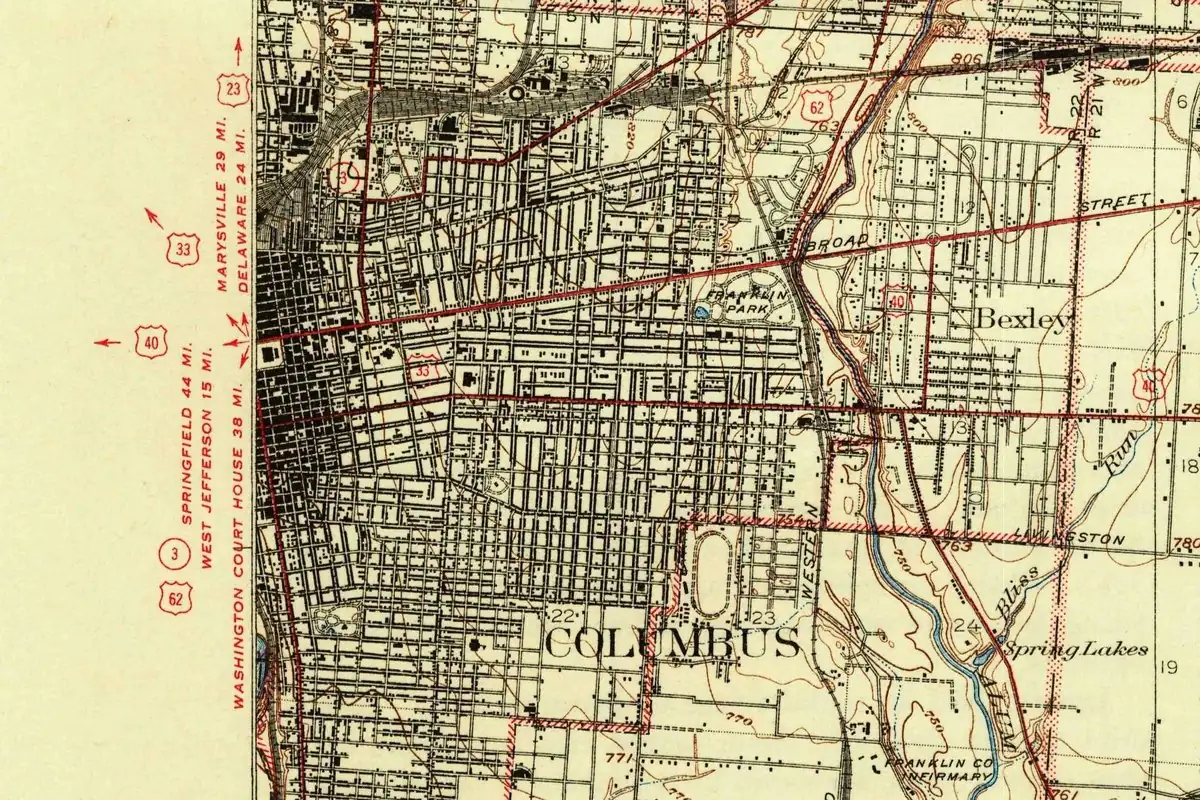
You can still see the result on old maps. On the 1892 government survey sheet above, Huntington is a tidy rectangle of streets beside the tracks, while Guyandotte sits a little way off at the mouth of its own river.
The name, written into law
Virgil A. Lewis gives the official side in his 1889 History of West Virginia. The legislature incorporated “The City of Huntington” on February 27, 1871, “named in honor of C. P. Huntington, of the Chesapeake and Ohio Railroad.” Henry Gannett’s 1905 bulletin on American place names says the same in fewer words.
Gannett’s bulletin has one more place named for him, in Fresno County, California: a village called Collis, “named for Collis P. Huntington, president of the Southern Pacific Railroad.” So in 1905 the same railroad builder had his last name on a West Virginia city and his first name on a California village.
Sources & further reading
- Virgil A. Lewis, History of West Virginia (1889), p. 631. Incorporation as “The City of Huntington,” February 27, 1871, “named in honor of C. P. Huntington.”
- James Morton Callahan, History of West Virginia, Old and New, vol. 1 (1923), pp. 114, 425, 437. Guyandotte as county seat in 1809; Huntington and his associates in 1869; the land purchase and the Central Land Company; the “irritating experience at Guyandotte,” the engineer’s plan, and building in 1871.
- Henry Gannett, The Origin of Certain Place Names in the United States (USGS, 1905), pp. 88, 163. Huntington, “named for C. P. Huntington, of the Chesapeake and Ohio Railway,” and Collis, California.
- GNIS feature 1540605 (U.S. Geological Survey). The federal record and map coordinates for Huntington.
Spot something wrong, or know more? Tell us here. You can also email us or use our contact page. Corrections are noted here with their date, never made silently.