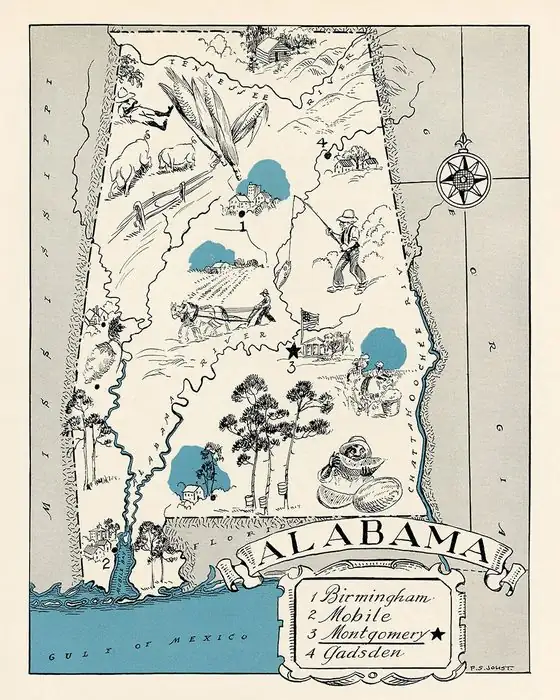
Calera, Alabama: A Lime Town With a Spanish Name
Calera, Alabama, went through a string of plain English lime names before it settled on a Spanish one in 1869. The town made lime, the railroad hauled it, and the name says so in a second language.
A town that ran on lime
Thomas McAdory Owen’s History of Alabama, published in 1921, gives the early story in a few lines. The first settler was John R. Gamble, “one of Jackson’s soldiers,” who settled there soon after Weatherford’s surrender at the end of the Creek War. About 1848 the Seale, Neely, Lyde and Wright families moved in from Old Cheraw, South Carolina. Then, in 1853 and 1854, the Alabama & Tennessee River Railroad was built through, “and the first post office established as Lime Station. Shortly after, lime works were established.”
The lime business lasted. J. R. Adams of Montgomery bought the works in 1883 and renamed them the Shelby Lime Co., Owen writes, and in his day the town’s industries still included “lime kilns, brick kilns, and ginneries,” along with a barrel and stave mill.
From Lime Kiln to Calera
The Encyclopedia of Alabama lists the names the place went through: Buxahatchie at first, then Limeville, Lime Kilns, Lime City and Lime Station. In 1869, it says, the name was changed to Calera, the “Spanish word for ‘lime.’” That’s close. Edward Halse’s 1908 dictionary of Spanish mining terms gives cal as lime and calera as “lime-pit or deposit” or “lime-kiln.” Either way, you end up back at the kilns. None of the sources we read says who picked a Spanish word, or why.
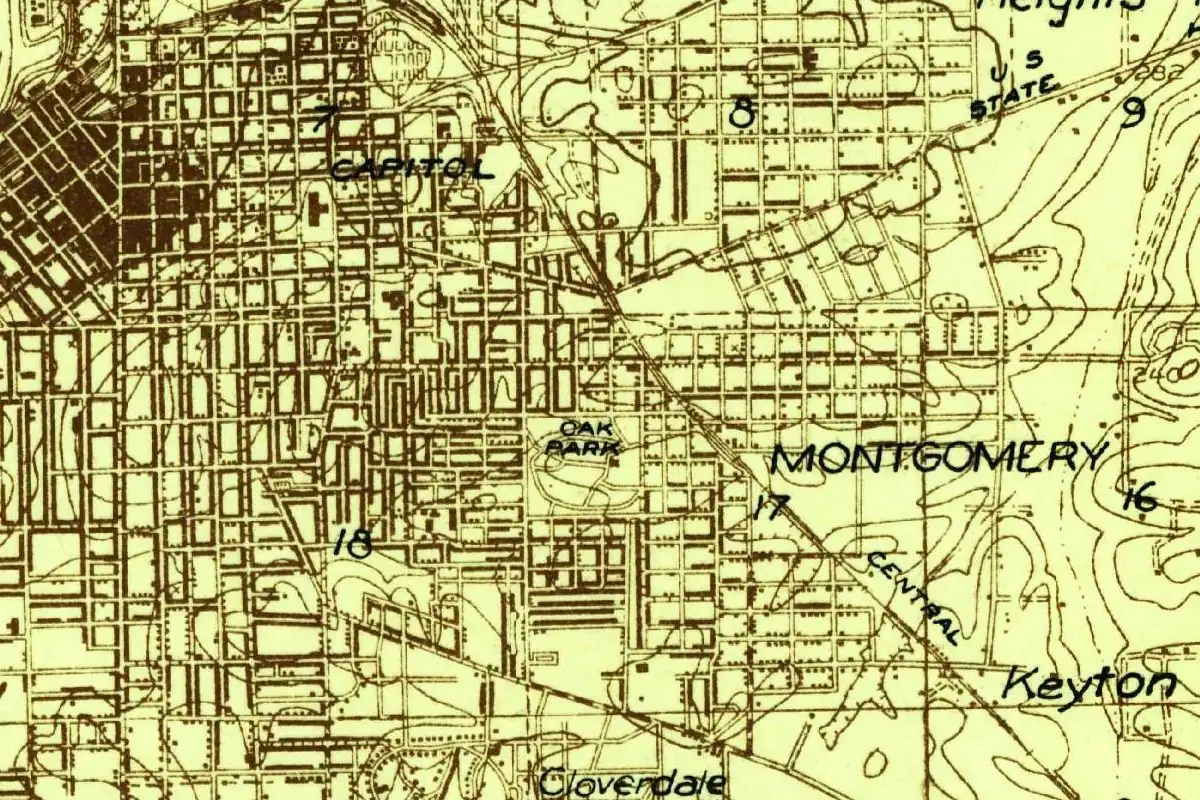
The old name stuck around in people’s memories, too. Owen prints a statement that Milton H. Smith, president of the Louisville & Nashville Railroad, gave the Alabama Railroad Commission in April 1905. Smith was looking back to the early 1870s, when the L&N got tied up in building the South & North Alabama road:
“When the construction of the road was entered upon, there was but one community between Montgomery and Decatur, I think, of over ten families, and that was at Lime Kiln, now Calera.”
So if you’d asked a railroad president, the lime town came first.
Where the railroads met
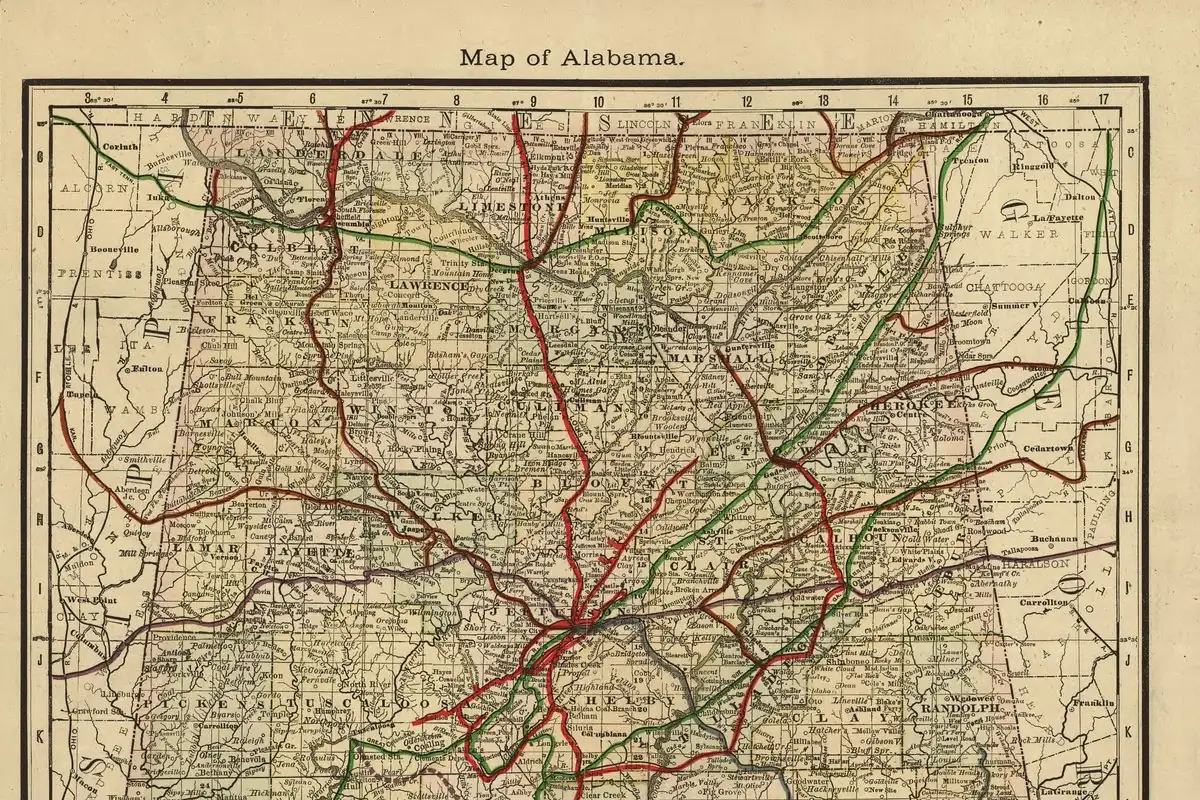
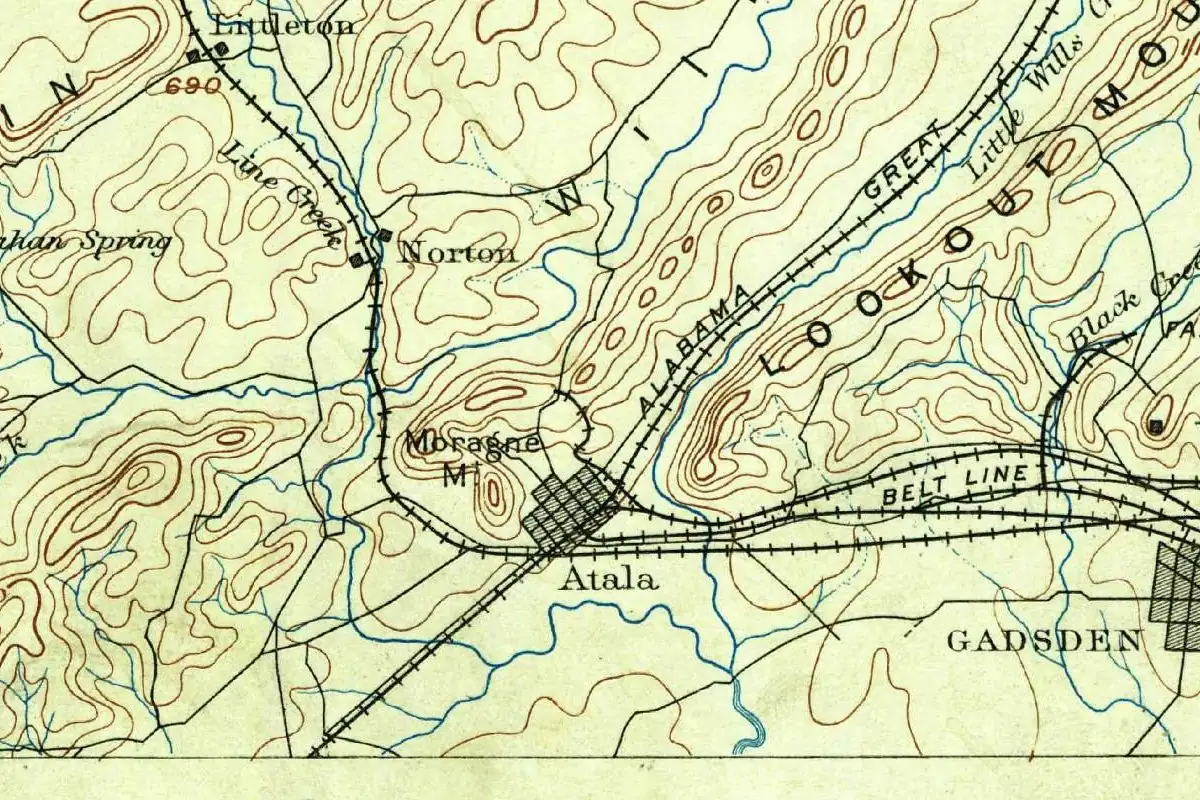
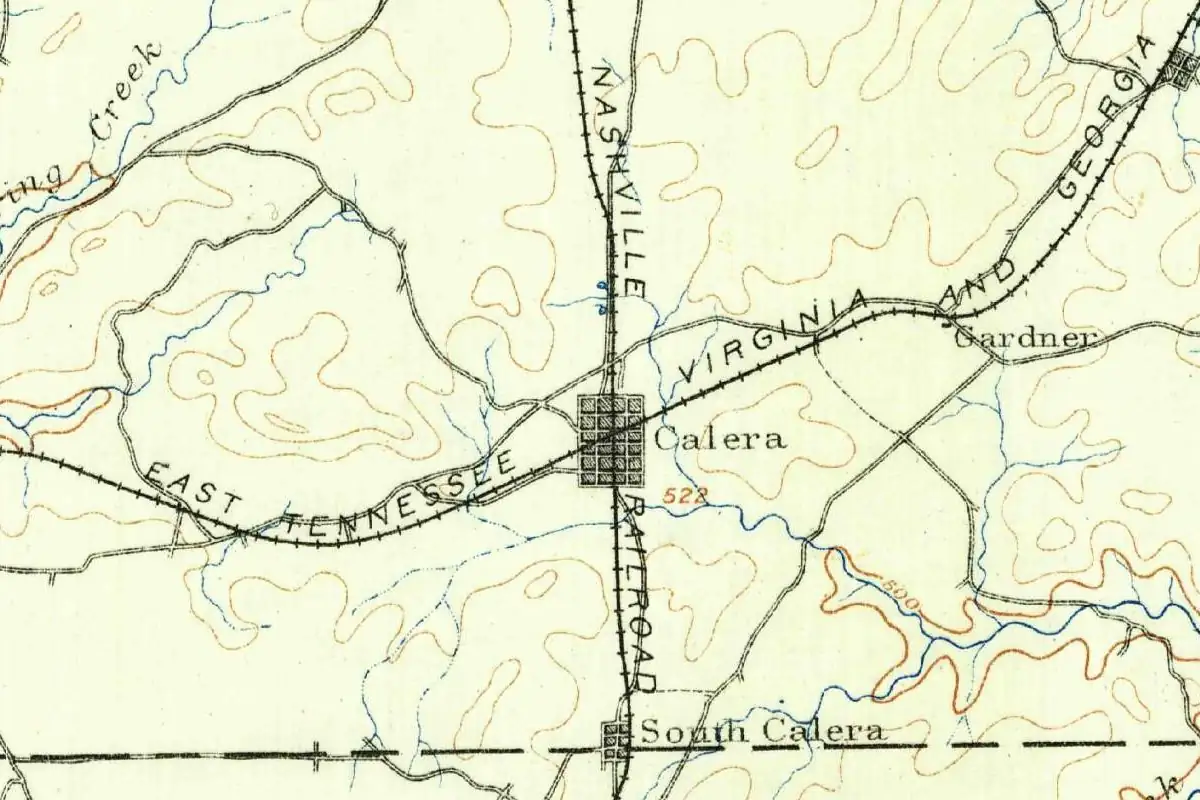
By 1921, Owen describes Calera as a junction of the Louisville & Nashville and the Southern Railway, about 40 miles (64 km) south of Birmingham. On the government’s 1890 survey sheet, the little grid of Calera sits right where the two lines meet. The Encyclopedia of Alabama says residents petitioned to incorporate in 1885 and held their first municipal elections in 1887. For the capital at the other end of Smith’s railroad, see Montgomery.
Quick answers
What does Calera mean?
Calera is Spanish. The Encyclopedia of Alabama gives it as the word for “lime,” and Edward Halse’s 1908 Spanish dictionary defines a calera as a lime pit or deposit, or a lime kiln. Both fit a town that was built on its lime works.
When did Calera, Alabama, get its name?
In 1869, according to the Encyclopedia of Alabama. Before that the place had several English names tied to lime.
What was Calera called before?
Buxahatchie, Limeville, Lime Kilns, Lime City and Lime Station, by the Encyclopedia of Alabama. Owen says the first post office was Lime Station, and an L&N president remembered the town as “Lime Kiln.”
Why is Calera a railroad town?
The Alabama & Tennessee River Railroad came through in 1853 and 1854, and the post office opened with it. By 1921 Calera was the junction of the Louisville & Nashville and the Southern Railway.
Key dates
- 1848About this year the Seale, Neely, Lyde and Wright families arrive from Old Cheraw, South Carolina.
- 1853-1854The Alabama & Tennessee River Railroad is built through, and the first post office opens as Lime Station.
- 1869The town's name is changed to Calera.
- 1883J. R. Adams buys the lime works, which become the Shelby Lime Co.
- 1887Calera holds its first municipal elections.
Getting there
Open Calera in Google Maps
Opens in a new tab. The pin is the center of Calera in the USGS place-name record.
The closest airports, Amtrak stations and intercity bus stops, measured in a straight line from the center of Calera.
Airports
- Birmingham-Shuttlesworth International (BHM) 32 mi 51 km
- Montgomery Regional (Dannelly Field) (MGM) 59 mi 95 km
- Hartsfield/Jackson Atlanta International (ATL) 139 mi 224 km
Amtrak trains
- Birmingham station (BHM) 28 mi 46 km
- Tuscaloosa station (TCL) 47 mi 76 km
Intercity buses
- Greyhound Sylacauga Allen Oil 28 mi 45 km
Distances are as the crow flies, not by road. We don't list schedules or fares because they change; check with the airline, Amtrak or the bus company before you go. Official data (FAA commercial service airports (2025), FAA airport locations, Amtrak stations and Intercity Bus Atlas) from the FAA and the U.S. Bureau of Transportation Statistics, checked Nov 6, 2026.
Sponsored
Staying in Calera?
Compare hotels in Calera, Alabama, on Expedia.
See hotels in CaleraWe may earn a commission if you buy through this link. It never changes what we write. Read our affiliate disclosure
Historical Sources & References
- Thomas McAdory Owen, History of Alabama and Dictionary of Alabama Biography, vol. 1 (1921), pp. 190-191. The “Calera” entry: John R. Gamble, the families from Old Cheraw, the railroad of 1853-4, the first post office as Lime Station, the lime works and the Shelby Lime Co., and the junction of the L&N and the Southern.
- Owen, History of Alabama, vol. 2 (1921), p. 905. Milton H. Smith’s April 1905 statement to the Alabama Railroad Commission, with the line about “Lime Kiln, now Calera.”
- Encyclopedia of Alabama, “Calera.” The earlier names, the 1869 change to Calera as the Spanish word for lime, and the incorporation petition of 1885 and first elections of 1887.
- Edward Halse, A Dictionary of Spanish and Spanish-American Mining, Metallurgical and Allied Terms (1908). “Cal,” lime, and “Calera,” a lime pit or deposit, or a lime kiln.
- GNIS feature 157907 (U.S. Geological Survey). The federal gazetteer entry for Calera, with its county and coordinates.
Spot something wrong, or know more? Tell us here. You can also email us or use our contact page. Corrections are noted here with their date, never made silently.