Lewes, Delaware: A Name on a 1672 Deed, Before Penn
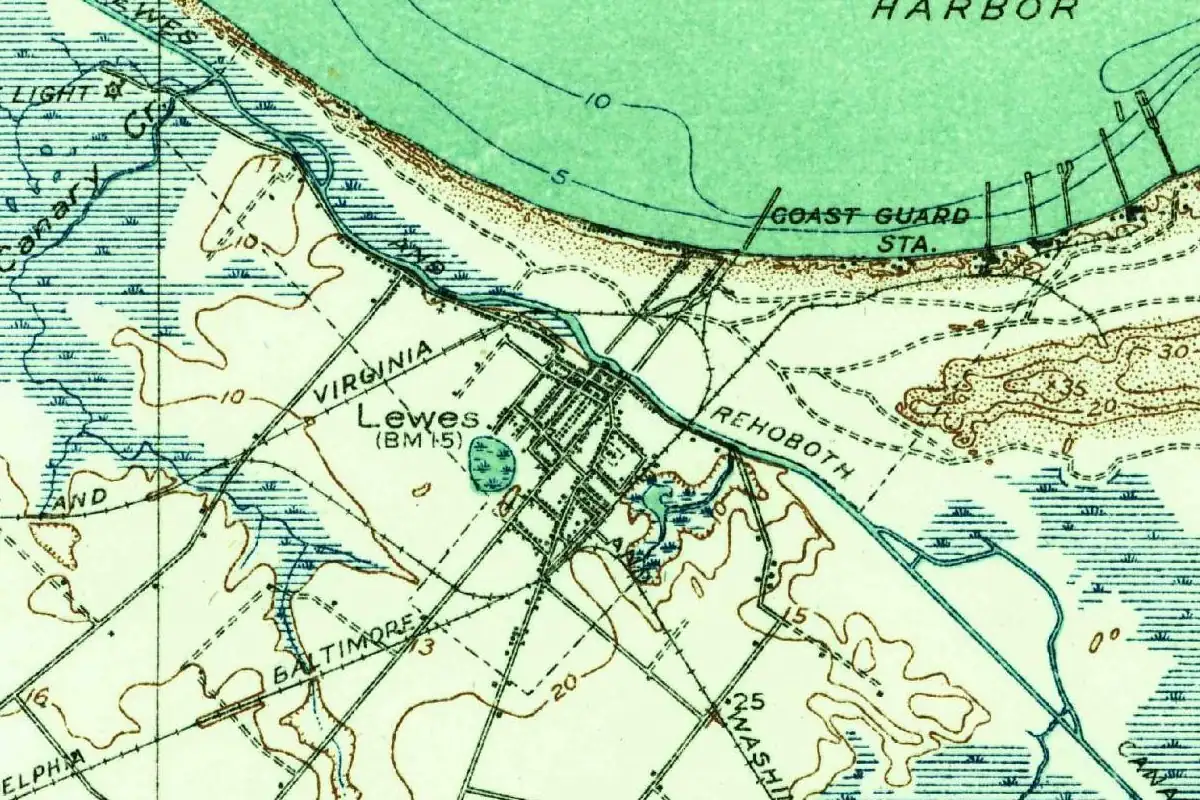
Lewes, Delaware, got William Penn’s official sanction as the town’s name in 1682, but the name already shows up on a 1672 land grant at the Horekill, ten years earlier. Why anyone picked “Lewes” in the first place is a question the old histories never answer.
The Horekill, and where that came from
Before Lewes, the place took its name from the creek, and even that name has two stories. Henry C. Conrad’s History of the State of Delaware (1908) says Dutch ships reached the bay in 1631 and landed “near the sight of Lewes,” and that the stream “was named Hoornkill in honor of De Vries, who lived in Hoorn,” a town in Holland. Later in the same book he’s more careful: the name came “in all probability” from Hoorn. The little colony didn’t survive. Conrad says every man in it was killed.
The English wrote the name differently. In Conrad’s words, “English documents give the name of the creek as Whorekill, or, in some cases, the Harlot’s Creek.” A story grew up to explain it, about Indian women who “had behaved disgracefully.” Conrad rejected that story outright. He said “there is no foundation for the legend, which sounds as if it were merely a piece of scurrilous forecastle jesting.” So you’ve got a polite explanation that even Conrad hedged, and a rude one that he dismissed. Neither is settled by the sources here.
A deed that already says Lewes
J. Thomas Scharf’s History of Delaware (1888) prints what he calls the first deed for land in the lower part of the state. On July 2, 1672, Governor Francis Lovelace granted Hermanus Frederick Wiltbank “all that piece of land at the Horekill, signed and called ‘Lewes’ in Delaware Bay.” The same deed ends by saying the piece of land “is called ye ‘West India fort.’” That’s ten years before the Duke of York deeded the area to Penn.
That’s a problem for the tidy version of the story. Scharf also shows the Horekill name still in use eight years later, when, in June 1680, the county’s justices asked Governor Edmund Andros to change it. Andros “re-christened the settlement Deale, which name it held until it became Lewes-town in 1682.” A surveyor’s report of 1728 still remembered that the town “was originally called Deale.” So, as Scharf prints it, “Lewes” was attached to at least one piece of land in 1672, then Deale became the official name for two years, and then Lewes won out. Scharf doesn’t keep his own dates straight, though. In a footnote earlier in the same volume, he says “it was not until after 1690 that the name was used in official records.”
What Penn’s year actually changed
In 1682, the Duke of York deeded the Delaware country to Penn. Scharf’s wording is careful: “the present names of the county and town were adopted or confirmed by Penn’s official sanction.” Adopted, or confirmed. He doesn’t say Penn invented the name. Conrad cites an earlier historian, Hazard, for the detail that in November 1682 Deale became Sussex.
The county’s name is the easy part. Henry Gannett’s federal place-name book of 1905 says Delaware’s Sussex was “named from the county in England.” The town is harder. Scharf drops a footnote you might miss: “Lewes is also the name of a town in Sussex County, England.” That’s a match worth noticing, but it’s all he says. None of these books states that the Delaware town was named for the English one, or who first chose the name for that land in 1672. Until a record turns up that explains it, the reason just isn’t on paper.
Penn’s name that didn’t stick
Penn tried one more rename at the same time. Conrad says Penn ordered Cape Henlopen changed to Cape James, and the Act of Union of December 1682 mentions the change. The cape didn’t go along with it. Gannett’s 1904 gazetteer of Delaware still lists “Henlopen” as the “cape on the eastern coast of Delaware at the entrance of Delaware Bay.” So Lewes kept a name that was older than Penn’s grant, and the cape threw off the name he gave it.
Sources & further reading
- J. Thomas Scharf, History of Delaware, 1609-1888, vol. 2 (1888), pp. 1201, 1205, 1221, 1223. The footnote saying the name wasn’t in official records until after 1690 (p. 1201); the 1680 petition to Andros and the new name Deale, held “until it became Lewes-town in 1682” (p. 1205); the names of 1682 “adopted or confirmed by Penn’s official sanction,” the Lovelace deed of July 2, 1672, for land “at the Horekill, signed and called ‘Lewes,’” and the footnote on Lewes in Sussex, England (p. 1221); the 1728 survey report, “the town was originally called Deale” (p. 1223).
- Henry C. Conrad, History of the State of Delaware, vol. 1 (1908), p. 14. The 1631 landing, the Hoornkill “in honor of De Vries, who lived in Hoorn,” the Whorekill legend and why he rejected it, and the end of the colony.
- Henry C. Conrad, History of the State of Delaware, vol. 2 (1908), pp. 575, 577, 683. “The town of Whorekill (now Lewes)” (p. 575); Hazard’s account of November 1682, Deale to Sussex and Cape Henlopen to Cape James, and the Act of Union (p. 577); the name from Hoorn “in all probability” (p. 683).
- Henry Gannett, The Origin of Certain Place Names in the United States, 2nd ed. (USGS Bulletin 258, 1905), p. 294. Sussex County, Delaware, “named from the county in England.”
- Henry Gannett, A Gazetteer of Delaware (USGS Bulletin 230, 1904). Henlopen, “cape on the eastern coast of Delaware at the entrance of Delaware Bay.”
- Delaware Public Archives, “Lewes” (Town and City Histories). Further reading: the state archives’ short history of the town, which credits Penn with naming it after the English town.
- GNIS feature 214214, Lewes (U.S. Geological Survey). The federal record for the town: county and coordinates.
Spot something wrong, or know more? Tell us here. You can also email us or use our contact page. Corrections are noted here with their date, never made silently.