How Crete, Nebraska Got Its Name (By Way of Illinois)
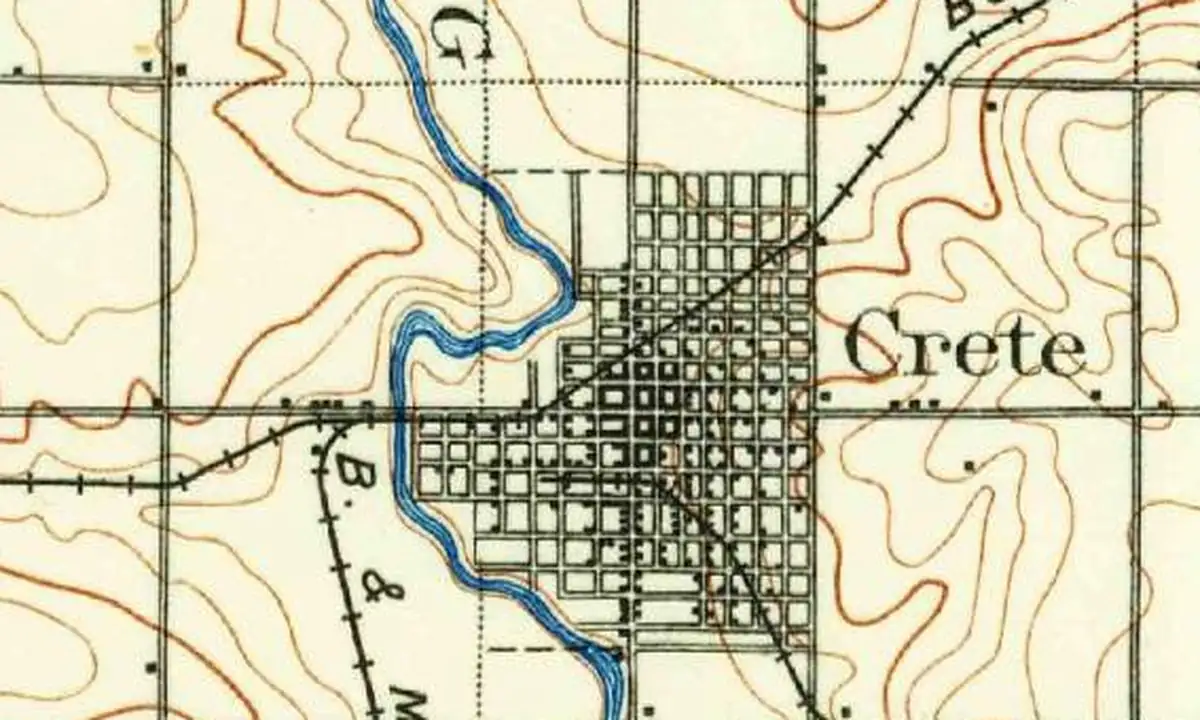
Crete, Nebraska, is named for Crete, Illinois. The Bickle family brought the name with them for their post office, and it stuck when two rival town sites merged in 1871.
Where the name comes from
It starts with a post office in a log cabin. A 1925 study of Nebraska place names says J. C. Bickle lived in a log house and “kept the post office, which he called Crete post office because he and his wife had come from Crete, Illinois.” The U.S. Geological Survey’s record also says the town was “named after the city of Crete, Illinois.”
Two towns, one name
Bickle had his land platted as a town called Blue River City, and the 1925 study says the plat was recorded on August 3, 1870. That fall the South Platte Land Company laid out a second town right next door. The next spring the two were joined, and, in the study’s words, “Mrs. Bickle was given the honor of naming the new town. She chose Crete, because she came from Crete, Illinois.”
Whose hometown?
The sources tell the Illinois part a little differently. The 1925 study says both Bickles came from Crete, Illinois. The City of Crete says the name honored the hometown of Jesse Bickle’s first wife. The National Park Service’s nomination of the Bickle house to the National Register says he named the office for his wife’s hometown and gives his appointment as postmaster as August 26, 1868. All of them point to Crete, Illinois. One detail doesn’t fit, though: the city says Jesse Bickle’s first wife died in 1856, so she can’t be the Mrs. Bickle who, in the 1925 study’s telling, picked the name in 1871.
The city adds one more reason the name fit: it matched the alphabetical order of the station names the Burlington railroad was giving towns west of Lincoln, with Crete in the C spot.
The rest of the record
The 1925 study says the legislature defined the town’s limits by an act approved March 7, 1871. The U.S. Geological Survey’s record says Crete was founded in 1870 and incorporated in 1873.
Sources & further reading
- Lilian Linder Fitzpatrick, Nebraska Place-Names (University of Nebraska, 1925). A public-domain study of the state’s place names, county by county. The Crete post office, Blue River City, the 1871 merger and Mrs. Bickle’s choice.
- City of Crete, “Crete History.” The log cabin post office named for the hometown of Jesse Bickle’s first wife; the alphabetical station names.
- National Park Service, National Register nomination for the Jesse C. Bickle House. Bickle’s 1868 appointment as postmaster and the office named for his wife’s hometown.
- GNIS feature 828460 (U.S. Geological Survey). The federal record for Crete. Founded 1870; incorporated 1873; named after Crete, Illinois.
Spot something wrong? Corrections are noted here with their date, never made silently.