Paradise, Nevada: The Strip's Town That Isn't Las Vegas
Paradise, Nevada, takes in most of the Las Vegas Strip, and it exists because Strip hotel owners asked Clark County in 1950 for a town of their own. The name most likely came from the land: before there was any town, the area south of Las Vegas already went by Paradise Valley. One popular account gives a club called the Pair-O-Dice the credit instead, and we’ll get to that.
Paradise Valley came first
Eugene Moehring, a historian at the University of Nevada, Las Vegas, wrote a history of the city’s growth, Resort City in the Sunbelt, in 1989. He calls Paradise Valley “the unofficial name of the Strip area.” He uses it for the people who lived out there before the town existed, the “inhabitants of Paradise Valley” who, like many later county residents, “felt no need for sewers, paid fire protection, or other municipal services—much less the higher taxes required to support them.”
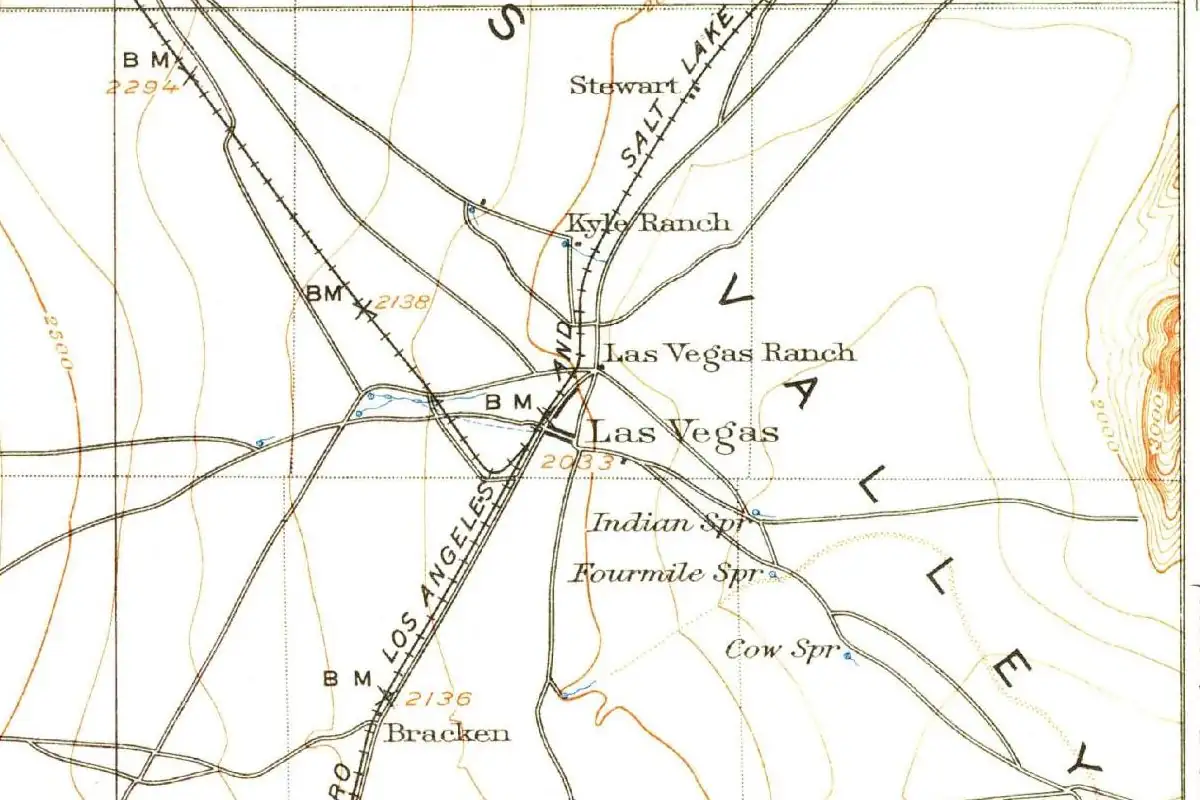
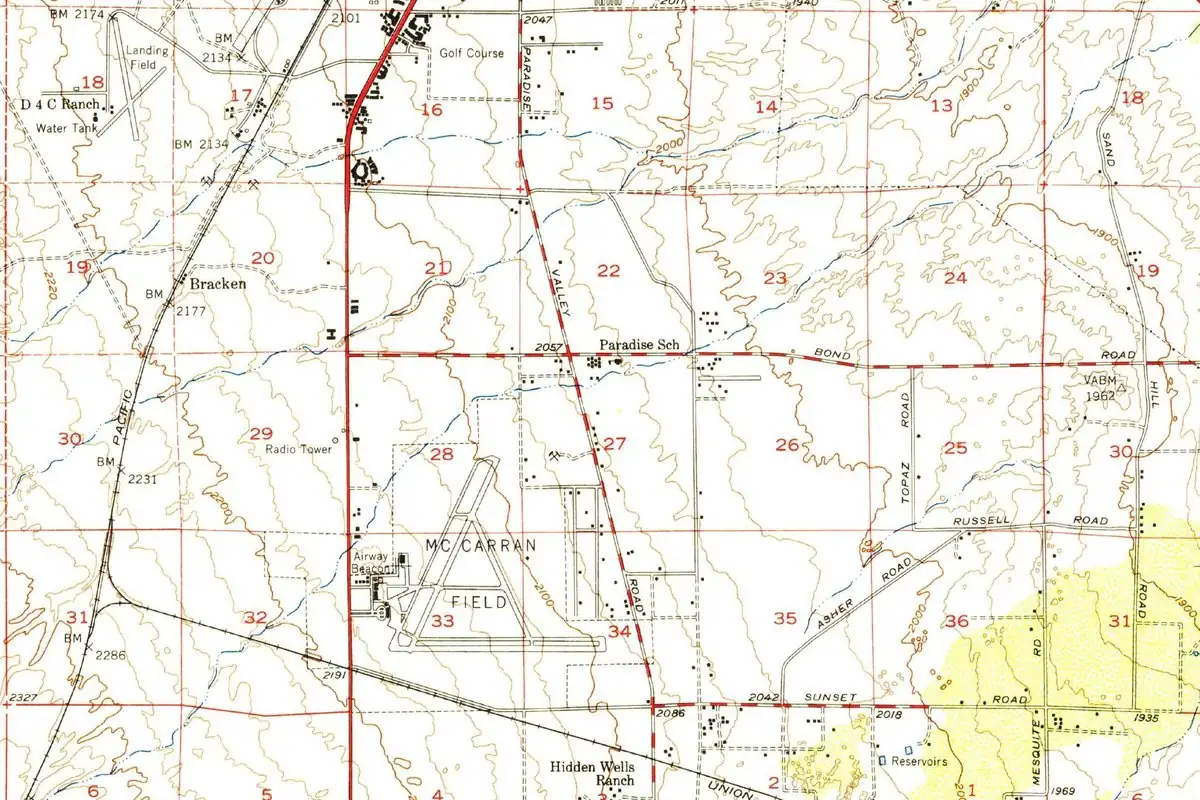
The old name hasn’t gone anywhere. The federal place-names database still lists a valley called Paradise Valley in Clark County, separate from the town. And on the 1952 map at the top of this page, you can follow Paradise Valley Road south past the Paradise School toward McCarran Field.
Why Paradise? The Las Vegas Review-Journal offered an answer in 2024: maps from the early 1900s, it said, called the southern part of the valley, where most of the farming was, “Paradise Valley” because it “encompassed lush vegetation.” The paper doesn’t say which maps, and the oldest federal map we checked, from 1907, doesn’t show the name near the Strip, so take it as the newspaper’s explanation, not a documented one.
Greenbaum’s petition for “Paradise City”
By 1950 the city of Las Vegas wanted the Strip. Moehring explains the catch: Nevada law said no city could annex an unincorporated township without the approval of the county commissioners. So in the fall of 1950, “as Las Vegas prepared to capture the Strip once and for all,” Paradise Valley residents, led by Flamingo Hotel executive Gus Greenbaum, “hastily organized a petition campaign to create the unincorporated township of Paradise City.”
It worked. “Victory came on December 8, 1950,” Moehring writes, “when county commissioners, anxious to block the expansion of Las Vegas while enlarging their own tax and power bases, acceded to the petitioners’ request.” Moehring adds that Greenbaum was elected chairman of the town board and, “as ‘Mayor of Paradise,’” pushed for streets, sewers and schools. The Green Felt Jungle, a 1963 exposé of Las Vegas gambling, put it more grandly: “In December, 1950, Gus Greenbaum was officially proclaimed the first mayor of Paradise.”
Notice that “City” in the petition. It didn’t last. In the 1963 book, and in the Las Vegas Sun decades later, the town is simply Paradise.
The Pair-O-Dice version
PBS tells it differently. Its American Experience profile of Guy McAfee, who ran a roadhouse on the highway south of town, says McAfee bought the Pair-O-Dice Club on Highway 91 from Frank and Angelina Detra and renamed it the 91 Club. Then it says McAfee and the other resort owners along the highway “formed a township called Paradise – in a nod to McAfee’s club – to provide a tax shelter for the resorts along the highway.”
It’s a great pun, and you’ll see it repeated. But PBS doesn’t say where it got the story, and its own timeline works against it. By that same profile, the club had already become the 91 Club, with a grand opening in March 1939, more than ten years before the town. Moehring agrees on the rename: he has McAfee buying the Pair-O-Dice soon after he came to Las Vegas in 1938 and calling it the 91 Club. He also puts Greenbaum at the head of the petition, not McAfee, and says the petitioners came from Paradise Valley.
UNLV historian Michael Green doesn’t buy the club story either. In a quote the Review-Journal reprinted in 2024 from Anthem View, a community paper it used to publish, he said: “It makes for a charming story to say Paradise was named for that, but if anything, it’s the other way around. The name Paradise was used for that area for a long time.” That lines up with Moehring’s Paradise Valley. Still, neither Green nor PBS points to a 1950 document that says why the name was picked. The valley has much more behind it, but no paper we read rules the club out for good.
McAfee and the name “the Strip”
McAfee probably didn’t name Paradise, but both Moehring and PBS credit him with another famous name. Moehring writes that it was McAfee “who first referred to the four-mile strip of Highway 91 south of town as ‘the Strip’—a reference to the Sunset Strip he had so often traveled between Beverly Hills and Hollywood.” PBS says the same, calling Los Angeles his old stomping grounds. Green is more careful. He told the Review-Journal in 2024 that the story has McAfee looking at the car lights on Highway 91 and thinking of the Sunset Strip, then added, “we really don’t have a smoking gun as much as we would like with that one.”
Paradise A, Paradise B and Winchester
The county didn’t get the paperwork right on the first try. Steve Kanigher of the Las Vegas Sun wrote in 2003 that the county formed a Paradise A and a Paradise B, “creating so much confusion among landowners and government officials that Paradise A was converted to Winchester.” He dates Winchester to October 1953 and says it was carved out of part of Paradise. Moehring puts Winchester “a year later” than Paradise, so the two don’t quite agree on the date.
Either way, the plan held. Kanigher reported that all of the Strip hotels south of Sahara Avenue sit outside the Las Vegas city limits, and that USA Today had called Paradise, with 186,070 people in the 2000 census, the most populous unincorporated town in the country. A Postal Service spokesman even told him a letter addressed just to “Paradise, NV” wouldn’t get delivered without the ZIP code. So if you’ve stayed in one of those Nevada hotels, you weren’t in the city of Las Vegas at all. You were probably in Paradise, a town that most likely took its name from an old valley and got its borders from a tax fight.
Quick answers
Is the Las Vegas Strip actually in Las Vegas?
Mostly not. The Las Vegas Sun reported in 2003 that all the Strip hotels south of Sahara Avenue are outside the city limits, and that Paradise includes most of the Strip.
Why is it called Paradise, Nevada?
Nobody has settled it. Historian Eugene Moehring shows the area was already known unofficially as Paradise Valley and that its residents petitioned for a “Paradise City” in 1950. PBS says resort owners chose it “in a nod to McAfee’s club,” the old Pair-O-Dice, while UNLV historian Michael Green says that if anything, it’s the other way around.
When did Paradise become a town?
December 8, 1950. That’s the day Clark County commissioners granted the petition, which kept the city of Las Vegas from annexing the Strip without their approval.
Who was the “Mayor of Paradise”?
Gus Greenbaum, the Flamingo Hotel executive who led the 1950 petition. Moehring says he was elected chairman of the town board, and The Green Felt Jungle says he was “officially proclaimed the first mayor of Paradise.”
Key dates
- 1939Guy McAfee opens the 91 Club, the old Pair-O-Dice on Highway 91, in March, according to PBS.
- 1950December 8: Clark County commissioners grant the petition led by Gus Greenbaum, and Paradise is born.
- 1952A U.S. Geological Survey map shows Paradise Valley Road and the Paradise School south of Las Vegas.
- 1953October: Winchester is carved out of Paradise after a Paradise A and Paradise B mix-up, per the Las Vegas Sun.
Getting there
The closest airports, Amtrak stations and intercity bus stops, measured in a straight line from the center of Paradise.
Airports
- Harry Reid International (LAS) Las Vegas 1 mi 2 km
- Boulder City Municipal (BVU) 19 mi 31 km
Amtrak trains
- Kingman station (KNG) 88 mi 141 km
- Needles station (NDL) 92 mi 148 km
Intercity buses
- Vegas Airporter Amtrak Connecting Service · Mccarran International Airport Amtrak Bus Stop under 1 mi 1 km
- Salt Lake Express Las Vegas (Airport) under 1 mi 1 km
- Gold Runner Las Vegas NV - RTC South Strip 2 mi 4 km
Distances are as the crow flies, not by road. We don't list schedules or fares because they change; check with the airline, Amtrak or the bus company before you go. Official data (FAA commercial service airports (2025), FAA airport locations, Amtrak stations and Intercity Bus Atlas) from the FAA and the U.S. Bureau of Transportation Statistics, checked Oct 31, 2026.
Historical Sources & References
- Eugene P. Moehring, Resort City in the Sunbelt: Las Vegas, 1930-1970 (1989), especially pp. 70-71. Paradise Valley as “the unofficial name of the Strip area”; the Nevada annexation law; Greenbaum’s 1950 petition for “Paradise City”; the county’s approval on December 8, 1950; Greenbaum as town board chairman and “Mayor of Paradise”; McAfee, the Pair-O-Dice and the 91 Club; McAfee and the name “the Strip.” The petition and the December 8 vote are on pp. 70-71; the pages for the other passages weren’t pinned down. A lending copy, read through the Internet Archive’s full-text search.
- Steve Kanigher, “Las Vegas: Bright lights, but not a big city,” Las Vegas Sun, July 18, 2003. Paradise includes most of the Strip; Strip hotels south of Sahara Avenue outside the city; the 2000 population; Paradise A, Paradise B and Winchester in October 1953; the Postal Service and “Paradise, NV.”
- PBS, American Experience, “Guy McAfee (1888-1960)”. The Pair-O-Dice Club, the 91 Club and its March 1939 opening, the township named “in a nod to McAfee’s club,” and the Sunset Strip. No source given for the Paradise story.
- Patrick Blennerhassett, “The origins of Paradise in Las Vegas,” Las Vegas Review-Journal, September 23, 2024. Michael Green’s quote to Anthem View on the Pair O’Dice story (“if anything, it’s the other way around”), and the paper’s own, unsourced, line on early-1900s maps and “lush vegetation.”
- Patrick Blennerhassett, “How did the Las Vegas Strip get its iconic name?,” Las Vegas Review-Journal, January 10, 2024. Green on McAfee and the Sunset Strip: “we really don’t have a smoking gun.”
- Ed Reid and Ovid Demaris, The Green Felt Jungle (1963; Pocket Books, 1964). Greenbaum “officially proclaimed the first mayor of Paradise” in December 1950. A lending copy, read through full-text search.
- GNIS feature 845094, Paradise (U.S. Geological Survey). The federal record and coordinates for the town. Also online: GNIS feature 842722, Paradise Valley, the valley in Clark County.
- U.S. Geological Survey, Las Vegas sheet (1:62,500), 1952. Paradise Valley Road and the Paradise School on the map shown above.
Spot something wrong, or know more? Tell us here. You can also email us or use our contact page. Corrections are noted here with their date, never made silently.