How Hollywood, California Got Its Name (Nobody Agrees Why)
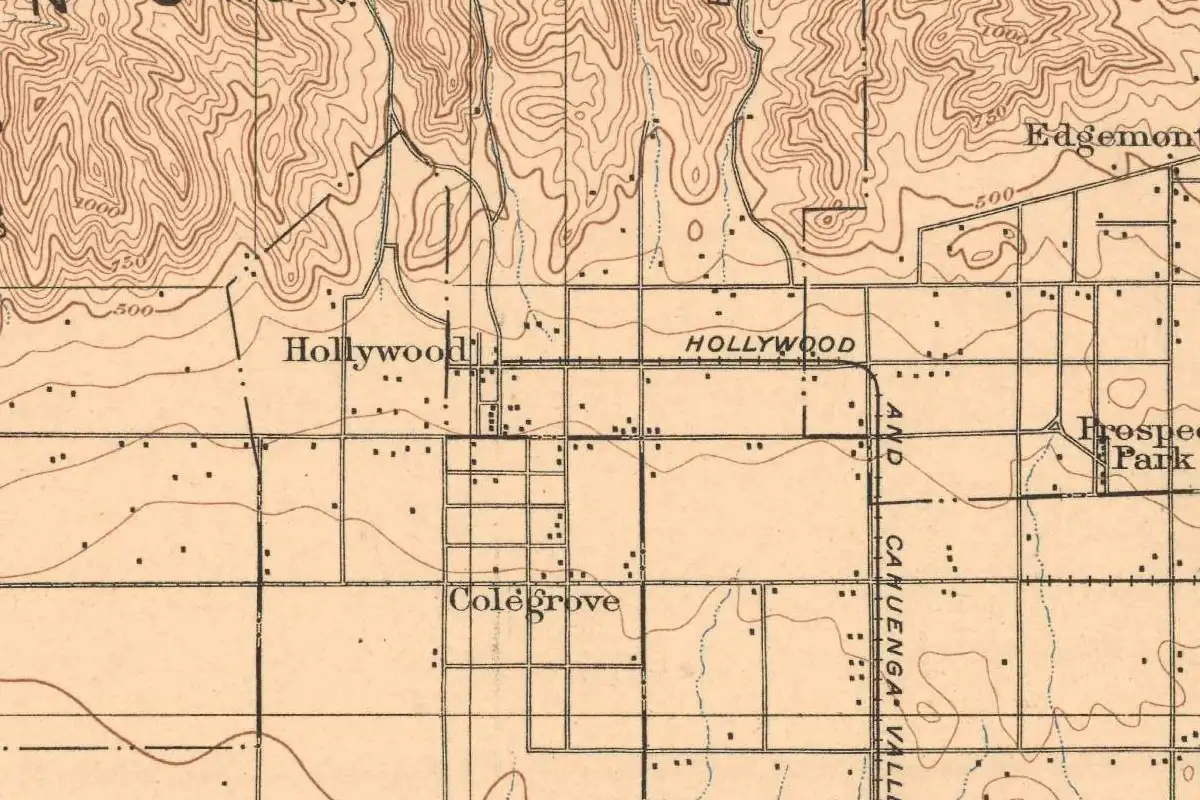
Hollywood, California, got its name from Harvey and Daeida Wilcox, who laid out the town in 1887, and the old accounts can’t agree on why they chose it. A woman on a train, a pair of holly trees, a padre’s Mass and a red-berried shrub have all been given the credit.
H. H. Wilcox’s map of 1887
The name first turns up in the paperwork of a land boom. On February 2, 1887, the Los Angeles Daily Herald ran its “Daily Real Estate Record” for the day before, and among the maps listed that day, right after the Mott tract and Weld’s subdivision, was the “Map of Hollywood, being subdivision of” land in section 10. Six weeks later the same column showed H. H. Wilcox selling lots 10 through 13 in Hollywood to Douglas J. Moore for $6,750.
By May the paper’s Cahuenga correspondent was talking it up. Several town sites had been suggested near the Cahuenga Pass, he wrote, “but it seems that Hollywood, located on a gentle slope, immediately south of the Cahuenga Pass,” was destined to become “the future city of the Cahuenga,” with avenues 100 feet wide and water piped to every lot. Three days later a one-line ad in the classifieds called it “Hollywood, the new city at Cahuenga.” What none of it says is why it was called Hollywood.
The county histories fill in the who. J. M. Guinn’s 1915 history of Los Angeles says Wilcox bought 200 acres “in what is now Hollywood,” laid out the original townsite, and “he and his wife gave the town its name, also naming its principal streets.” Guinn and Sheehan date the laying out to 1887; a 1923 booklet says 1888, but the 1887 newspapers settle that one.
Even the founder’s first name wobbles. Guinn calls him Harvey H. Wilcox, the 1887 records just say H. H. Wilcox, and both Hollywood books of the 1920s call him Horace: the 1923 booklet has Horace H. Wilcox, and Perley Poore Sheehan’s 1924 book spells it out as Horace Henderson Wilcox. Guinn’s sketch of Daeida says she was born in Hicksville, Ohio, married Wilcox in Kansas and came to California with him in 1883.
Four explanations, none of them from 1887
None of the reasons below shows up in the 1887 Herald or in Guinn’s histories of 1901 and 1915. The earliest versions we found were printed between 1920 and 1928, and by 1923 a Hollywood booklet was already calling the question “a friendly controversy” that had “been going on for years.”
The woman on the train
Sheehan’s Hollywood as a World Center (1924) gives the most detailed version. The name, he wrote, “was one that Mrs. Wilcox had picked up on the train from a casual acquaintance—a woman who had given the name of Hollywood to a country place of hers in Ohio. Mrs. Wilcox liked the name and applied it to her ranch.” Only later, he says, did Wilcox cut the ranch into lots and call it a town.
The holly trees that died
Sheehan adds a postscript: Wilcox “was a man of delicate conscience. To justify the name he imported a pair of English holly-trees and sought to make them grow. The trees died.”
A ranch hand told it the other way around. In 1928 a news story datelined Hollywood, about the town’s old settlers’ picnic, ran as far away as Madoc, Ontario. It quoted John Day, who had worked on the Wilcox ranch: “I planted two holly trees right at Cahuenga Pass. So Mrs. Ida Wilcox Beveridge, who owned 160 acres there, decided to call the place Hollywood. The trees died.” In Sheehan’s version the name came first and the trees second. In Day’s, the trees came first.
Father Serra’s Mass
Trowbridge Hall’s 1920 guide to the California missions sends you over Sunset Boulevard “into Hollywood, so named in remembrance of a mass to the holy wood of the cross celebrated by Father Junipero Serra, near what is now the center of the town.” Hall doesn’t say where he got that, and he doesn’t connect it to the Wilcoxes at all. Serra himself was real enough: in 1769 he founded the first of the California missions, at San Diego.
The California holly on the hills
The 1923 booklet Can Anything Good Come Out of Hollywood?, by Laurance L. Hill and Silas E. Snyder, puts Serra’s Mass up against a second idea: that the name came from “the gladsome glow of the California holly which reddens the hills every Christmas season.” That shrub isn’t a true holly. Mary Elizabeth Parsons’s Wild Flowers of California (1902) lists it as Christmas-berry, Californian holly or toyon, a member of the rose family, and says the holly name “refers more to the berries than to the leaves,” since the leaves aren’t shaped like holly at all.
Which story holds up best
The who is solid. Guinn, Hill and Snyder, Sheehan and John Day all give the name to the Wilcoxes, and the 1887 records tie H. H. Wilcox to the Hollywood tract from its first months. The why is where it falls apart, because every answer was written down decades after the fact.
If you want a front-runner, the woman on the train carries the most weight. It’s the most specific, it comes attached to Mrs. Wilcox herself, and it’s the one Sheehan gives as the origin rather than as a side debate. It’s still secondhand, though, printed 37 years after the map by a writer who doesn’t say where he heard it, and none of these sources names the woman or her Ohio place. The holly trees come from a man who says he planted them, but Day and Sheehan can’t agree on whether the trees were the cause or the afterthought.
Serra’s Mass is the weakest. The name doesn’t appear in anything we found until the Wilcox map of 1887, and Hall offers no source for the Mass. The toyon idea is believable, since the shrub grows wild in the Coast Ranges from San Diego to Mendocino County, but no account from the Wilcox side says that’s what they were thinking of.
From city to neighborhood
Hollywood grew into a town of its own. Hill and Snyder say it incorporated in 1903 as “a city of the sixth class,” and that its trustees passed an ordinance forbidding droves of more than 2,000 sheep on Hollywood Boulevard at any one time. The 1928 picnic story names Sanford Rich as the man who took office in 1903 as the first mayor.
The city lasted seven years. Guinn records that Hollywood consolidated with Los Angeles at an election on January 24, 1910, voting 409 to 18, while Los Angeles voters approved it 6,224 to 373, adding 4.45 square miles (11.5 square kilometers) to the city. Hollywood isn’t a separate city today, either: the Census Bureau’s 2020 list of places in California has a West Hollywood but no Hollywood. Daeida Wilcox Beveridge, who had remarried in 1894, died on August 7, 1914, three years after the first movie studio set up in town, by Sheehan’s count.
So the most famous place name in show business started as a line in a list of real estate maps, and the reason behind it was left out of the record. You can pick your favorite version, but for now that’s all any of them is.
Quick answers
Who named Hollywood?
Harvey and Daeida Wilcox. Guinn’s 1915 history says Wilcox laid out the townsite and that “he and his wife gave the town its name,” and the later accounts by Sheehan and ranch hand John Day give the choice to Daeida.
Is Hollywood named after holly trees?
Maybe, but nobody’s proved it. A 1924 book and a 1928 news story both mention holly trees on the Wilcox ranch that died, and they don’t agree on whether the trees came before or after the name.
Did Father Serra name Hollywood?
There’s no evidence he did. A 1920 mission guide says the name remembers a Mass to the Holy Wood of the Cross that Serra celebrated there, but it cites nothing, and the earliest record of the name we found is the Wilcox map of 1887.
Is Hollywood its own city?
Not anymore. It incorporated in 1903 and voted to consolidate with Los Angeles on January 24, 1910, so today it’s part of Los Angeles.
Key dates
- 1887February 1: the Map of Hollywood shows up among the maps in the Los Angeles Daily Herald's real estate record.
- 1903Hollywood incorporates as a city of the sixth class.
- 1910January 24: Hollywood votes 409 to 18 to consolidate with Los Angeles.
- 1914August 7: Daeida Wilcox Beveridge dies.
- 1920A mission guide says the name remembers Father Serra's Mass of the Holy Wood of the Cross.
- 1924Perley Poore Sheehan prints the story of the name Mrs. Wilcox heard on a train.
- 1928Ranch hand John Day says the town was named for two holly trees he planted.
Getting there
The closest airports, Amtrak stations and intercity bus stops, measured in a straight line from the center of Hollywood.
Airports
- Hollywood Burbank (BUR) 7 mi 12 km
- Los Angeles International (LAX) 12 mi 19 km
Amtrak trains
- Glendale station (GDL) 4 mi 7 km
- Burbank station (BBK) 5 mi 8 km
Intercity buses
- Greyhound Glendale Bus Stop 4 mi 7 km
- Amtrak Chartered Vehicle Amtrak Connecting Service · Glendale Amtrak 4 mi 7 km
- Gold Runner Glendale 4 mi 7 km
Distances are as the crow flies, not by road. We don't list schedules or fares because they change; check with the airline, Amtrak or the bus company before you go. Official data (FAA commercial service airports (2025), FAA airport locations, Amtrak stations and Intercity Bus Atlas) from the FAA and the U.S. Bureau of Transportation Statistics, checked Oct 31, 2026.
Historical Sources & References
- Los Angeles Daily Herald, February 2, 1887, “Daily Real Estate Record”. The recorder’s list for Tuesday, February 1, 1887, with the “Map of Hollywood, being subdivision of” land in section 10. The earliest appearance of the name we found.
- Los Angeles Daily Herald, March 17, 1887. H. H. Wilcox sells lots 10 to 13 in Hollywood to Douglas J. Moore.
- Los Angeles Daily Herald, May 16, 1887. The Cahuenga correspondent on Hollywood as “the future city of the Cahuenga,” south of the pass.
- Los Angeles Daily Herald, May 19, 1887. The classified line “Hollywood, the new city at Cahuenga.”
- J. M. Guinn, A History of California and an Extended History of Los Angeles and Environs, vol. 1 (1915). Hollywood laid out in 1887 by H. H. Wilcox (pp. 442-443) and the consolidation vote of January 24, 1910 (p. 364).
- J. M. Guinn, same work, vol. 2 (1915), “Mrs. Daeida Wilcox Beveridge,” pp. 458-461. The 200 acres, the townsite, “he and his wife gave the town its name,” Daeida’s Ohio birth, the move from Kansas in 1883, her 1894 marriage to Philo J. Beveridge and her death on August 7, 1914.
- J. M. Guinn, Historical and Biographical Record of Los Angeles and Vicinity (1901), p. 194. Hollywood “laid out in 1887,” near the entrance to the Cahuenga Pass; nothing on the name.
- Trowbridge Hall, Californian Trails (1920), p. 50. The claim that Hollywood was named for Serra’s Mass of the Holy Wood of the Cross.
- Laurance L. Hill and Silas E. Snyder, Can Anything Good Come Out of Hollywood? (1923). The “friendly controversy” over the Mass and the California holly (p. 10), Horace H. Wilcox giving the community its name (pp. 16-17) and the 1903 incorporation and sheep ordinance (p. 18).
- Perley Poore Sheehan, Hollywood as a World Center (1924), pp. 10-15. The woman on the train with a country place called Hollywood in Ohio, the English holly trees that died, the 1887 subdivision and the first movie studio in 1911.
- North Hastings Review, Madoc, Ontario, October 3, 1928. News story datelined Hollywood on the old settlers’ picnic marking 25 years of progress, quoting ranch hand John Day on the two holly trees and naming Sanford Rich as the first mayor in 1903.
- Mary Elizabeth Parsons, The Wild Flowers of California (1902), pp. 89-90. Christmas-berry, Californian holly or toyon, a rose-family shrub whose holly name “refers more to the berries than to the leaves.”
- U.S. Census Bureau, 2020 Gazetteer of places. Lists West Hollywood among California’s places, but no Hollywood.
- GNIS feature 1660757 (U.S. Geological Survey). The federal record and coordinates for Hollywood, a populated place in Los Angeles County.
Spot something wrong, or know more? Tell us here. You can also email us or use our contact page. Corrections are noted here with their date, never made silently.