San Diego, California: A Ship, a Saint and a Renamed Bay
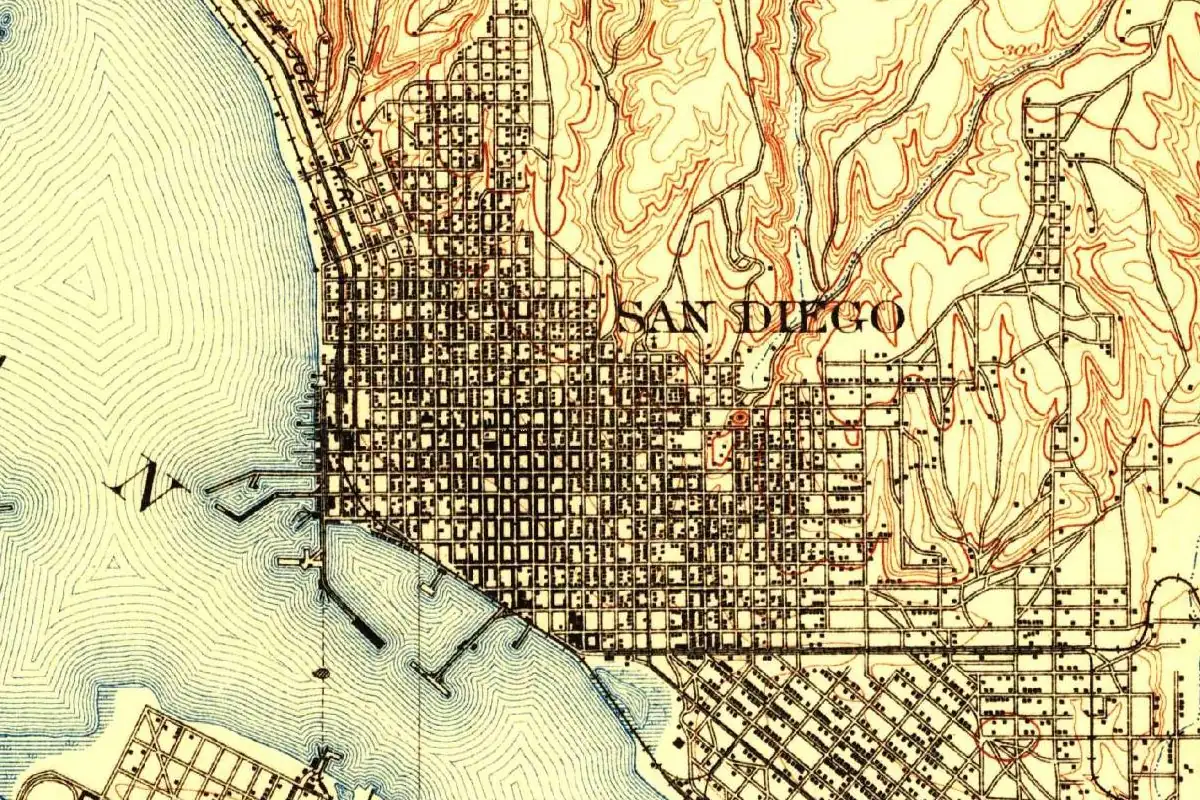
San Diego, California, shares its name with the flagship Sebastián Vizcaíno sailed into the bay in 1602 and the saint his crew honored ashore with a Mass. Sixty years before that, the first Spanish ships to anchor there had already given the harbor a different name: San Miguel.
Cabrillo’s San Miguel
Juan Rodríguez Cabrillo got there first. His three ships had left the port of Navidad, in Mexico, on June 27, 1542, and the National Park Service, which runs Cabrillo National Monument on Point Loma, says it took him about three months to reach “a very good enclosed port.” That’s San Diego Bay. The relation of his voyage, in the translation Herbert Eugene Bolton published in 1916, puts it plainly: they “discovered a port, closed and very good, which they named San Miguel.” Bolton dates the discovery to September 28.
Cabrillo didn’t stay long. A storm blew in, the people on shore told the Spaniards by signs about other bearded men in the interior, and on Tuesday, October 3, the ships left “this port of San Miguel” and kept going north. The Park Service counts six days in the harbor and calls the visit the first contact between Europeans and the coastal peoples of California, the Kumeyaay among them.
The San Diego sails in
The name San Miguel didn’t stick. In 1602 Sebastián Vizcaíno came up the coast with three vessels: the Santo Tomás, the frigate Tres Reyes, and the captain’s ship, the San Diego, which Bolton says had been brought from Guatemala for the voyage. Vizcaíno sailed on the San Diego himself.
His diary says that on Sunday, November 10, they reached a port “which must be the best to be found in all the South Sea.” Two days later, “the day of the glorious San Diego,” almost everyone went ashore, built a hut, and said Mass “in celebration of the feast of Señor San Diego.” They cleaned the ships, took on wood and water, made peace with the people who came down from the hills by handing out presents and fish, and sailed on November 20. The diary sums it up in one line: “This port was given the name of San Diego.”
You’ll notice the diary never says why. Hubert Howe Bancroft, writing his History of California in 1884, thought the answer was both: the name was given “doubtless with reference to that of the flag-ship, and also to the day of San Diego de Alcalá.” He also noted that Vizcaíno “pays no heed” to Cabrillo’s San Miguel and gives no sign he even knew about it. If Bancroft is right about the feast, San Diego has company on this site: the Spanish fleet that founded St. Augustine, Florida, reached the coast on August 28, 1565, St. Augustine’s day.
Which day was the feast?
The sources don’t quite agree on the date. The diary says the 12th was San Diego’s day, and Bancroft repeats that. Bolton, in a footnote, isn’t so sure. The expedition’s book of council records has Vizcaíno calling a council on the 11th, with the San Diego already at anchor in the bay, so Bolton thinks the diary’s 12th “should be the 11th,” and he adds that the feast of San Diego was November 13. Either way, the saint and the ship had the same name, and the bay got it.
A Franciscan from Alcalá, not Spain’s patron saint
So who was San Diego? Bancroft calls him “St James of Alcalá,” a Franciscan from Andalusia who lived from 1400 to 1463 and was canonized in 1588 for his pious life and the miracles credited to him. Writing in English, Bancroft simply turned Diego into James.
That’s where it gets tangled. Henry Gannett’s place-name book for the U.S. Geological Survey says, in both the 1902 and 1905 editions, that San Diego is “a corruption of Saint Iago, the patron saint of Spain.” Bancroft’s saint was a 15th-century friar, not the patron of all Spain. Nothing in Vizcaíno’s diary or in Bancroft points to Spain’s patron, and the feast the crew celebrated in that November was San Diego’s. So if you run into the “Saint Iago” version, it goes back at least to Gannett, and the 1602 diary doesn’t back it up.
From the port to the town
The name sat on the harbor for well over a century before Spain came back to settle. In 1769 the Spanish expedition to occupy California camped at what Bancroft calls Old, or North, San Diego, at the foot of the hill where the old presidio’s ruins could still be seen in his day. On Sunday, July 16, 1769, Father Junípero Serra raised and blessed a cross and founded the first of the California missions. Bancroft says it was dedicated, “as the port had been by Vizcaino long before, to San Diego de Alcalá,” on a spot the native people called Cosoy, now Old Town.
Bancroft’s note on the saint ends with one more detail: “Alcalá was rarely attached to the name of the mission in popular usage.” In everyday speech it was already plain San Diego, and plain San Diego is what you’ll find on the bay and the city today. Two days before Serra’s ceremony, a land party under Gaspar de Portolá had already left San Diego for Monterey Bay, and on August 2 it named the river where Los Angeles would later grow.
Quick answers
Who named San Diego?
Sebastián Vizcaíno’s expedition. His diary records that in November 1602 “this port was given the name of San Diego.” The mission founded there in 1769 was dedicated to the same saint.
Is San Diego named after a ship?
Partly, according to Bancroft. Vizcaíno’s flagship was the San Diego, and Bancroft says the name was given with reference to that ship and also to the feast day of San Diego de Alcalá, which the crew marked with a Mass on shore.
What was San Diego called before?
San Miguel. That’s the name Juan Rodríguez Cabrillo gave the bay in 1542, sixty years before Vizcaíno arrived.
Is San Diego named after Spain’s patron saint?
No. Gannett’s 1905 book says it honors “Saint Iago, the patron saint of Spain,” but Vizcaíno’s diary records a Mass for the feast of San Diego in the port it named, and Bancroft identifies the saint as San Diego de Alcalá, a Franciscan friar who died in 1463.
Key dates
- 1542September 28: Juan Rodríguez Cabrillo finds a closed, very good port and names it San Miguel.
- 1602November 10: Vizcaíno's ships reach the same bay. Two days later his men hold a Mass ashore for the feast of San Diego, and the port is named San Diego.
- 1769July 16: Junípero Serra founds the first California mission, dedicated to San Diego de Alcalá, at Cosoy, now Old Town.
- 1905Gannett's USGS place-name book says the name honors "Saint Iago, the patron saint of Spain."
Getting there
The closest airports, Amtrak stations and intercity bus stops, measured in a straight line from the center of San Diego.
Airports
- San Diego International (SAN) 2 mi 4 km
- McClellan-Palomar (CRQ) Carlsbad 29 mi 47 km
Amtrak trains
- San Diego station (SAN) under 1 mi 1 km
- San Diego station (OLT) 4 mi 6 km
Intercity buses
- Amtrak Chartered Vehicle Amtrak Connecting Service · San Diego under 1 mi 1 km
- Gold Runner San Diego under 1 mi 1 km
- Mexicoach San Diego (Santa Fe Depot) under 1 mi 1 km
Distances are as the crow flies, not by road. We don't list schedules or fares because they change; check with the airline, Amtrak or the bus company before you go. Official data (FAA commercial service airports (2025), FAA airport locations, Amtrak stations and Intercity Bus Atlas) from the FAA and the U.S. Bureau of Transportation Statistics, checked Oct 31, 2026.
Historical Sources & References
- Herbert Eugene Bolton, ed., Spanish Exploration in the Southwest, 1542-1706 (1916). English translations of the two primary accounts. The relation of Cabrillo’s voyage names the port San Miguel and gives the departure on October 3 (pp. 23-24); Bolton’s introduction dates the discovery to September 28 (p. 6). Vizcaíno’s diary covers the arrival on November 10, the Mass for the feast of San Diego, and “This port was given the name of San Diego” (pp. 79-82), with Bolton’s footnote on the 11th and the feast on November 13 (p. 80). His introduction describes the San Diego as the captain’s ship (pp. 45-46).
- Hubert Howe Bancroft, History of California, vol. 1, 1542-1800 (1884). The name given “with reference to that of the flag-ship, and also to the day of San Diego de Alcalá,” and Vizcaíno ignoring Cabrillo’s San Miguel (pp. 97-98); the 1769 camp at Old San Diego (p. 134); the founding of the mission on July 16, 1769, at Cosoy, and the note on San Diego de Alcalá (p. 137).
- Henry Gannett, The Origin of Certain Place Names in the United States, 2nd ed. (USGS, 1905), p. 273. The “Saint Iago, the patron saint of Spain” version. Also online: the 1902 first edition, p. 230, with the same entry (spelled “St. Iago”).
- National Park Service, “Juan Rodriguez Cabrillo,” Cabrillo National Monument. Cabrillo’s departure from Navidad on June 27, 1542, “a very good enclosed port,” six days in the harbor, and first contact with peoples such as the Kumeyaay.
- GNIS feature 1661377 (U.S. Geological Survey). The federal record and coordinates for the city of San Diego.
Spot something wrong, or know more? Tell us here. You can also email us or use our contact page. Corrections are noted here with their date, never made silently.