How Pasadena, California Got a Chippewa Name by Mail
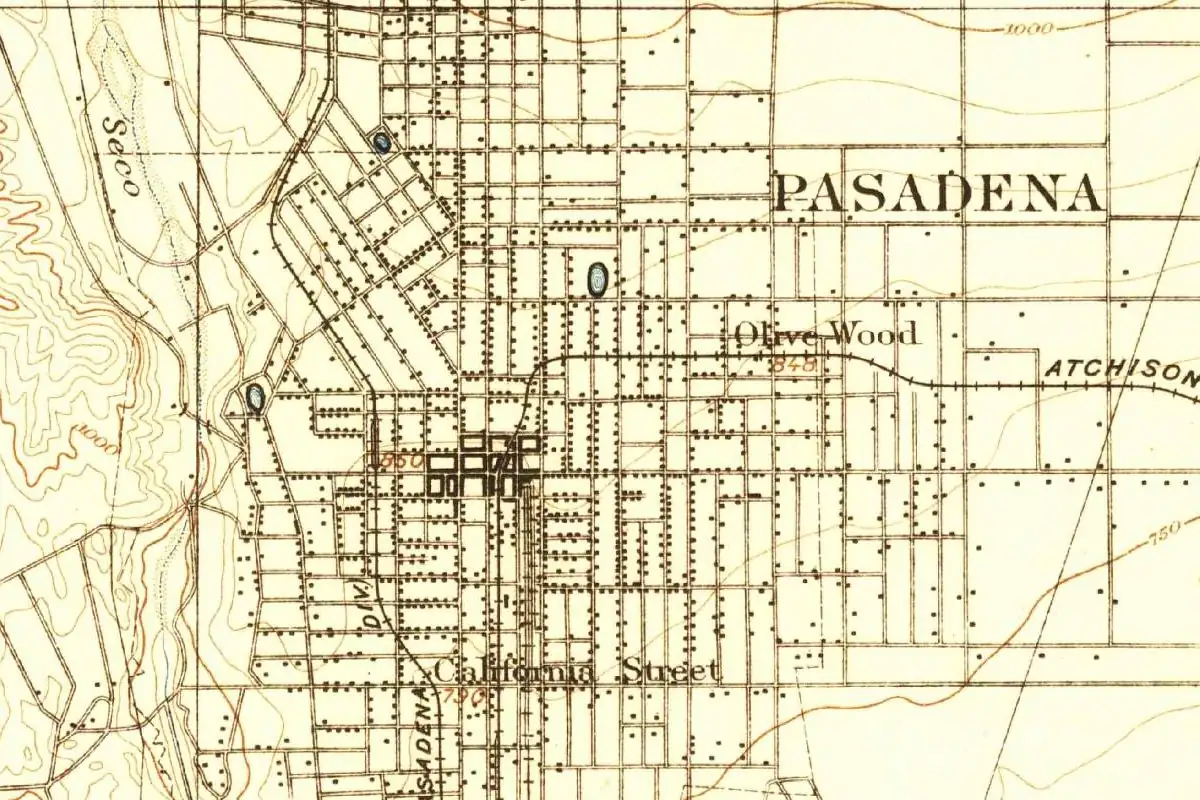
Pasadena, California, got its name in the mail: a colony leader wrote to a college friend working as a missionary, who sent back a list of Chippewa words. Pasadena was the word from that list the settlers voted for in 1875, and what it means was argued over for decades afterward.
A colony that needed a name
In the 1870s the settlement was simply the Indiana Colony, a group organized in Indianapolis that settled at the far end of the San Gabriel Valley. Hiram Reid, who published a history of the town in 1895, gathered accounts from people who were there. One of them, Judge B. S. Eaton, said the colonists were getting their mail through Los Angeles and needed a post office, and “the Washington authorities would never consent to such a name as ‘Indiana Colony.’”
Calvin Fletcher, one of the colony’s big stockholders, wanted something that sounded like it belonged in California. Eaton remembered what the rancher Manuel Garfias had told him about where he’d built his house: “Porque es la llave del Rancho,” because it’s the key of the ranch, the gap where cattle came in and out. Eaton figured no Yankee would try to pronounce a name that started with two consonants, but the “key” idea got passed along.
A letter to a missionary
That’s where Dr. T. B. Elliott, president of the colony, came in. Reid says Elliott searched his own books and came up empty, then remembered a college friend from Hamilton College in New York who’d gone west as a missionary. He wrote to him and asked for a pleasant-sounding Indian word that would fit.
The answer was a slip of paper with four phrases on it, which Reid printed word for word from the original:
- “Weoquan Pa sa de na”: “Crown of the valley.”
- “Gish ka de na Pa se de na”: “Peak of the Valley.”
- “Tape Daegun Pa sa de na”: “Key of the Valley.”
- “Pe qua de na Pa sa dena”: “Hill of the Valley.”
At the bottom it said: “Accent last syllable of each compound word. Chippewa dialect.” Chippewa is another name for the Ojibwe, as Reid himself notes.
The letter that came with it was lost after Elliott died, and his widow couldn’t recall the missionary’s name. So you’re looking at a name whose source is an anonymous note. According to an 1883 account Reid quotes, the vote came at a stockholders’ meeting on April 22, 1875. The other choices were Indianola and Granada, and Pasadena won “by a vote of more than four to one.”
So what does it mean?
Honestly, it depends who you ask, and the experts weren’t impressed. Elliott told the meeting it meant “Crown of the Valley,” and Henry Gannett’s 1905 federal guide repeated that. But only the full phrase on the slip was glossed that way. When Reid showed his draft to Theodore Coleman, a newspaper editor who’d lived in Chippewa Falls, Wisconsin, Coleman wrote to contacts there for help. He reported back that “weo-quan” was the word for hat, and concluded that Pasadena had been stitched together from halves of two words, giving it the sense of “valley in the hills, or between the hills.” One of his correspondents, Rev. Casimir Vogt, a longtime missionary among the Ojibway, traced it to a root meaning “I split something.”
In 1916, A. L. Kroeber, in a University of California study of the state’s place names of Indian origin, was blunter about “crown of the valley.” He wrote that the phrase “has all the appearance of having been coined by an American out of Indian or imaginary Indian terms.” Nellie Van de Grift Sanchez quoted him in her guide to California place names and added her own warning about the other popular story: “Let no man believe in the absurd story that it means ‘Pass of Eden.’”
The Eden story
That Eden version was around early. Reid found a railroad guide from 1890 that explained Pasadena as Spanish for “Gate of Eden,” and he called it “the climax of absurdity.” He also reported that at a fair in 1886, Major George H. Bonebrake, president of the Los Angeles Board of Trade, argued that Pasadena came from “Pas d’Eden” and was the real Garden of Eden. Reid says he did it “just purely as a matter of fun.”
Set the Eden stories aside and the trail is clear: the name didn’t come from Spanish or from the valley’s own Native people. It came off a missionary’s list of Chippewa phrases, picked for its sound. Elliott’s daughter later remembered he chose it for being “euphonious, of fitting length, and easily spelled.” Kroeber noted in 1916 that Pasadena was often called “the Crown City,” so the translation the experts doubted is the one that stuck as a nickname.
Sources & further reading
- Hiram A. Reid, History of Pasadena (1895), pp. 338-341. The heart of this story: Eaton’s account, the Garfias “key of the ranch,” Elliott’s letter, the missionary’s slip printed verbatim, the 1875 vote, Coleman’s and Vogt’s notes on the Chippewa words, and the Eden stories.
- A. L. Kroeber, California Place Names of Indian Origin (University of California, 1916), p. 54. A scholar’s doubt about “crown of the valley,” and the “Crown City” nickname.
- Nellie Van de Grift Sanchez, Spanish and Indian Place Names of California (1922 edition), p. 82. Repeats the Chippewa origin, quotes Kroeber, and rejects “Pass of Eden.”
- Henry Gannett, The Origin of Certain Place Names in the United States (USGS, 1905). The federal guide’s version: “An Indian word meaning ‘crown of the valley.’”
- GNIS feature 1664804 (U.S. Geological Survey). The federal record for Pasadena, incorporated June 19, 1886.
Spot something wrong, or know more? Tell us here. You can also email us or use our contact page. Corrections are noted here with their date, never made silently.