Stockton, California: The Town That Almost Was Castoria
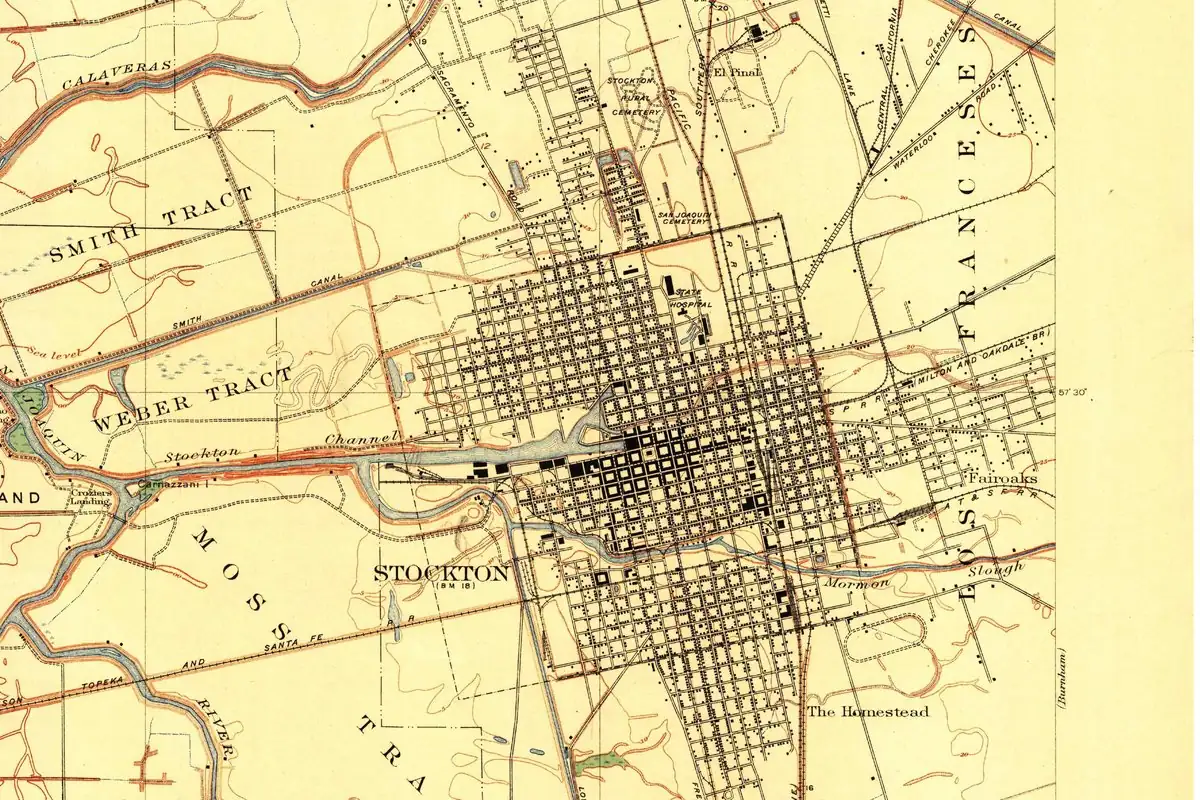
Stockton, California, could have been Castoria, its founder’s “fancy name” for a beaver settlement. Charles Weber went with Commodore Stockton instead, and by 1880 a local historian wrote that Weber “now regrets that he did not adopt the name Castoria.”
Tuleburg, New Albany or Castoria
George Tinkham, who published a history of Stockton in 1880, says the settlement first went by Weber’s settlement, or French Camp, and that Weber and his partner couldn’t agree on a real name. The partner wanted New Albany, because he’d been born in Albany, New York. Weber liked two others.
One was Tuleburg, after the tules, the tall marsh reeds that grew thick on the low, swampy ground along the sloughs. That’s the name the place actually carried before it became Stockton. The other was Castoria. Tinkham explains it in a note at the back of his book: “The name Castoria means beaver settlement, and Captain Weber thought the name appropriate, as the vicinity was literally a beaver settlement.” He adds that you could still see the old beaver burrows along the banks in his day.
A promise from the commodore
Here’s how Stockton won. During the Mexican War, Weber was taken prisoner by Castro, who was retreating toward Mexico, and was let go near the Rio Grande. Weber made his way back to Los Angeles, and that’s where he met Commodore Stockton for the first time.
Tinkham doesn’t flatter the commodore. He calls him “a man proud, dignified, and egotistical,” who felt sorry for Weber and promised the young pioneers all sorts of help once he got back to Washington, including a government steamer for their own use. Elated, and with what Tinkham calls “a strong feeling of friendship” for the commodore, Weber “resolved that his life work should bear the name of Stockton.”
Tinkham’s 1923 county history adds an earlier step. When Weber organized a company to trade at the gold diggings, he called it the Stockton Mining Company, and that was the first time the word was used, chosen “because of his great admiration for Commodore Robert F. Stockton.” The name became official for the town in a petition to the Court of Sessions on July 23, 1850, and Gannett’s 1905 list for the Geological Survey confirms whom it honors.
The steamer never came
You can guess the rest. The help the commodore promised never showed up. Tinkham puts it bluntly: “the aid promised by Commodore Stockton never came,” and Weber wished he’d stuck with Castoria.
So the city kept the name of a man who never delivered. Castoria didn’t vanish completely, though: Tinkham’s 1923 history says the county created a Castoria township in 1853, covering the southern part of the county.
Sources & further reading
- George H. Tinkham, A History of Stockton (1880). The candidate names Tuleburg, New Albany and Castoria, the meeting with Stockton, the promised steamer and Weber’s regret (pp. 5-6 and 101-102), plus the appendix note on Castoria and the beavers.
- George H. Tinkham, History of San Joaquin County (1923). The Stockton Mining Company as the first use of the name (p. 52), Castoria township (p. 64) and Weber naming the town for the commodore (p. 118).
- Henry Gannett, The Origin of Certain Place Names in the United States (USGS, 1905). Named for Commodore R. F. Stockton, “who participated in the conquest of California.”
- GNIS feature 1659872 (U.S. Geological Survey). The federal record and map location for Stockton, in San Joaquin County.
Spot something wrong, or know more? Tell us here. You can also email us or use our contact page. Corrections are noted here with their date, never made silently.