Vallejo, California: The General Wanted to Call It Eureka
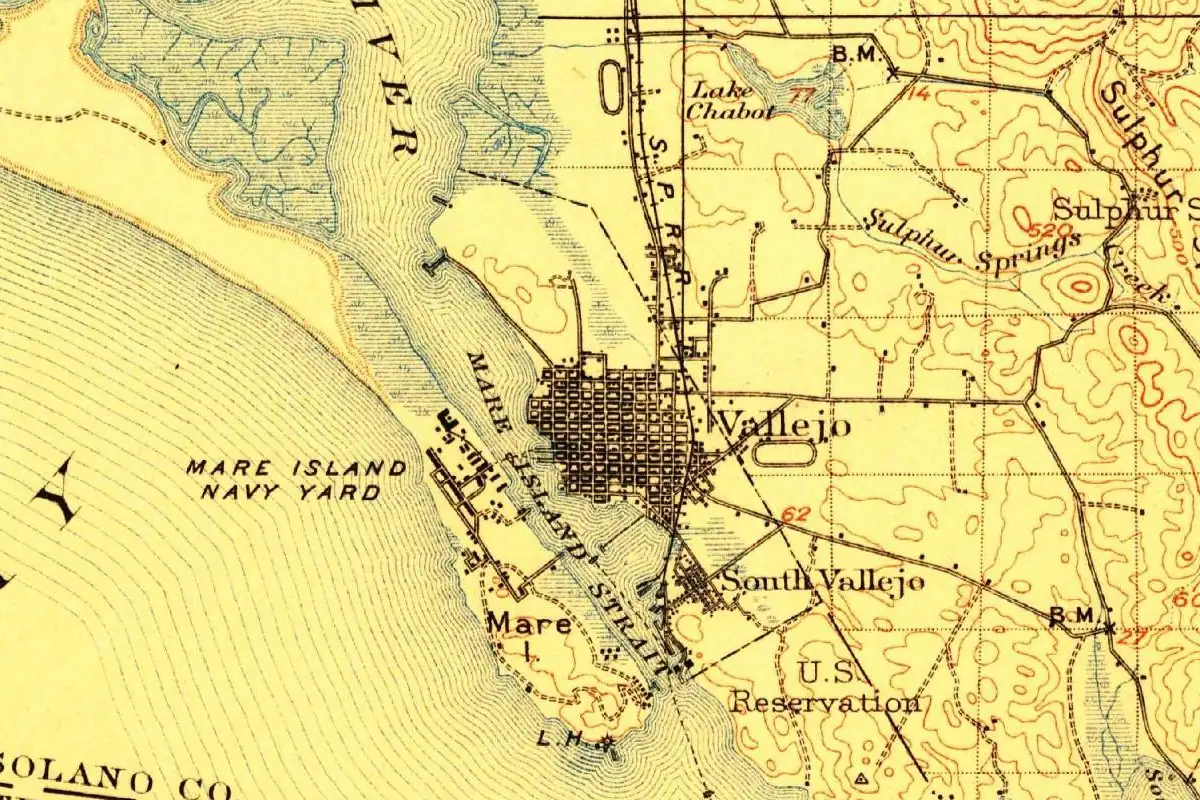
Vallejo, California, was supposed to be called Eureka. General Mariano Vallejo wanted that name, but his colleagues suggested his own instead. For a short while, the town was even the state capital.
Eureka, Eden, then Vallejo
The story comes from J. P. Munro-Fraser’s History of Solano County, published in 1879. In 1850, he writes, General Vallejo became convinced that the state capital belonged at “a place which he desired to name Eureka, but which his colleagues, out of compliment to himself, suggested should be called Vallejo.” Earlier in the same book, Munro-Fraser adds a detail that’s easy to miss: the town “was to have been called Eureka, and at one time actually bore the name of Eden.” In another chapter he dates it: when the county court created Vallejo township in March 1851, the city “was known as Eden.”
Henry Gannett’s 1905 federal guide to place names keeps it simple: the city is “named for Gen. Mariano G. Vallejo, a Mexican officer.”
Who the general was
Nellie Van de Grift Sanchez, in her guide to California place names, calls the Vallejos “among the most prominent of the California pioneer families” and quotes Bancroft’s history on the general. Mariano Guadalupe Vallejo was born at Monterey in 1808, served the Mexican government in several posts, and was at one time “Commandante General of California.” He founded Sonoma. He saw where things were heading and, in Bancroft’s words, “finally cast in his lot with the United States, for which he seems to have been ill repaid.”
An offer too big to refuse
Vallejo didn’t just lend his name. In a memorial to the state Senate in April 1850, which Munro-Fraser reprints at length, he offered land and money to build a capital from scratch: 20 acres for the capitol and grounds, 136 more acres for a governor’s house, a university, hospitals, asylums, schools and a prison, plus $370,000 to put up the buildings. A Senate committee said the offer looked “more like the legacy of a mighty Emperor to his people than the free donation of a private planter to a great State.”
The governor signed the law on the permanent seat of government on February 4, 1851, and the legislature first met in Vallejo on January 5, 1852. It lasted about a week. Munro-Fraser says the new town lacked “that vortex of dissipation” Sacramento had plenty of, so the Assembly voted to move the session there. The Senate rejected the move by one vote, on a Saturday. Then, in his version, “Senator Anderson found an extra sized louse on his pillow,” moved to reconsider on Monday, and on January 12, 1852, the government was on its way to Sacramento.
It came back in January 1853 and left again the next month, this time for Benicia. Later, a bill fixed the capital at Sacramento. If you visit Vallejo today, you’re in a city that hosted the legislature twice and lost it both times.
His wife’s name went next door
Vallejo’s family name is on this town, but his wife’s name is on the town next door. Sanchez quotes General William T. Sherman’s memoirs: Dr. Semple got land from Vallejo on the condition that he’d build a city named for the general’s wife, Francisca Benicia. So the town was first called Francisca.
Sherman says that’s what prompted the leading men of Yerba Buena to rename their town San Francisco, and that Semple, “outraged” at the near match, switched his town to the wife’s other name. “Benicia it has been to this day.” Sanchez notes that Vallejo himself told it differently: he said Yerba Buena changed its name for convenience, to put the mission, the town and the presidio under one name. Either way, the general ended up with one city named for him and another for his wife, about seven miles apart, as the 1879 history puts it.
Sources & further reading
- J. P. Munro-Fraser, History of Solano County (1879). Eden as the town’s name in March 1851 (p. 30); Eureka and Eden, and Benicia seven miles away (p. 70); the Eureka-to-Vallejo naming, the 1850 memorial, the committee’s reply, the 1852 and 1853 sessions and the louse (pp. 189-193).
- Nellie Van de Grift Sanchez, Spanish and Indian Place Names of California (1922 edition). Bancroft on Vallejo’s life (pp. 241-242), Sherman on Francisca and Benicia (pp. 227-228), and Vallejo’s own explanation of the San Francisco name (pp. 195-196).
- Henry Gannett, The Origin of Certain Place Names in the United States (USGS, 1905). Vallejo “named for Gen. Mariano G. Vallejo, a Mexican officer,” and Benicia “named by General Vallejo for his wife.”
- GNIS feature 1661612 (U.S. Geological Survey). The federal record and map location for Vallejo; it has no note on the name.
Spot something wrong, or know more? Tell us here. You can also email us or use our contact page. Corrections are noted here with their date, never made silently.