Klamath Falls, Oregon: How Linkville Got a New Name
Klamath Falls, Oregon, was Linkville for 25 years, until a county surveyor argued in 1891 that a town by a waterfall should have the falls in its name. “There is,” the local paper quoted Isa Leskeard, “a great deal in the name of a town situated by a heavy cataract.”
George Nurse and the Link River ferry
George Nurse had been the sutler at Fort Klamath, the man who sold goods to the soldiers there. In the spring of 1867, according to a 1905 history of central Oregon, he got a government permit and started a ferry across Link River, at the point where it broadens into what the book calls Little Ewauna Lake. He opened a store on the bank, mostly trading with Indians for furs at first, and platted lots around it.
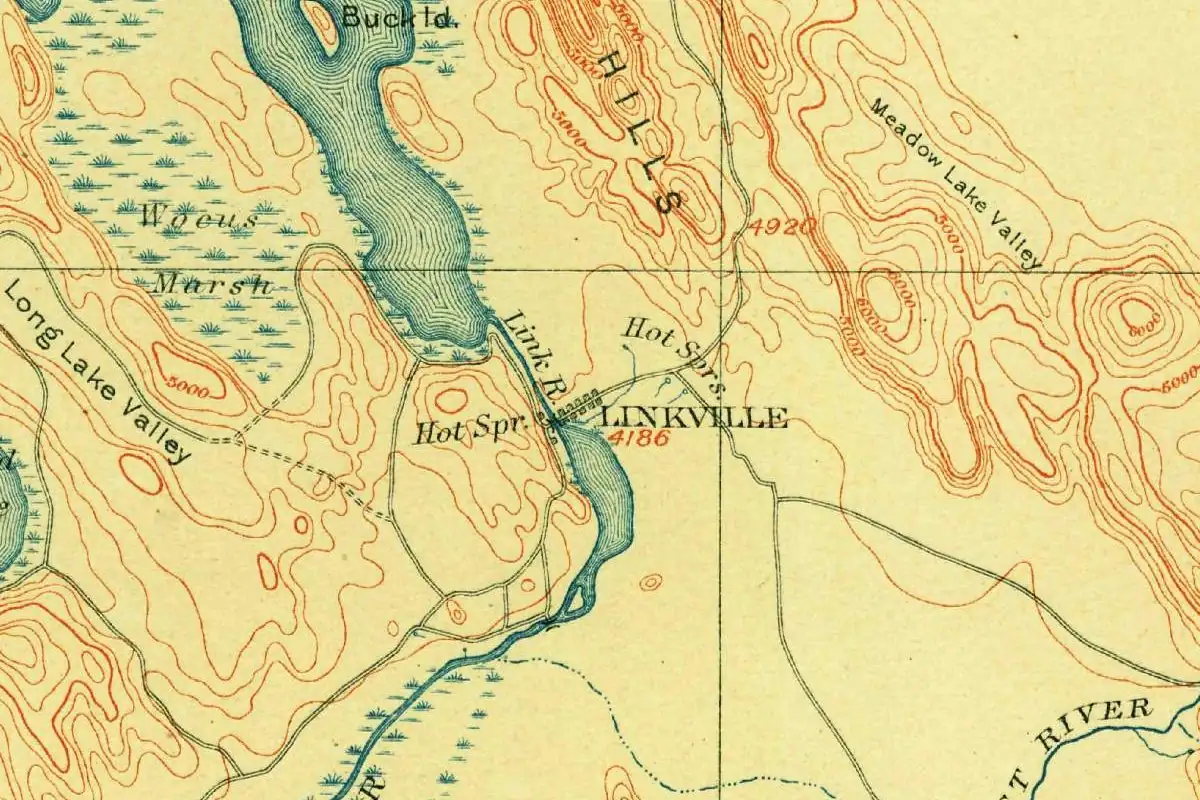
“Appropriately enough the town was named Linkville by Nurse because of its location on Link river, the stream which connects Upper Klamath lake with Lake Ewauna,” the history says. The federal GNIS record agrees on the date: founded in 1867. You can still see the old name on the U.S. Geological Survey’s 1889 map, printed in capitals right beside Link River.
Too small a name for a growing town
By the time the town was ready to incorporate, a lot of people wanted a new name. The 1905 history says Linkville itself “was not distasteful with the exception of the diminitive termination.” The town was growing, and they figured a name ending in “city” would suit it better than one ending in “ville.” “Klamath City” got popular support. Even so, Linkville was the name in the bill that incorporated the town.
Isa Leskeard had a different idea. The Klamath County Star first mentioned it on April 10, 1891: Leskeard “thinks the name of this town should be Klamath Falls. That name advertises the fact that there are falls here.” Towns at other falls already had that advantage, the paper said, and after quoting Leskeard on the value of a name, it added, “we are inclined to think so, too.”
A petition, and a letter from Washington
In December 1891, a lawyer named W. C. Hale drew up a petition to the first assistant postmaster general, and Leskeard, the town recorder and a real estate agent went around collecting names. Not everyone liked the idea. On December 18, the Star pushed back against “one or two dry-mouthed old settlers” who thought Linkville was well enough known already.
The petition worked. A letter dated March 11, 1892, told the postmaster that “the postmaster general has changed the name of your postoffice from Linkville to Klamath Falls,” and the change took effect on April 1, 1892. The town itself stayed Linkville on paper for almost another year, until it was granted a new charter on February 7, 1893. The history marks the moment: “At the last stroke of 12 on Monday night, February 6, 1893, Linkville ceased to exist except in memory.”
Where “Klamath” comes from
The falls part was Leskeard’s selling point. The other half was already all over the map: Henry Gannett’s 1905 survey of U.S. place names says Klamath Falls was “named for the Indian tribe,” the Klamath people, the same name the nearby lake, the Klamath River and the county carry. What the word Klamath first meant is a separate question, and none of the sources here answers it.
So if you’re wondering why the town isn’t called Linkville anymore, the short answer is advertising. In 1891, a town that wanted to grow decided its name should tell people about its waterfall.
Sources & further reading
- An Illustrated History of Central Oregon (1905), pp. 976 and 979. George Nurse, the 1867 ferry and store, the naming of Linkville for Link River, the “Klamath City” idea, Isa Leskeard’s suggestion in the Klamath County Star, the petition, the Post Office Department’s letter and the 1893 charter.
- Henry Gannett, The Origin of Certain Place Names in the United States (USGS, 1905), p. 177. Klamath Falls “named for the Indian tribe.”
- GNIS feature 1136445 (U.S. Geological Survey). Founded in 1867; current name adopted in 1892.
Spot something wrong, or know more? Tell us here. You can also email us or use our contact page. Corrections are noted here with their date, never made silently.