Portland, Oregon: The Coin Toss That Beat Boston
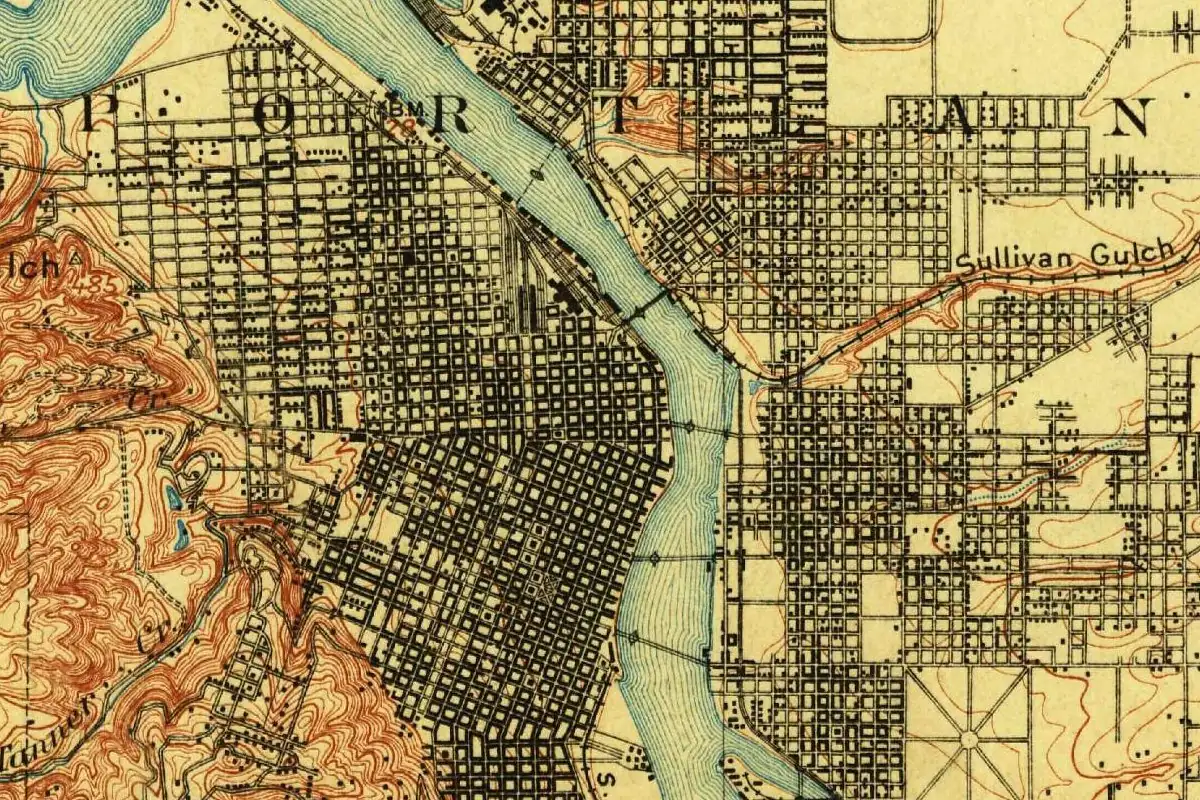
Portland, Oregon, came close to being called Boston: in 1845 its two owners couldn’t agree on a name, so they tossed a copper cent, and Portland won. Francis W. Pettygrove, who came from Maine, wanted Portland, and Amos L. Lovejoy, from Massachusetts, wanted Boston.
A town with lots for sale and no name
The land changed hands before anybody thought about a name. A young Tennessean named William Overton claimed it first, and on a canoe trip between Fort Vancouver and Oregon City he took Lovejoy ashore to look at it. Joseph Gaston’s 1911 history of the city says Lovejoy noticed the deep water along the bank, where ships had already tied up, and took a half interest on the spot. Overton soon sold the other half to Pettygrove for fifty dollars and left.
The new partners had a cabin built and the land surveyed, and by 1845 they were selling lots. Gaston puts it plainly: “In 1845 Portland was started, and lots sold before it had any name.” You can see why that got awkward fast.
Two out of three at Oregon City
The question came up over dinner in Oregon City. H. W. Scott’s 1890 history lists who was at the table: Lovejoy and his wife, Pettygrove and his wife, and a Mr. Wilson. Lovejoy wanted Boston, and Pettygrove wanted Portland. “It was jestingly agreed to decide the controversy by tossing a penny,” Scott writes.
Pettygrove supplied the coin, “a memento of old times ‘Down East,’” and won the first toss. To please Lovejoy, they made it two out of three, and Pettygrove took two. Gaston tells it a little differently: three tosses, with the cent coming down “tails up” twice for Portland and “heads up” once “for dear old Boston.” Either way you read it, Boston lost.
Portland, Maine, or Calais?
Henry Gannett’s federal place-names book changed its answer between editions. The 1902 edition lumped Oregon’s Portland in with Portland, Maine, as “named, indirectly, for the town in England.” By 1905 it had the coin toss instead, decided “by two settlers, one from Portland, Maine, and the other from Boston, Massachusetts.”
That’s a slight stretch for both men. Scott says Pettygrove was born in Calais, Maine, in 1812, and Gaston calls Portland “his favorite old home town.” Lovejoy came from Massachusetts, not necessarily from Boston itself. What each man wanted was a name from back home.
The cent is still around
Gaston’s book printed an engraving of the coin, captioned “The coin that was tossed to decide the name of the town.” The Oregon Historical Society’s encyclopedia says it’s an 1835 cent and that it came to the society around 1910.
The man who won the toss didn’t stay long in the city he named. In 1851, Scott writes, Pettygrove sold the rest of his Portland property and sailed north with several other Portland people to the Strait of Juan de Fuca, where he started Port Townsend.
Sources & further reading
- H. W. Scott, ed., History of Portland, Oregon (1890), pp. 80–86. Overton’s claim, Pettygrove’s birth in Calais, the dinner at Oregon City, the penny “Down East,” the best of three, and Pettygrove’s move to Port Townsend.
- Joseph Gaston, Portland, Oregon, Its History and Builders, vol. 1 (1911), pp. 197–200. Lovejoy and the deep water, Overton’s sale for fifty dollars, lots sold before the town had a name, and the three tosses.
- Henry Gannett, The Origin of Certain Place Names in the United States (USGS, 1902 and 1905). The 1902 “indirectly, for the town in England” and the 1905 coin toss.
- The Oregon Encyclopedia, “Portland Penny.” The 1835 cent and its arrival at the Oregon Historical Society around 1910.
- GNIS feature 1136645 (U.S. Geological Survey). The federal record for Portland.
Spot something wrong, or know more? Tell us here. You can also email us or use our contact page. Corrections are noted here with their date, never made silently.