Olympia, Washington: Before It Was the Capital, It Was Smithfield
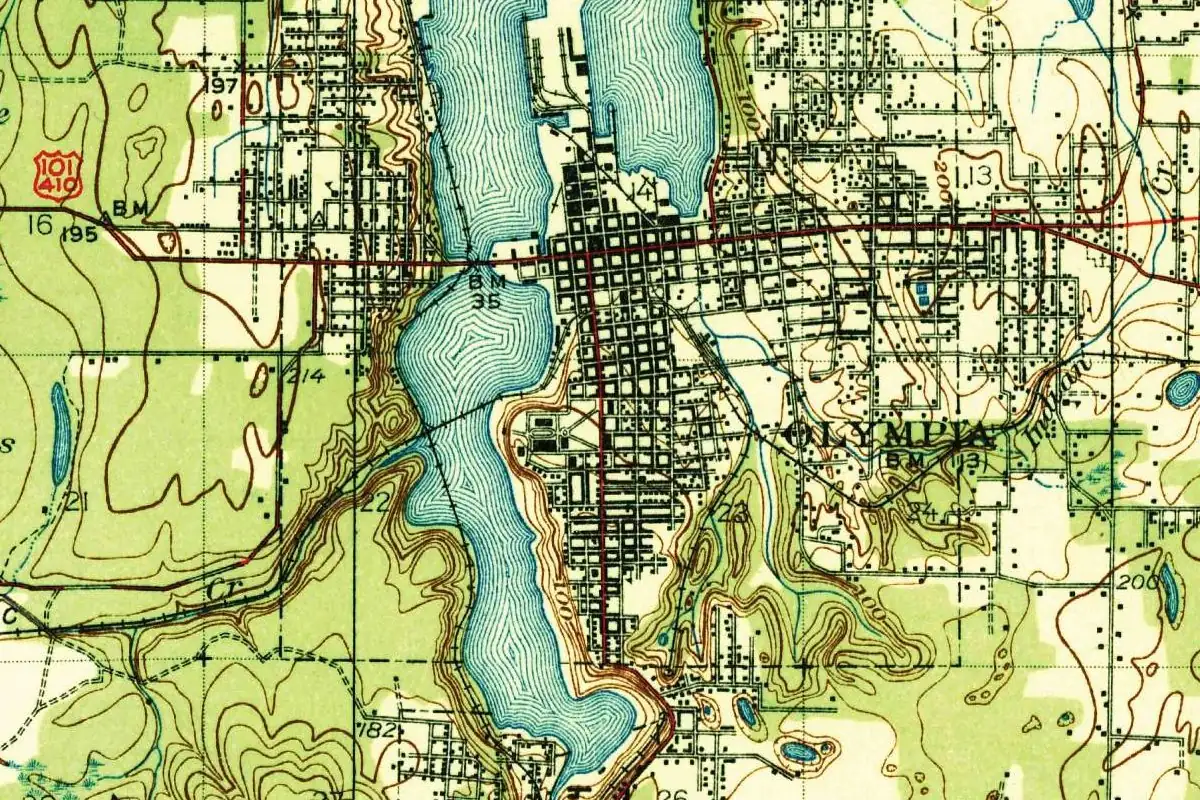
Olympia, Washington, was once Smithter, a blend of its two owners’ names, and more often Smithfield, before it took its name from the Olympic Mountains. Who actually suggested the switch is less certain: the early accounts point to Isaac N. Ebey, and one later account names Charles Hart Smith.
Smithter, then Smithfield
In 1846, two partners, Edmund Sylvester and Levi Lathrop Smith, took up two pieces of public land together, one of them at the head of Budd Inlet. They soon decided that spot would become an important settlement. Edmond Meany, the University of Washington history professor who wrote the 1923 book on the state’s place names, says one of its first names was “Smithter,” a combination of the partners’ names. “Smithfield” seems to have caught on more, and Thomas Prosch, in his 1906 history of Tacoma, later used it as his example of a temporary pioneer name: “Olympia was first called Smithfield.”
Smith didn’t live to see the change. He’d been elected to the legislature of Oregon’s provisional government, and on his way there by canoe he drowned, Meany says, “supposedly during an attack of his malady,” the epilepsy he suffered from. His share of the claim went to Sylvester.
The place had older names, too. Meany records “Stu-chus-and” from one writer, “Stitchas,” meaning “bear’s place,” from another, and “Steh-chass” as the name the Nisqually people used, according to George Gibbs. Those spellings come from three different recorders, and only one of them gives a meaning.
Ebey or Smith?
Meany places the naming right after the California gold rush, when Sylvester, Ebey and two others bought the brig Orbit in California to sail north to Puget Sound. According to Meany, the historian Hubert Howe Bancroft quoted Elwood Evans, backed by Sylvester himself, as saying the name came from the Olympic Mountains and was Ebey’s suggestion. Later, Evans changed his story and gave the credit to Charles Hart Smith.
Meany sided with Ebey. He calls him “a man of reading and refinement” who also suggested “Lake Geneva” for what’s now Lake Washington. He even offers a bit of evidence from Ebey’s bookshelf: the pioneer owned a copy of Olympia Fulvia Morata’s Critical Observation on Homer. You can take that clue for what it’s worth. It shows Ebey had the name in front of him, not that he’s the one who said it out loud.
From Greece, by way of a ship captain
The mountains got their name first. On July 4, 1788, the British captain John Meares saw the mountain and named it Mount Olympus, and George Vancouver kept the name on his charts in 1792. The government’s GNIS database sums up the town’s name the short way: “Named from the ancient mountain of Greece.” So the capital’s name went from Greece to a peak on the Olympic Peninsula and then to the new town at the head of Budd Inlet.
It caught on fast. The Hudson’s Bay Company’s Nisqually Journal for April 25, 1851, reports that “a port of entry has been established at the City of Olympia.” That summer and the next, as you can read in our story of the state’s name, settlers north of the Columbia used Olympia’s Fourth of July celebrations to talk about a government of their own. A town that had been Smithfield a few years earlier was already where people went to talk about a new territory.
Sources & further reading
- Edmond S. Meany, Origin of Washington Geographic Names (1923). The “Olympia” entry (pp. 197–199) covers the older Native names, Sylvester and Smith, Smithter and Smithfield, Smith’s death, the Ebey and Charles Hart Smith accounts, Ebey’s book and the 1851 Nisqually Journal entry. The “Mount Olympus” entry (pp. 176–177) has Meares naming the peak on July 4, 1788, and Vancouver keeping it. The “Washington” entry (p. 338) mentions the Fourth of July celebrations in Olympia in 1851 and 1852.
- Thomas W. Prosch, McCarver and Tacoma (1906), p. 163. Notes in passing that “Olympia was first called Smithfield.”
- GNIS feature 1533353 (U.S. Geological Survey). The federal record for the capital: “Named from the ancient mountain of Greece.”
Spot something wrong, or know more? Tell us here. You can also email us or use our contact page. Corrections are noted here with their date, never made silently.