How Spokane Got Its Name (and Lost the "Falls")
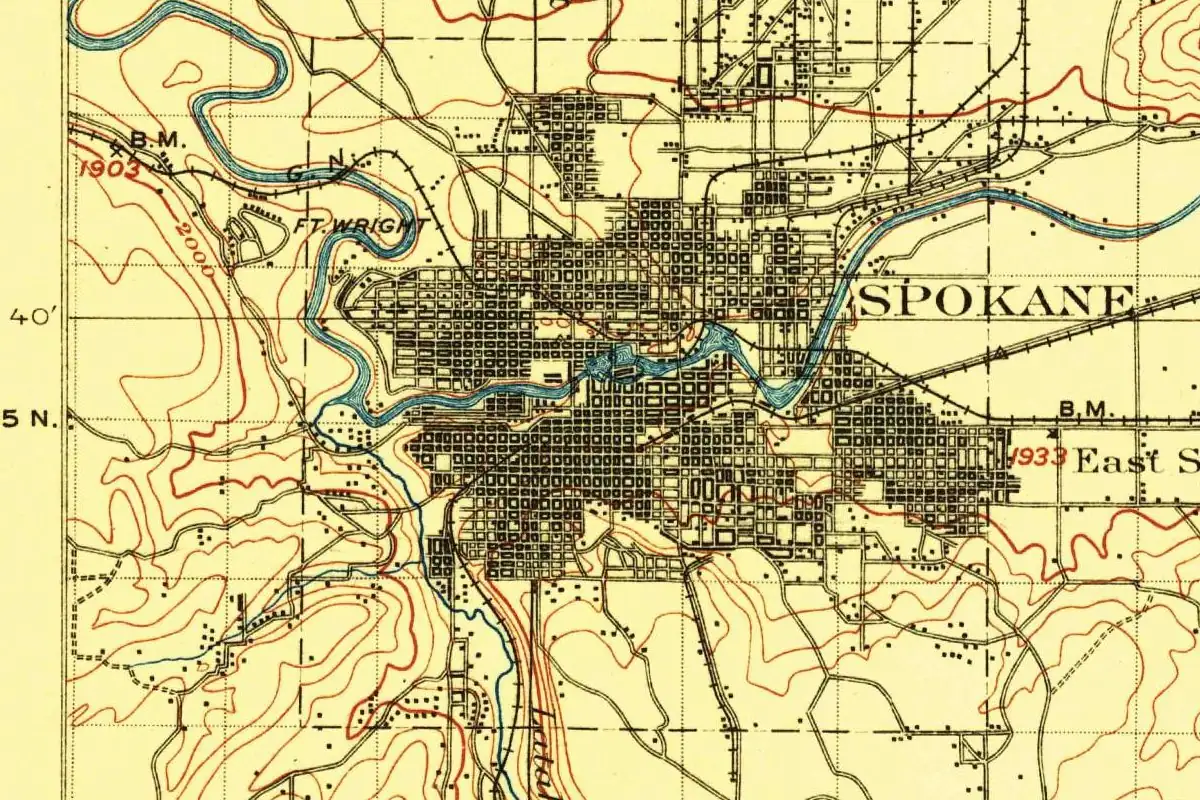
Spokane, Washington, was officially Spokane Falls for years and didn’t drop the “Falls” until 1890. The name itself belongs to the Spokane people, and it reached the city by way of a river, two fur-trading posts and a county.
From a people to a river
Edmond Meany, the University of Washington historian who catalogued the state’s place names in 1923, lays out the order: the name “was first applied to the Indians, then to the river and the region it drained.” It took a while to settle. Lewis and Clark wrote about the people and the falls in 1805 but used the name “Skeetsomish.” The fur trader David Thompson wrote of the Spokane River in 1811, yet his own map labels it “Skeetshoo.”
The fur trade is what made the name stick. In 1810, Jaco Finlay and Finan McDonald, working under Thompson for the North West Company, built Spokane House where the Little Spokane River meets the Spokane. The Astorians of the Pacific Fur Company put up a rival Fort Spokane nearby in 1812. Both posts were later abandoned, but Meany says they “helped materially to fix the name on the country.” By 1826, Hudson’s Bay Company men were writing “Spokane River,” and so was the botanist David Douglas.
Spokane Falls becomes Spokane
The territorial legislature created Spokane County on January 29, 1858. The city came later, incorporated in 1881, and for years its official name was Spokane Falls. GNIS, the federal government’s database of place names, says the city was reincorporated in 1890 and took its current name the same year.
What does Spokane mean?
You’ll run into “children of the sun” just about everywhere, and Henry Gannett’s 1905 survey of American place names, published by the U.S. Geological Survey, gives exactly that. The trail is messier than the slogan, though. Meany collected four versions:
- Ross Cox, a fur trader, met the head chief in 1812 and gave his name as “Il-lim-spokanee,” which Cox said meant “son of the sun.”
- Rev. Myron Eells, a missionary whose father had worked among the Spokane, thought “Il-lim” was short for the word for “chief,” so the name meant “chief of the sun people” and was “not probably the name of the chief, but his title.”
- M. M. Cowley, a settler in the Spokane Valley from 1872, said the people called themselves “Sinkomahnahs” and that the everyday greeting “Hust-Spokanee” meant “good sun.”
- Edward S. Curtis wrote that the word “seems to be related to spukani, ‘sun,’ but the force of the reference is not apparent.”
The Spokane Tribe’s own history page says the common “children of the sun” translation most likely comes from that chief, Illim-Spokanee. Meany saw where things were heading back in 1923: he guessed the local definition, “child of the sun,” would “become fixed in speech and literature.” Most of these versions agree there’s a sun in the word. If you want to know exactly what the rest of it means, nobody in the record settles it.
The falls had a name of their own
The waterfall the city dropped from its name had an older name. According to Curtis, the people’s own name for Spokane Falls was “Stluputqu,” meaning “swift water.” That’s Curtis’s account alone, and Meany doesn’t offer a second one. Still, it’s the one name in the whole story that’s about the water and not the sun.
Sources & further reading
- Edmond S. Meany, Origin of Washington Geographic Names (1923), pp. 283–285. How the name spread from the people to the river, the region and the city; Lewis and Clark, Thompson, Spokane House, Fort Spokane; the county in 1858; the years as Spokane Falls; and the versions of the meaning from Cox, Eells, Cowley and Curtis.
- Henry Gannett, The Origin of Certain Place Names in the United States (USGS, 1905). “Named for an Indian tribe, the name meaning ‘children of the sun.’”
- GNIS feature 1512683 (U.S. Geological Survey). Incorporated in 1881, reincorporated in 1890 under the current name.
- Spokane Tribe of Indians, “History.” The tribe’s own note that “children of the sun” most likely comes from the chief Illim-Spokanee.
Spot something wrong, or know more? Tell us here. You can also email us or use our contact page. Corrections are noted here with their date, never made silently.