Manchester, New Hampshire, and Judge Blodget's Prediction
Manchester, New Hampshire, owes its name to a prediction: Judge Samuel Blodget liked to say Derryfield was “destined to become the Manchester of America.” In 1810, three years after he died, the town took him at his word and renamed itself after the city in England.
Derryfield and Londonderry’s cattle
For nearly sixty years, the town was Derryfield. In 1751, Governor Benning Wentworth put together part of Londonderry and some neighboring land “into a township by the name of Derryfield,” according to C. E. Potter’s History of Manchester, published in 1856. Potter passes along the explanation for that name with a “said to”: it came from the fact that “the people of Londonderry had been accustomed to turn their cattle to pasture upon the hills and meadows within its limits.”
It wasn’t a place people expected much from. At the town’s centennial in 1851, a local doctor, William M. Parker, remembered that when he was a boy, “they used to tell about going out of the world into Derryfield.”
The judge and his canal
Samuel Blodget was born in Woburn, Massachusetts, in 1724, and he moved to Amoskeag Falls, on the Merrimack River in Derryfield, in 1793. He had a big idea: a canal and locks around the falls. Potter tells how it went. Work started on May 2, 1794. His first design, a lock of his own invention, failed and swallowed a large part of his fortune. He kept at it with lotteries and a new plan, and by the end of 1806 the locks were done.
The opening came in May 1807. Blodget, 83 years old, rode a raft through the whole canal and the locks into the Merrimack while a crowd on shore cheered. Potter quotes what he said when he got home: “I have but one object now to live for, my canal is completed.” He died on September 1 of that year.
The vote of 1810
As it turns out, the line that mattered for the name had nothing to do with the canal. Potter says Blodget “was wont to say, that the town was ‘destined to become the Manchester of America.’” Henry Gannett’s 1905 bulletin for the U.S. Geological Survey says the New Hampshire city was “named from the city in England.”
At the town meeting of March 13, 1810, the voters picked a committee “to petition the General Court to have the name of the town of Derryfield altered to Manchester.” The legislature agreed that June. Potter says the change was made “out of compliment to the opinion of Judge Blodget,” and that one of the committee members, Thomas Stickney, was the judge’s grandson. The first factory on the Merrimack had already been started there, and “many of the people hoped that his prognostication was soon to be realized.” You might expect a big town behind a bold name like that. Potter puts the population in 1810 at six hundred and fifteen.
Not everyone told it quite that way. At the town’s centennial in 1851, the Rev. Cyrus W. Wallace passed along that “it has been said” the change was “suggested and mainly effected” by a man in town named Stickney, who predicted Manchester “would one day vie in importance with the Manchester of Old England.” Potter’s book, which prints that speech, gives the prediction to the judge. Either way, the name points to the same city in England.
The old name hangs on
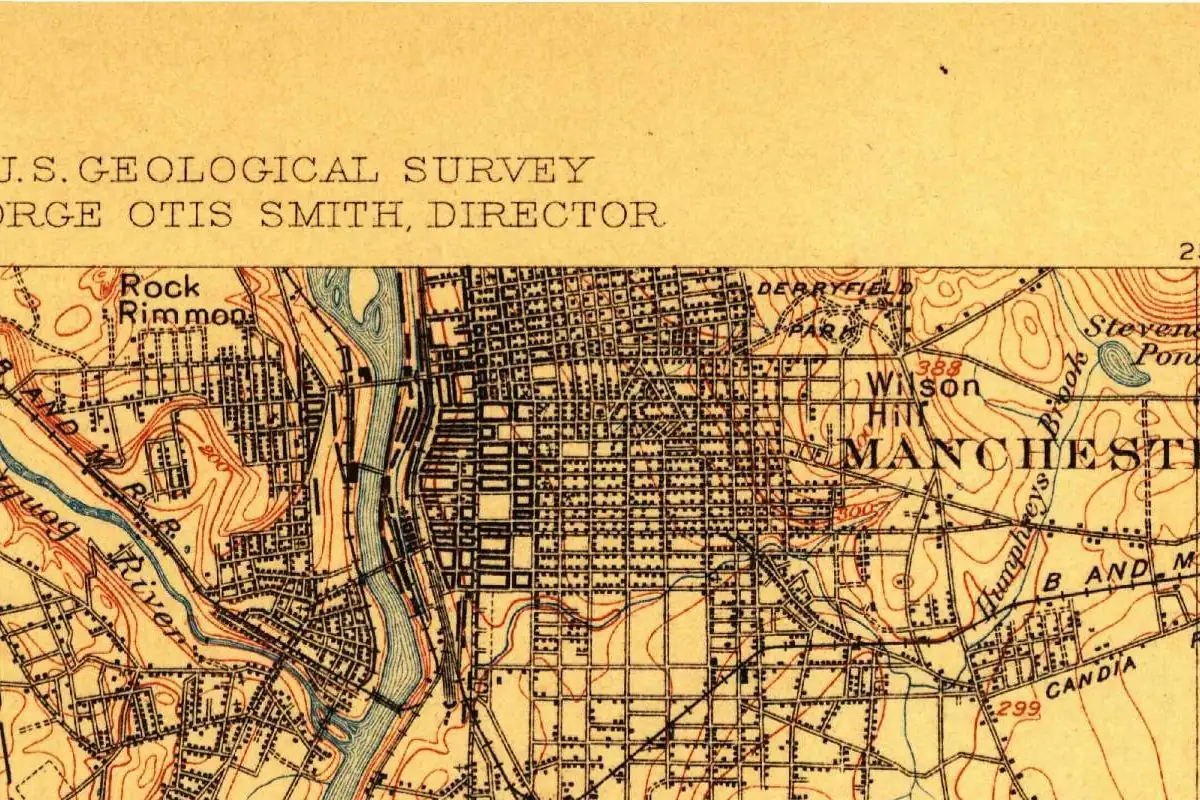
Names don’t change overnight in people’s heads. Parker, speaking in 1851, said the town “was known as Derryfield, sometime after the name was changed to Manchester.” And if you look at the 1905 map above, you can still find the old name on the east side of the city, in Derryfield Park.
Sources & further reading
- C. E. Potter, The History of Manchester, Formerly Derryfield, in New-Hampshire (1856). The Derryfield charter of 1751 and the cattle-pasture story (p. 265); William M. Parker’s centennial remarks (p. 58) and the Rev. Cyrus W. Wallace’s centennial address, with the Stickney version (p. 8); Samuel Blodget’s life, canal and death in 1807 (pp. 525–536); the vote of 1810, the “Manchester of America” and the population of 615 (p. 543).
- Henry Gannett, The Origin of Certain Place Names in the United States (USGS, 1905), p. 197. Manchester in Hillsboro County, New Hampshire, “named from the city in England.”
- GNIS feature 868243 (U.S. Geological Survey). Manchester’s entry in the federal place-name database, which places it in Hillsborough County.
Spot something wrong, or know more? Tell us here. You can also email us or use our contact page. Corrections are noted here with their date, never made silently.