Concord, New Hampshire, and the Fight That Came Before the Name
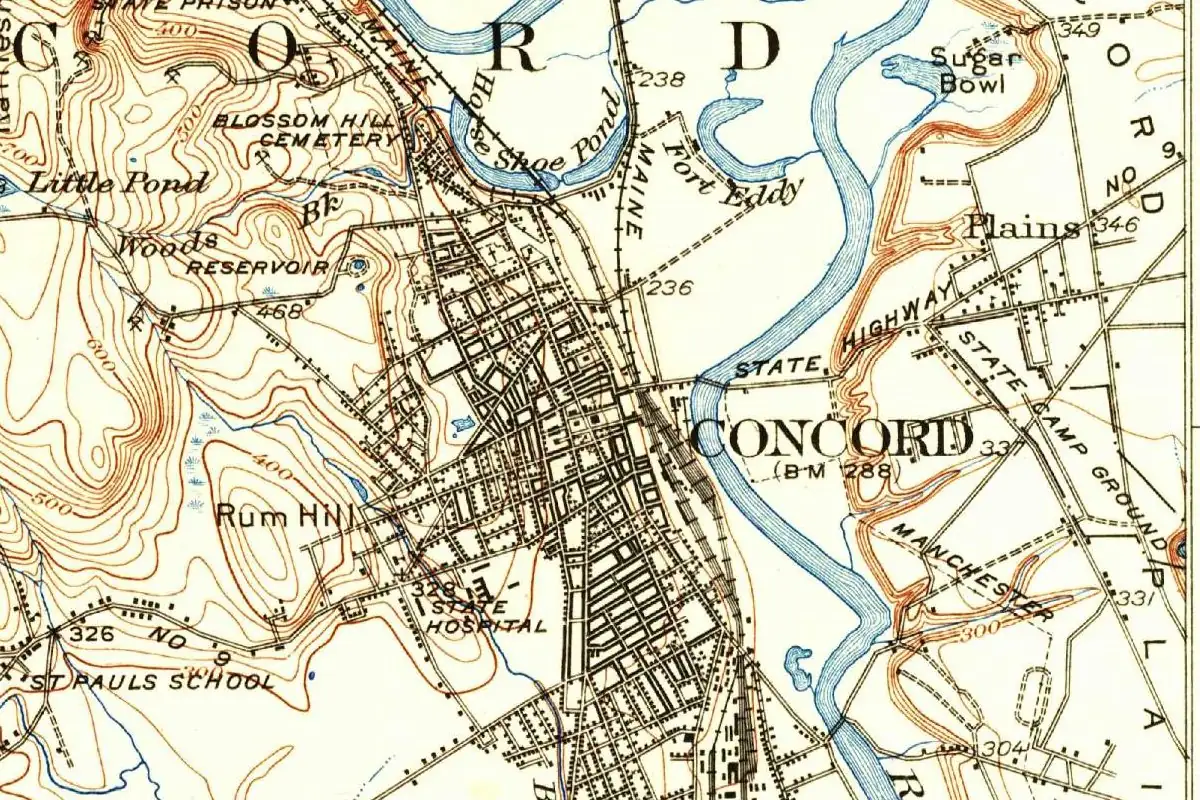
Concord, New Hampshire, got its name in 1765, after decades of fighting with Bow over the land, and the old histories don’t say why it was picked. By then the settlers had already lived under two other names, Penacook and Rumford.
Penacook, then Rumford
The story starts with a grant from Massachusetts, not New Hampshire. John Farmer and Jacob Moore’s 1823 Gazetteer of the State of New-Hampshire says the tract, “originally called Penacook,” was granted on January 17, 1725, to Benjamin Stevens, Ebenezer Eastman and others. Penacook was also the name of the Native people of the area. Charles J. Fox, writing about the Merrimack Valley in 1846, places “the Penacooks around Penacook, now Concord.”
Settlers arrived the next year. Then, in 1733, Farmer and Moore write, “the plantation was incorporated by the name of Rumford.” That was a Massachusetts town, and New Hampshire saw things differently.
Rumford against Bow
In 1727, New Hampshire had granted a township of its own called Bow. Alonzo Fogg’s 1874 gazetteer says that grant “covered nearly the whole territory” of the Penacook tract. So two sets of owners claimed the same ground. Farmer and Moore put it plainly: “a controversy existed between the proprietors of Rumford and Bow” from about 1733 until 1762, when the King in Council decided it on appeal.
The fix, when it came, stung. On May 25, 1765, the New Hampshire House passed a bill, and on June 7 the council and governor approved it. Its title tells you how New Hampshire saw the place: “An act for setting off a part of the Town of Bow,” with the people on it, and “making them a Parish.” James O. Lyford’s 1903 city history quotes the act, which made the settlers “a Parish by the name of Concord.” Nathaniel Bouton, in his 1856 History of Concord, called the terms “humiliating to the inhabitants of Rumford; but it was the best they could get.”
A name that means agreement
Here’s the odd part. After all that fighting, the name they ended up with means getting along. Fogg quotes the act and adds that Concord “means harmony and agreement with one another.” It’s tempting to read the name as a peace sign at the end of a long feud. That may be right, but neither Bouton nor Lyford says why that word was chosen, and Fogg only explains what it means.
The peace wasn’t quite finished, either. Lyford says that for nineteen years Concord held “the title of ‘Parish of Bow,’” and that it did so “much to the distaste of its inhabitants.” Only in January 1784 did a new act say “that the Parish of Concord be henceforth called the Town of Concord.”
Where Rumford went
The old name didn’t vanish. Farmer and Moore tell the story of Benjamin Thompson, who was born in Woburn, Massachusetts, and “settled here in early life.” He went to England in 1775 and later served the Duke of Bavaria, who made him a count, “taking his title from the name of the town where he had spent most of his youth.” So if you’ve ever come across the name Count Rumford, you’ve met Concord’s old name, carried off to Europe by a man who grew up there.
Sources & further reading
- John Farmer and Jacob B. Moore, A Gazetteer of the State of New-Hampshire (1823), pp. 106–108. The Penacook grant of January 17, 1725; Rumford in 1733; the controversy with Bow until 1762; and Benjamin Thompson, Count Rumford, who took his title from the town.
- Nathaniel Bouton, The History of Concord (1856), p. 240. Rumford “as incorporated by Massachusetts,” the act of 1765 and its “humiliating” conditions for Rumford.
- James O. Lyford, ed., History of Concord, New Hampshire, vol. 1 (1903), pp. 238, 276–277. The dates of the 1765 act, its wording (“a Parish by the name of Concord”), and the 1784 act that made Concord a town.
- Alonzo J. Fogg, The Statistics and Gazetteer of New-Hampshire (1874), pp. 117–118. The Bow grant of 1727 and the meaning of the word concord.
- Charles J. Fox, History of the Old Township of Dunstable (1846), p. 19. The Penacooks “around Penacook, now Concord.”
- GNIS feature 873303 (U.S. Geological Survey). The federal record for Concord, “Capital of State of New Hampshire.”
Spot something wrong, or know more? Tell us here. You can also email us or use our contact page. Corrections are noted here with their date, never made silently.