Keene, New Hampshire, and the Diplomat Behind the Name
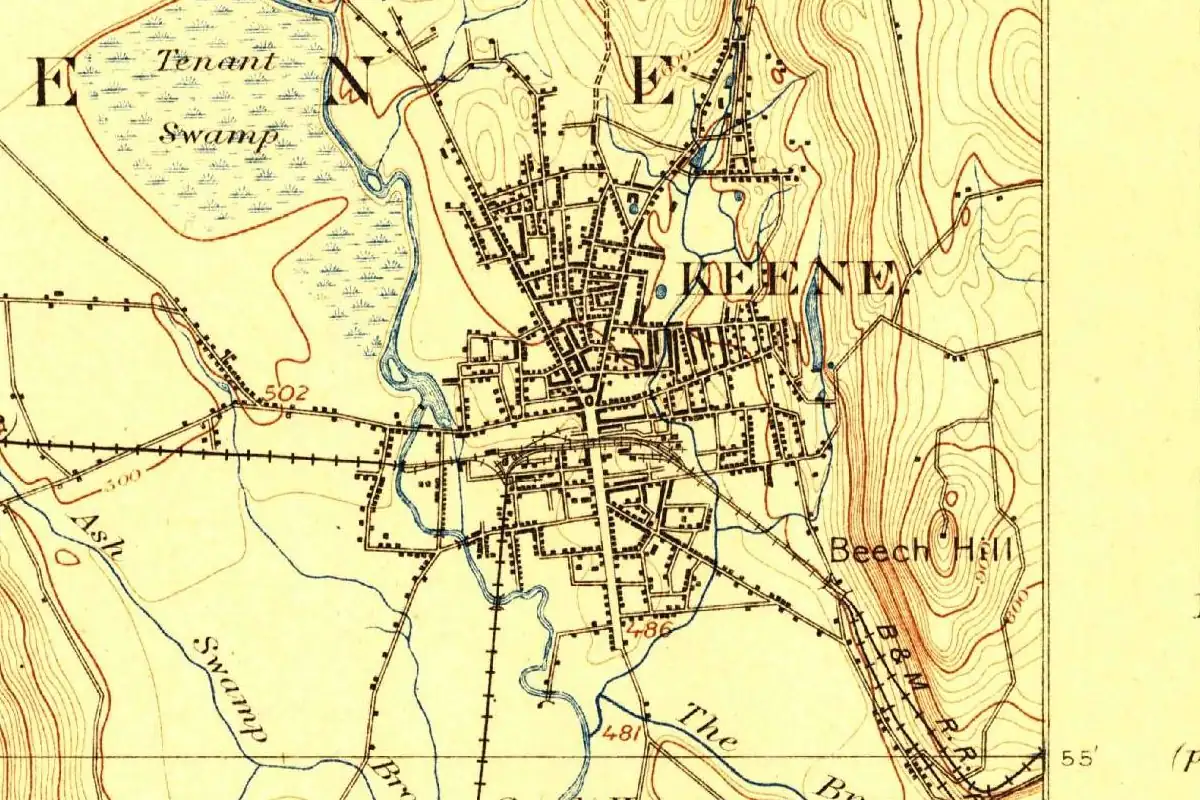
Keene, New Hampshire, is named for Sir Benjamin Keene, a British envoy in Madrid who tried to help Gov. Benning Wentworth collect for a timber shipment. Wentworth never got his money, but he named a town after the man who tried.
Upper Ashuelot first
Before it was Keene, the town was a Massachusetts grant. Simon G. Griffin’s History of the Town of Keene, published in 1904, says it was first called “the upper Township on Ashuelot River,” which people shortened to “Upper Ashuelot,” and “by that name the town was known until it was changed to Keene in 1753.”
Then the colonial boundary caught up with them. When the line between the two provinces was run, the settlers found themselves, in Griffin’s words, “shut out from Massachusetts,” and they worried their land titles might not hold. Benjamin Bellows petitioned the New Hampshire governor and council for the settlers, who had come “by virtue of a grant from the Massachusetts Government before the line of Government was run.” The council agreed, and the New Hampshire charter is dated April 11, 1753.
A shipment of oak
Griffin tells why the name went to a diplomat. “Claiming the right to name the town, the governor named it Keene.” Years before, when Wentworth was a merchant in Portsmouth, he had contracted with an agent of the Spanish court to supply a large amount of oak timber, and he borrowed money in London to do it. By the time he delivered the timber at Cadiz, the agent who made the deal was out of office, and the new one wouldn’t pay. On the way home his ship sank. He and the crew got away in a boat, and he found himself bankrupt.
He went back to Spain to press his claim. Sir Benjamin Keene was the English minister there, and he “used his influence to aid Mr. Wentworth.” It didn’t work, but Griffin says Wentworth “formed a warm friendship for Sir Benjamin, and his gratitude, and his admiration for the man, led him to name this town in his honor.” The short version is in the U.S. Geological Survey’s 1905 bulletin on place names, written by Henry Gannett: Keene, the city in Cheshire County, was “named for Sir Benjamin Keene.”
It wasn’t always stated so firmly. John Farmer and Jacob Moore’s 1823 state gazetteer says the name came from “an English nobleman, perhaps Sir Benjamin Keene.” And the timber story is Griffin’s alone: he doesn’t say where he found it, and it’s the only telling of it we found.
Who Sir Benjamin was
If you’re picturing a stiff royal official, Griffin’s sketch of him will surprise you. Keene was born in 1697 at King’s Lynn, in Norfolk, the son of a merchant who became the town’s mayor. He went to Madrid as an agent of the South Sea Company, became British consul there in 1724 and minister plenipotentiary in 1727. Griffin quotes Horace Walpole’s description of him as “one of the best kind of agreeable men, quite fat and lazy, with universal knowledge.”
There’s a small coincidence in that birthplace. Charles Wesley Tuttle’s 1887 biography says Captain John Mason, the man who named New Hampshire, was born in King’s Lynn too.
A toast to the name
On May 26, 1853, Keene celebrated a hundred years under its New Hampshire charter. A big tent had gone up near the Square, but it rained so hard that everything was held in the town hall instead, Griffin says. He prints the toasts, and the second one went to the man behind the name: “Sir Benjamin Keene — We pay the debt for his name by ‘keeping his memory green.’” The toast talks about a debt, and so does the story behind the name: the money Spain never paid Wentworth.
Sources & further reading
- S. G. Griffin, A History of the Town of Keene (1904). “Upper Ashuelot” (p. 52); the settlers “shut out from Massachusetts” by the new line (pp. 56–57); the Bellows petition, the governor’s right to name the town and the timber story (pp. 103–104); the charter of April 11, 1753 (p. 107); the rainy centennial of 1853 and its toasts (pp. 453–455); and the life of Sir Benjamin Keene, with Walpole’s description (pp. 618–619).
- Henry Gannett, The Origin of Certain Place Names in the United States (USGS, 1905), p. 173. Keene “named for Sir Benjamin Keene.”
- John Farmer and Jacob B. Moore, A Gazetteer of the State of New-Hampshire (1823), p. 167. An earlier, less certain version: the name “derived from an English nobleman, perhaps Sir Benjamin Keene.”
- Charles Wesley Tuttle, Capt. John Mason, the Founder of New Hampshire (1887), p. 7. Mason “was born in King’s Lynn.”
- GNIS feature 867823 (U.S. Geological Survey). Keene’s entry in the government’s names database: founded in 1736, a town in 1753 and a city in 1874.
Spot something wrong, or know more? Tell us here. You can also email us or use our contact page. Corrections are noted here with their date, never made silently.