Saco, Maine: The River Name That Outlasted Pepperrellborough
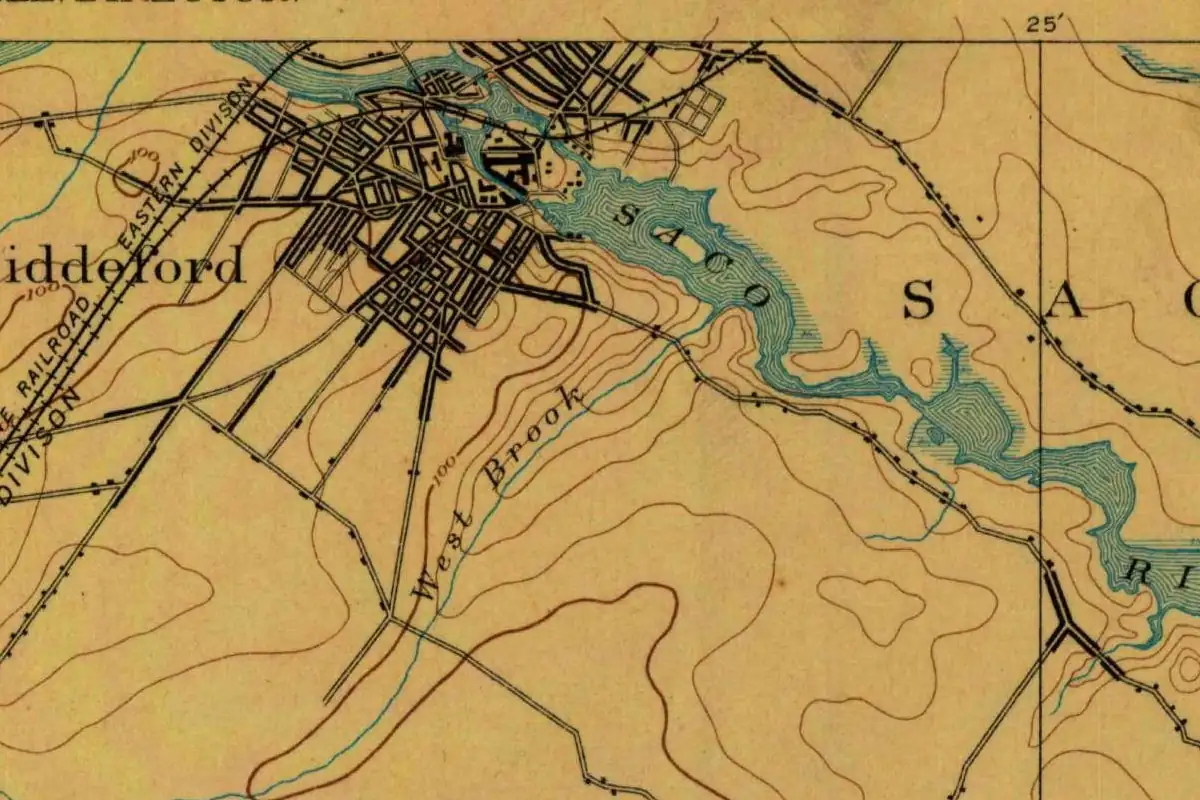
For 43 years, Saco, Maine, was officially Pepperrellborough. In 1805 the town went back to Saco, the name of its river, which had come from a Native word and, as the town’s 1830 historian put it, had “never been out of popular use.”
Saco before Saco was a town
The name is older than the town. George Folsom, who published a history of Saco and Biddeford in 1830, says that in the 1630s “Saco” covered the settlements on both sides of the river. A 1635 agreement he quotes names “Peyton Cooke of Saco, Gent.” and “Mr. Richard Williams likewise of Saco.”
Later the whole area became the town of Biddeford, on both banks. George J. Varney’s 1881 gazetteer of Maine gives 1719 for that.
Enter Pepperrellborough
By 1762 the people on the east side of the river wanted their own government. That June, Folsom says, the lawmakers set off “all the lands in the Town of Biddeford lying on the East side of Saco River,” plus Indian Island, as a separate district “by the name of Pepperrellborough.” It got the powers of a town except one: it couldn’t send its own representative to the General Assembly.
The name honored “Sir William Pepperell, then recently deceased, who had been a large proprietor,” according to Varney. You’ll see it spelled two ways in the old books: Folsom writes Pepperrellborough with a double r, Varney Pepperellborough with one.
Back to Saco
The new name never really caught on. “The name of Pepperrellborough was retained by the town until 1805,” Folsom writes, “when the old and more convenient designation, Saco, was substituted, on the petition of the town, by an act of the Legislature. This name had, indeed, never been out of popular use.”
That’s the whole story of the switch, and it’s a tidy one. The town asked, the Legislature agreed, and the river name came back. Saco became a city in 1867, Varney says.
What “Saco” means
Here’s where it gets less tidy. Everyone agrees the name is Native, but not on what it means, and none of the old books we used names the exact language.
- “Pouring out.” Henry Gannett’s government place-names book, first published in 1902 and revised in 1905, says Saco comes “from an Indian word, sohk or sank, ‘pouring out;’ hence the outlet or discharge of a river or lake.” The U.S. Geological Survey’s own record for the city repeats the same line, so it’s one source, not two.
- “The outlet.” R. A. Douglas-Lithgow’s 1909 dictionary of New England’s Native place names says, for Saco Bay, that it “may mean ‘the outlet,’ or ‘outflow’” and “literally ‘a pouring out.’” For the river’s New Hampshire stretch, he credits the scholar J. Hammond Trumbull with “Outlet.”
- “From the south side.” Douglas-Lithgow also lists another reading for the river, “From the south side,” credited to J. G. Crawford.
- A tribe’s name. Douglas-Lithgow says the town’s name was “Derived from Shawakatoc, or Shawocotuck, a tribe residing there.”
He also collects old spellings of the river from early writers: Sawocotuck, Sawahquatook, Sawguatock. The hedging, like “may mean,” is his. So if you’re keeping score, “outlet” or “pouring out” has the most backing, but nobody in these books claims the last word.
The river is still where it was. Varney noted in 1881 that it “separates the city from Biddeford,” which is pretty much where this story started: a river name that both banks once shared.
Sources & further reading
- George Folsom, History of Saco and Biddeford (Saco, 1830). “The name of Saco was used at that period to include the settlements on both sides of the river,” and the 1635 agreement naming “Peyton Cooke of Saco” (pp. 32-33); the June 1762 act creating “a separate and distinct District by the name of Pepperrellborough” (p. 266); “The name of Pepperrellborough was retained by the town until 1805,” “the old and more convenient designation, Saco,” “never been out of popular use” (p. 267).
- George J. Varney, A Gazetteer of the State of Maine (Boston, 1881), pp. 486-487. Biddeford incorporated in 1719; Pepperellborough named “in honor of Sir William Pepperell, then recently deceased, who had been a large proprietor”; changed to Saco in 1805; a city in 1867; “The name, Saco, is of Indian origin”; the river “separates the city from Biddeford.”
- Henry Gannett, The Origin of Certain Place Names in the United States (USGS Bulletin 197, 1902), p. 227, and 2nd ed. (USGS Bulletin 258, 1905), p. 269. “Derived from an Indian word, sohk or sank, ‘pouring out;’ hence the outlet or discharge of a river or lake.” The 1905 scan’s text reads “sohh,” most likely a scanning error for the 1902 “sohk.”
- R. A. Douglas-Lithgow, Dictionary of American-Indian Place and Proper Names in New England (Salem, 1909), pp. 51-54, 79. Saco “Derived from Shawakatoc, or Shawocotuck, a tribe residing there”; Saco Bay “may mean ‘the outlet,’ or ‘outflow’”; the Saco River in New Hampshire, “From the south side” (J. G. Crawford) and “Outlet” (J. H. Trumbull); the old spellings Sawocotuck, Sawahquatook and Sawguatock.
- GNIS feature 574646 (U.S. Geological Survey). The federal record, with the same “pouring out” wording as Gannett.
Spot something wrong, or know more? Tell us here. You can also email us or use our contact page. Corrections are noted here with their date, never made silently.