Portland, Maine: The Name That Beat Casco and Falmouthport
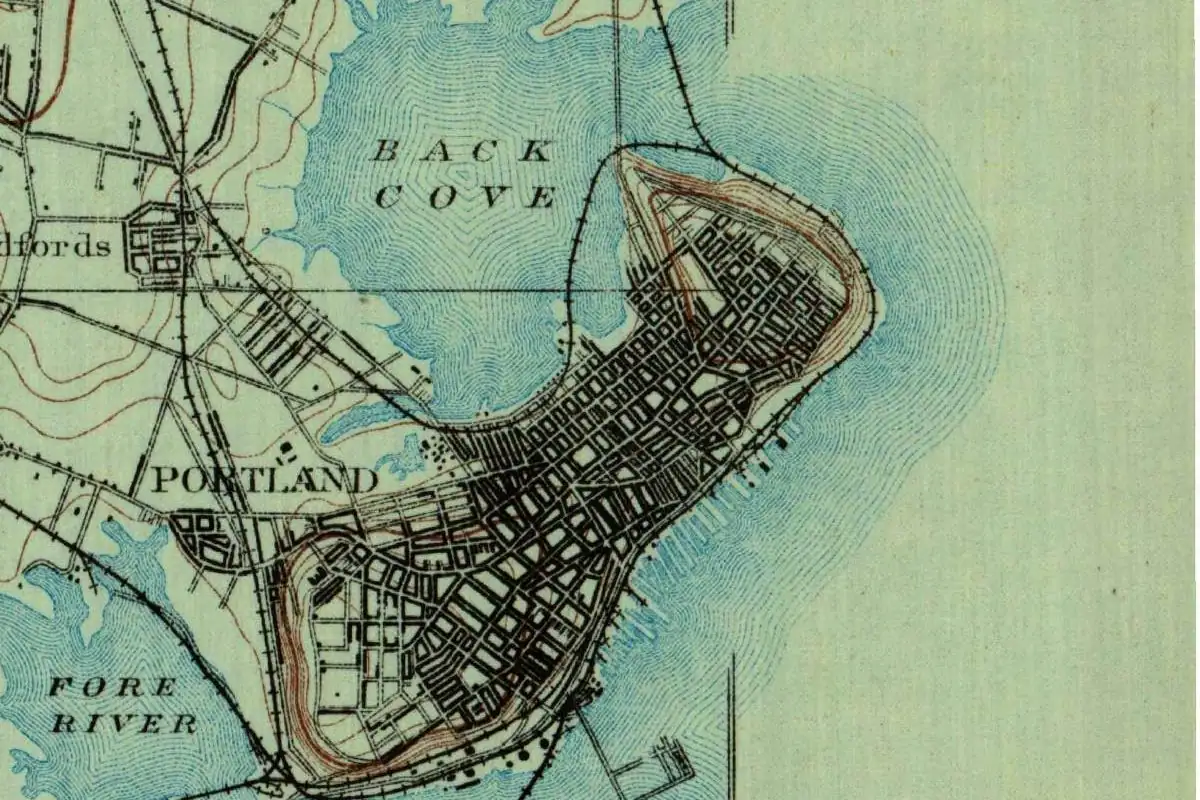
When Portland, Maine, split off from the town of Falmouth in 1786, it could just as easily have been called Casco or Falmouthport. It took Portland instead, an old English name already attached to the headland and channel at the mouth of its harbor.
The Neck of Falmouth
For more than a century, the city was just “the Neck,” one part of a town called Falmouth. That name dates to 1658, when the settlements around Casco Bay came under Massachusetts. William Willis, whose History of Portland came out in a second edition in 1865, quotes the terms: the places “formerly called Spurwink and Casco bay” would “henceforth” be “called by the name of Falmouth.”
Then came the Revolution. In October 1775, British warships under Captain Mowatt shelled the Neck and set it on fire. The flames, Willis writes, “involved all the thickest part of the settlement in one common ruin,” and he counts 136 dwelling houses burned. In 1783 a Falmouth town meeting agreed, without opposition, to let the Neck become a separate town, and on July 4, 1786, the legislature passed “An act for erecting that part of the town of Falmouth commonly called the Neck, into a town by the name of Portland.”
Casco vs. Falmouthport
Getting to that name took an argument. “Casco and Falmouthport were rivals of the successful candidate,” Willis writes, “and the claims of each were strenuously urged.”
Casco had history and a nice sound on its side. Falmouthport had familiarity: people far away already knew Falmouth, so a new name could cause “misapprehension and mistake.” Its backers held up Newburyport as an example.
Casco also had a problem. Opponents said its meaning in English was “indelicate or offensive.” Others said it meant “something pleasant or agreeable.” Willis adds that Capt. John Preble, who had lived at Penobscot and served as an interpreter, said Casco meant “a Heron,” because so many of those birds came to the bay. R. A. Douglas-Lithgow’s 1909 dictionary of New England’s Native place names gives yet another reading, “Goes round, like a collar,” and also says it may come from Aucocisco, “a resting place” or “a crane.” So you’ve got at least four meanings and no agreement, and Willis’s footnote shows the meaning itself had become part of the fight.
Why Portland won
As it turns out, nobody even campaigned for Portland in the newspaper. “Not a voice in the public paper was lifted up in its support,” Willis says. One letter writer, after weighing the other two, simply predicted that both “must give place to the more acceptable name of Portland.”
Willis gives three reasons it won: “its local application, its euphonious sound, and its ancient connection with a part of our territory.” That connection was old. In the earliest English name for the area, the island now called Bangs’, and the land opposite it in Cape Elizabeth, were both called Portland, and the main channel between them was “Portland Sound.” The headland where the lighthouse stands was “Portland head,” and it still is. The people of Cape Elizabeth had wanted Portland for their own town, Willis says, but the government named them after the cape instead.
Where did that first Portland come from? Henry Gannett’s 1905 U.S. Geological Survey book only says the city was “named, indirectly, from the town in England.”
A Portland on the other coast
The name kept traveling. Gannett’s same book says Portland, Oregon, got its name from “the toss of a copper by two settlers, one from Portland, Maine, and the other from Boston.” You can read how that coin toss went. So a name that started on a headland in Casco Bay ended up, by way of a coin, on the far side of the continent.
Sources & further reading
- William Willis, The History of Portland, from 1632 to 1864, 2nd ed. (Portland, 1865). The 1658 terms naming Falmouth (pp. 89-90); Mowatt’s attack in October 1775, “one common ruin” and the 136 houses burned (pp. 518-521); the 1783 vote and the act of July 4, 1786 (p. 580); Casco, Falmouthport and Portland; “not a voice in the public paper”; Portland island, Portland Sound and “Portland head”; Preble’s “a Heron” (pp. 580-581).
- Henry Gannett, The Origin of Certain Place Names in the United States, 2nd ed. (USGS Bulletin 258, 1905), p. 251. Portland, Maine, “named, indirectly, from the town in England”; Portland, Oregon, named by “the toss of a copper.”
- R. A. Douglas-Lithgow, Dictionary of American-Indian Place and Proper Names in New England (Salem, 1909), p. 10. Casco: “Goes round, like a collar,” or from Aucocisco, “a resting place,” or “a crane.”
- GNIS feature 573692 (U.S. Geological Survey). The federal record for the city of Portland.
Spot something wrong, or know more? Tell us here. You can also email us or use our contact page. Corrections are noted here with their date, never made silently.