Bangor, Maine: The City Named After a Hymn Tune
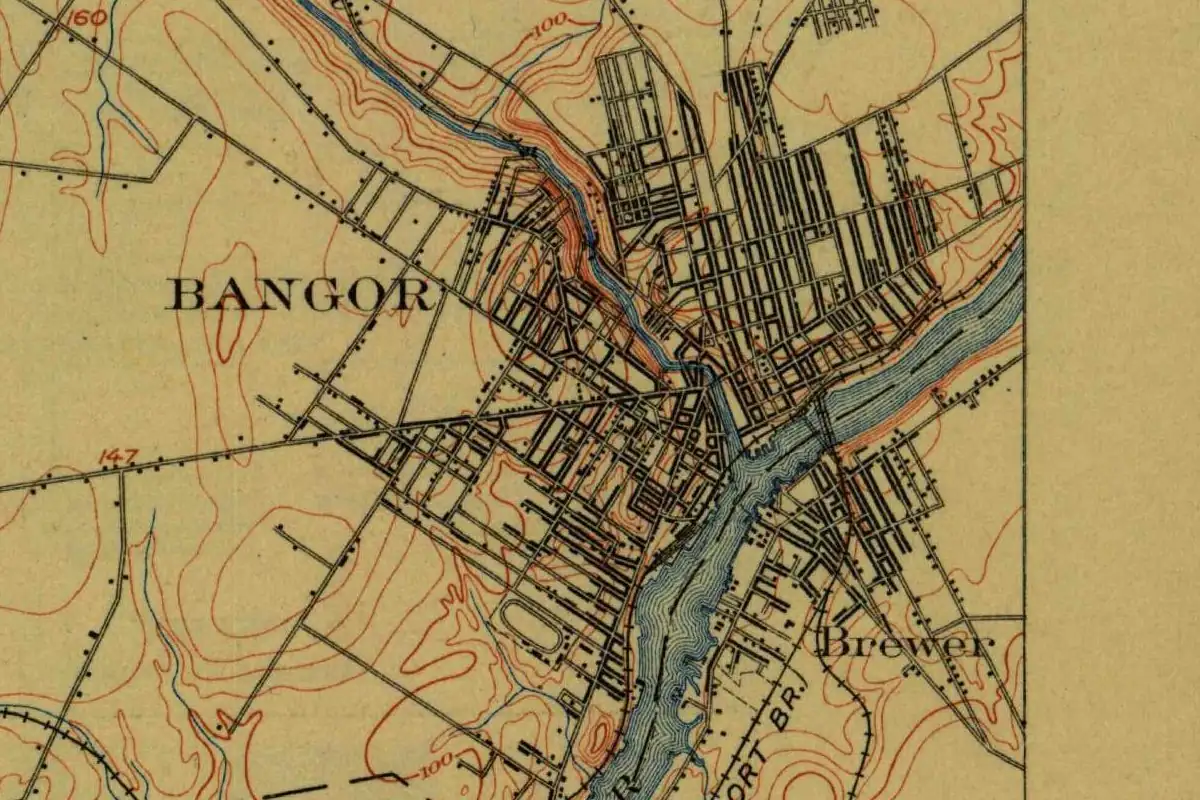
Bangor, Maine, was supposed to be called Sunbury. The minister sent to Boston for its town charter gave the name of his favorite hymn tune instead, and in 1791 that tune’s name, Bangor, went into the law.
Kenduskeag, then Sunbury
The settlement on the Penobscot went through a few names first. George J. Varney’s Gazetteer of the State of Maine (1881) lists Kenderquit, Condeskeag and Kenduskeag, and says that in 1769 it was “Kenduskeag Plantation.” The federal place-names database gives slightly different dates, but the same order: Kenduskeag Plantation, then Sunbury, then Bangor.
Sunbury was a sunny name on purpose. Varney says the settlers chose it “as being descriptive of the attractive appearance of the place.” A county history from 1882 credits the minister himself, “the aesthetic Parson Noble,” with coming up with it for “the sunny banks of their river.”
Parson Noble’s favorite tune
The Rev. Seth Noble was the man the settlers trusted to go to the General Court in Boston and get the place made a town. He was also a singer. When Bangor celebrated 100 years of settlement in 1869, the orator of the day, John E. Godfrey, put it this way: “Mr. Noble was an excellent singer, and the solid old minor tune of Bangor was a favorite with him.”
The 1882 county history even gives you the words people sang to it, a hymn that calls on the living to come and look at the ground where they’ll soon lie. Not exactly a sunny hymn. The tune, the history says, “so haunted his imagination” that Noble decided it made a better name than Sunbury, and he put it in. The act incorporating Bangor passed on February 25, 1791.
Accident, or a plan?
All the old accounts agree on the tune. They don’t agree on how the switch happened. Varney tells it as a moment on the spot: “when the speaker called for the name of his town, Mr. Noble replied, ‘Bangor,’” and “this accidently or otherwise became the name of the town.” Godfrey makes it sound more deliberate: “It occurred to him that that name for the town would be more satisfactory than Sunbury, and it was inserted in the charter.”
Keep in mind when these were written. Godfrey spoke in 1869, almost 80 years after the charter, and he called it a story that “is familiar.” The U.S. Geological Survey’s file hedges a little too, saying the town was named “supposedly in honor of the minister’s favorite hymn tune.” Henry Gannett’s 1905 federal place-names book doesn’t hedge at all: named by Noble “from an old psalm tune.”
Did anyone back home mind? The county history says “it has never been hinted that his constituents were dissatisfied with his conduct.” Godfrey’s version is shorter: “He was not disappointed.”
The story in rhyme
By 1849 the tale was well enough known that Bangor told it in verse. When the city rededicated its old city hall that year, one citizen offered a long comic rhyme, later printed in the centennial book. In it, the parson jogs along toward the General Court, “now whistling and now humming” old psalm tunes, and you can guess the rest:
Then Sunbury he scouted, and, Filled with the solemn clangor Of the old tune most dear to him, Said, “Let the name be Bangor.”
It’s a joke poem, not a record. But it shows that less than 60 years after the charter, people in Bangor already knew their town had been named by a man humming on the road, or at least that’s how they liked to tell it.
Sources & further reading
- George J. Varney, A Gazetteer of the State of Maine (Boston, 1881), pp. 97-98. The early names, “Kenduskeag Plantation” in 1769, Sunbury chosen “as being descriptive of the attractive appearance of the place,” and Noble’s reply, “Bangor,” “which was the name of his favorite tune,” “accidently or otherwise.”
- The Centennial Celebration of the Settlement of Bangor (Bangor, 1870). John E. Godfrey’s address (p. 43): “the solid old minor tune of Bangor was a favorite with him”; “it was inserted in the charter. He was not disappointed.” The “Rhyme of the Ancient City Hall,” from the 1849 rededication (pp. 162-166), with the stanza quoted above.
- History of Penobscot County, Maine (Cleveland: Williams, Chase & Co., 1882), p. 539. “The aesthetic Parson Noble,” the words of the hymn sung to the tune, the substitution of the name and the act of February 25, 1791.
- Henry Gannett, The Origin of Certain Place Names in the United States, 2nd ed. (USGS Bulletin 258, 1905), p. 36. “Named by the Rev. Seth Noble, its representative in legislature, from an old psalm tune.”
- GNIS feature 561558 (U.S. Geological Survey). The federal record: Kenduskeag Plantation from 1776 to 1787, then Sunbury until 1791, “supposedly in honor of the minister’s favorite hymn tune.”
Spot something wrong, or know more? Tell us here. You can also email us or use our contact page. Corrections are noted here with their date, never made silently.