Augusta, Maine: Why the Capital Ditched 'Harrington'
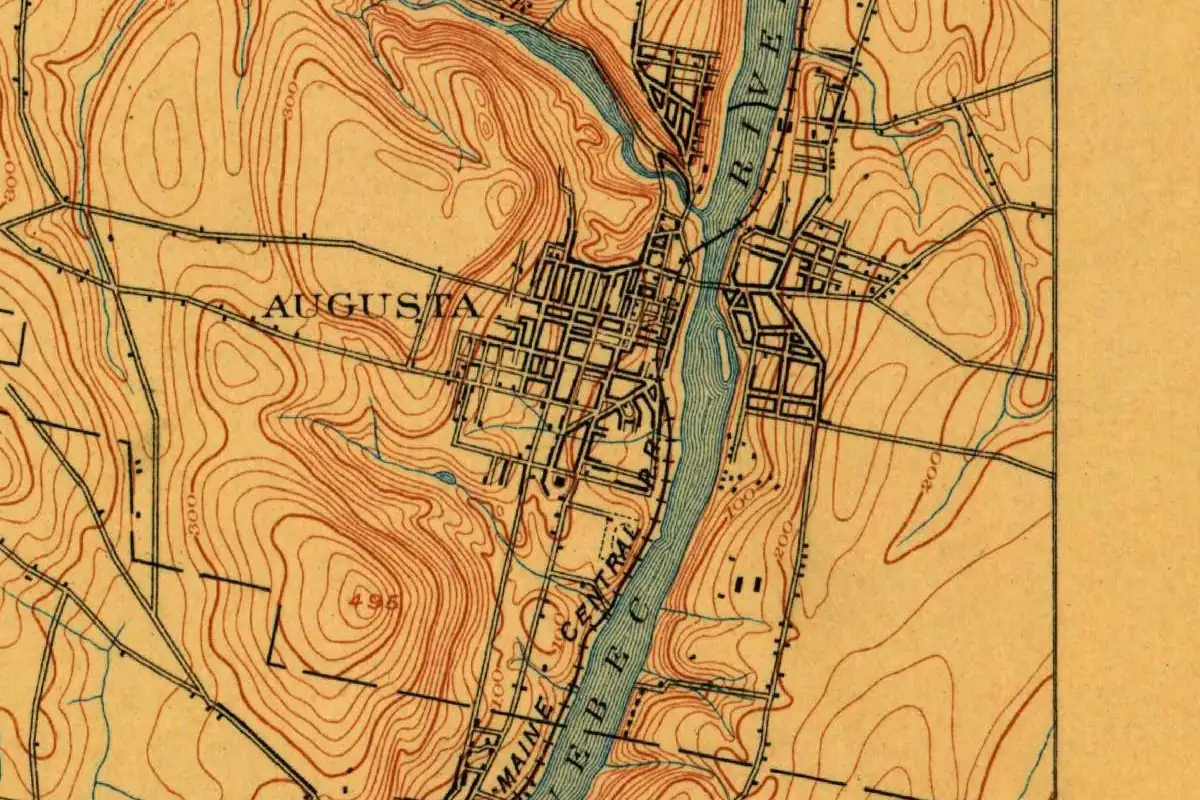
Augusta, Maine, was born Harrington in 1797. Within months the town asked the legislature for a new name, Augusta, and its petition never said why, which is how Maine ended up with a capital whose namesake nobody can pin down.
Carved out of Hallowell
The spot had an older name. Back in the 1600s, the Plymouth colony ran a trading house here at a place called Cushnoc, “now Augusta,” as George J. Varney’s 1881 gazetteer puts it. Later the area belonged to the town of Hallowell.
Then Hallowell split. On February 20, 1797, according to James W. North’s History of Augusta (1870), the legislature divided the town and made its middle and north parishes into a new town called Harrington. North says the name was picked by Amos Stoddard, then the town’s representative, “in honor of Lord Harrington a distinguished English patriot.”
“For many reasons”
The new town didn’t like it. “This name was not agreeable to the town, and immediate measures were taken to change it,” North writes. The selectmen sent a petition saying “that for many reasons which operate in the minds of your petitioners they are desirous that the name of Harrington may be changed for the name of Augusta.”
And that’s all you get. They skipped “a lengthy detail of reasons” and trusted that the favor “will be readily granted.” It was. On June 9, 1797, Harrington became Augusta.
Herring-town
Why drop Harrington so fast? Kennebec County’s 1892 history, edited by Henry D. Kingsbury and Simeon L. Deyo, admits the reason “has never been given to the public” and “is not even hinted in the records.” Then it offers a guess. The rapids at Cushnoc were a busy place for catching migrating fish, and “the wits of disgruntled Hallowell” twisted Harrington into “Herring-town.” That joke, the book says, “seems to have led” the town fathers to look for a name that was harder to make fun of.
It’s a good story, and it may well be true. But notice the word “seems.” It’s the county history’s best explanation, not something written down in 1797.
So who was Augusta?
Here the sources split three ways.
A princess. Henry Gannett’s 1905 U.S. Geological Survey book says Augusta, Maine, and Augusta County, Virginia, were both “named for Augusta of Saxe-Gotha, wife of Frederick, Prince of Wales.” He doesn’t say where he got that.
A lost town. The 1892 county history points somewhere else. Around 1716, the Pejepscot Company started a settlement at Small Point, now in Phippsburg, and called it Augusta. Indians destroyed it in 1722. The book calls it “more than probable” that this lost town suggested the name. In the same paragraph, though, it admits that why Augusta was chosen “does not clearly appear and is not certainly known.”
A general’s daughter. The version you’ll find in modern references, Encyclopaedia Britannica among them, is Pamela Augusta Dearborn, daughter of Henry Dearborn. A Portland Press Herald article on the question repeats it while noting that the accounts have differed over the years. Dearborn was no stranger here. North mentions him commanding a company on Benedict Arnold’s 1775 expedition, “afterwards Secretary of War,” and just before the split he got 208 votes in Hallowell when the town voted for Congress. But neither North, nor Kingsbury and Deyo, nor Gannett mentions his daughter at all. We could only see search-engine excerpts of the modern articles, not the pages themselves, so we can’t tell you what records they rely on.
What the record does say
So the name is disputed, and it may stay that way unless someone turns up a letter from 1797. What’s solid is the paper trail North and the county history quote: a name handed down from the legislature, a town that wanted out of it right away, and a petition that told lawmakers almost nothing. Augusta became the state capital in 1828, and to this day the reason behind its name sits in the “many reasons” those selectmen chose not to write down.
Sources & further reading
- James W. North, The History of Augusta (Augusta, 1870), pp. 125, 277-278, 301. The division of Hallowell on February 20, 1797, and the change to Augusta “on the ninth of the following June” (p. 278); Dearborn’s 208 votes (pp. 277-278); Captain Henry Dearborn, “afterwards Secretary of War,” on Arnold’s expedition (p. 125); Stoddard naming Harrington for “Lord Harrington a distinguished English patriot,” “This name was not agreeable to the town,” and the selectmen’s petition (p. 301).
- Henry D. Kingsbury and Simeon L. Deyo, eds., Illustrated History of Kennebec County, Maine (1892), vol. 1, p. 406. The reason “is not even hinted in the records”; “Herring-town”; the Pejepscot Company’s Augusta at Small Point (about 1716 to 1722); “more than probable”; “is not certainly known.”
- Henry Gannett, The Origin of Certain Place Names in the United States, 2nd ed. (USGS Bulletin 258, 1905), p. 33. “Named for Augusta of Saxe-Gotha, wife of Frederick, Prince of Wales.”
- George J. Varney, A Gazetteer of the State of Maine (1881), p. 91. The trading house at Cushnoc, “now Augusta”; Harrington and the change to Augusta in 1797; capital of the state in 1828.
- Encyclopaedia Britannica, “Augusta, Maine.” The Pamela Augusta Dearborn version. Seen only through search-engine excerpts.
- Portland Press Herald, on the origin of Augusta’s name. Says the accounts have varied, including the “Herring Town” jibe and the Dearborn story. Seen only through search-engine excerpts.
- GNIS feature 581636 (U.S. Geological Survey). The federal record: state capital in 1828, incorporated as a city in 1849.
Spot something wrong, or know more? Tell us here. You can also email us or use our contact page. Corrections are noted here with their date, never made silently.