Cherokee, North Carolina: From Yellow Hill to Cherokee
Cherokee, North Carolina, got its name from the Cherokee people when its post office opened in 1882, and before that the spot was called Yellow Hill. What the word Cherokee means is a harder question. James Mooney, the ethnologist who spent years collecting Cherokee words and stories, said it means nothing at all in Cherokee, and the experts who tried to trace it elsewhere never agreed.
Yellow Hill, or “Red earth”
The town sits on the Oconaluftee River, on the Qualla Boundary, which The North Carolina Gazetteer describes as the home of the Eastern Band of Cherokee Indians. Mooney, who studied the Eastern Band for the Bureau of American Ethnology, wrote in 1900 that William Holland Thomas, acting as agent for the eastern Cherokee, laid off the lands bought for them into five districts, or “towns”: Bird town, Paint town, Wolf town, Yellow hill and Big cove. Mooney added that they still kept those names in his day.
He also gave the Cherokee names for the five, in the same order, and the fourth is the one to watch. Yellow hill’s Cherokee name, as Mooney wrote it, was E’lawâ’di, “Red earth,” and he noted that it was “now Cherokee post-office and agency.” So the same spot had an English name that said yellow and a Cherokee name that, in Mooney’s translation, said red. Elsewhere in the same book, he places a peak “about 2 miles northeast of Cherokee or Yellow Hill.” The federal place-names database still lists a Cherokee-language variant for the town, spelled Elawa diyi.
The post office of 1882
Yellow Hill became the center of things under Nimrod Jarrett Smith, principal chief of the Eastern Band from 1880 to 1891. The state’s historical marker program, in its write-up on Smith, says he moved to a farm he called “Yellow Hill,” in the Yellow Hill community, and centralized tribal government there. A location near his house was picked as the base for “the first official United States Agent to the EBCI in 1882.”
That same year, a post office named Cherokee opened. The North Carolina Postal History Society’s catalog for Swain County lists John M. Enloe as its first postmaster, appointed July 25, 1882. The catalog doesn’t say who chose the name. By 1892, a federal census report on the Eastern Band could describe the agency and the training school as “at Cherokee, formerly known as Yellow hill.”
Henry Gannett’s place-name books for the U.S. Geological Survey list the “village in Swain County, North Carolina” among some twenty places across the country “named for an Indian tribe.” Yellow Hill didn’t vanish, either. The North Carolina Gazetteer lists Yellow Hill Town among the five townships of the Qualla Boundary, along with Big Cove, Wolf Town, Paint Town and Bird Town, and calls Cherokee “the governmental and spiritual center of the Eastern Band of Cherokee Indians.”
What does “Cherokee” mean?
Here’s where the sources split. Mooney started from the language itself: “Cherokee, the name by which they are commonly known, has no meaning in their own language, and seems to be of foreign origin.” Among themselves, he wrote, the form is Tsa’lagi’ or Tsa’ragi’. Their own name for themselves, he said, was Ani’-Yun’wiya’, “real people” or “principal people.”
He traced the outside name back to Chalaque in a Portuguese account of De Soto’s expedition published in 1557, Cheraqui in a French document of 1699, and Cherokee in English by 1708. Then the guesses begin.
The cave version
Mooney thought there was “evidence that it is derived from the Choctaw word choluk or chiluk, signifying a pit or cave,” passed along through the trade language used across the Gulf states. He pointed out that the Iroquois name for the Cherokee, as another ethnologist recorded it, meant “inhabitants of the cave country.” The Handbook of American Indians, in a 1907 entry signed with Mooney’s initials, sounds more cautious: the name “may be derived from the Choctaw chiluk-ki, ‘cave people.’”
The “different speech” version
The North Carolina Gazetteer, edited by William S. Powell, gives another answer for the town: “The name probably is from the Muskogee Indian word tciloki, meaning ‘people of a different speech.’” It doesn’t say who proposed it. Note the “probably.”
The fire version, and why Gannett dropped it
In 1902, Gannett’s first edition said the word came “from cheere, ‘fire,’” and was “said to be the name of their ‘lower heaven.’” Mooney had already rejected a fire connection two years earlier. He called James Adair’s attempt to tie the name to the Cherokee word for fire “an error founded upon imperfect knowledge of the language.” Gannett’s 1905 edition dropped the fire story and said simply, “The meaning is uncertain.”
That’s still the fairest summary. The town is named for the people, and nobody disputes that. The word itself came from outside the language, and you’ll find the cave and “different speech” explanations in print, each hedged with a “may” or a “probably.”
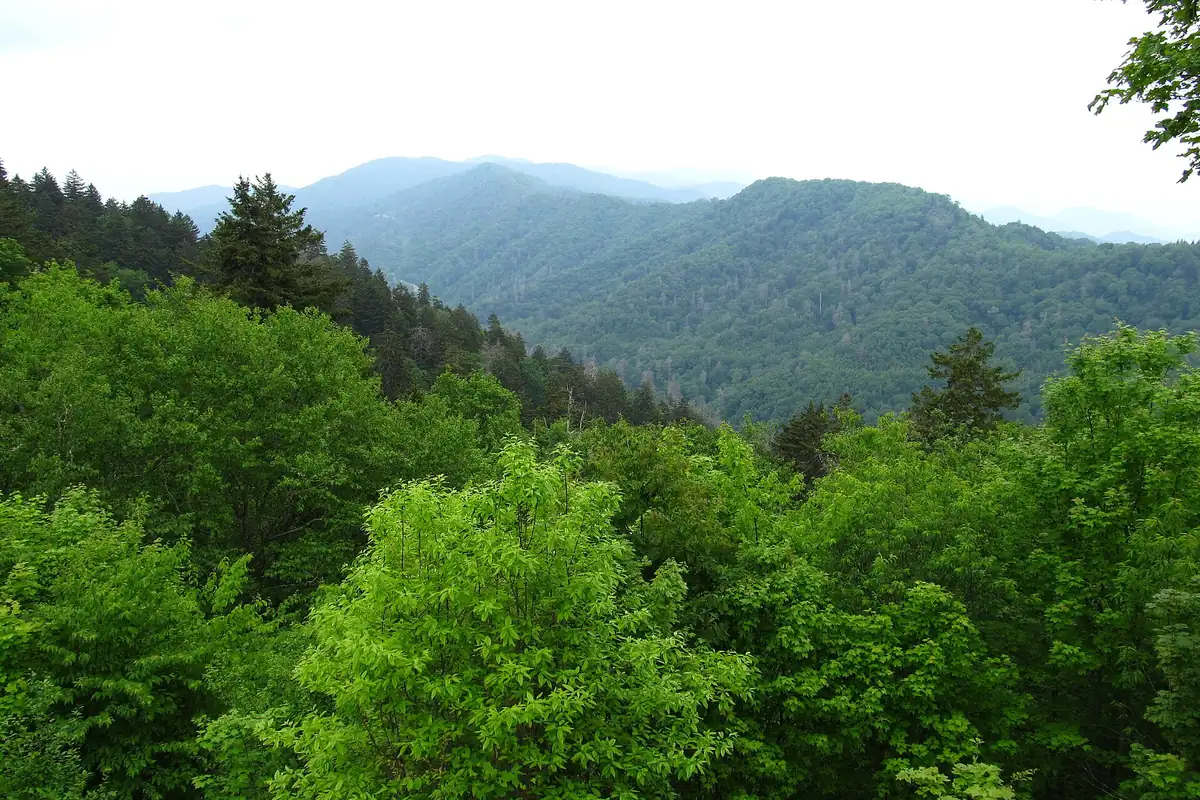
Gateway to the Smokies
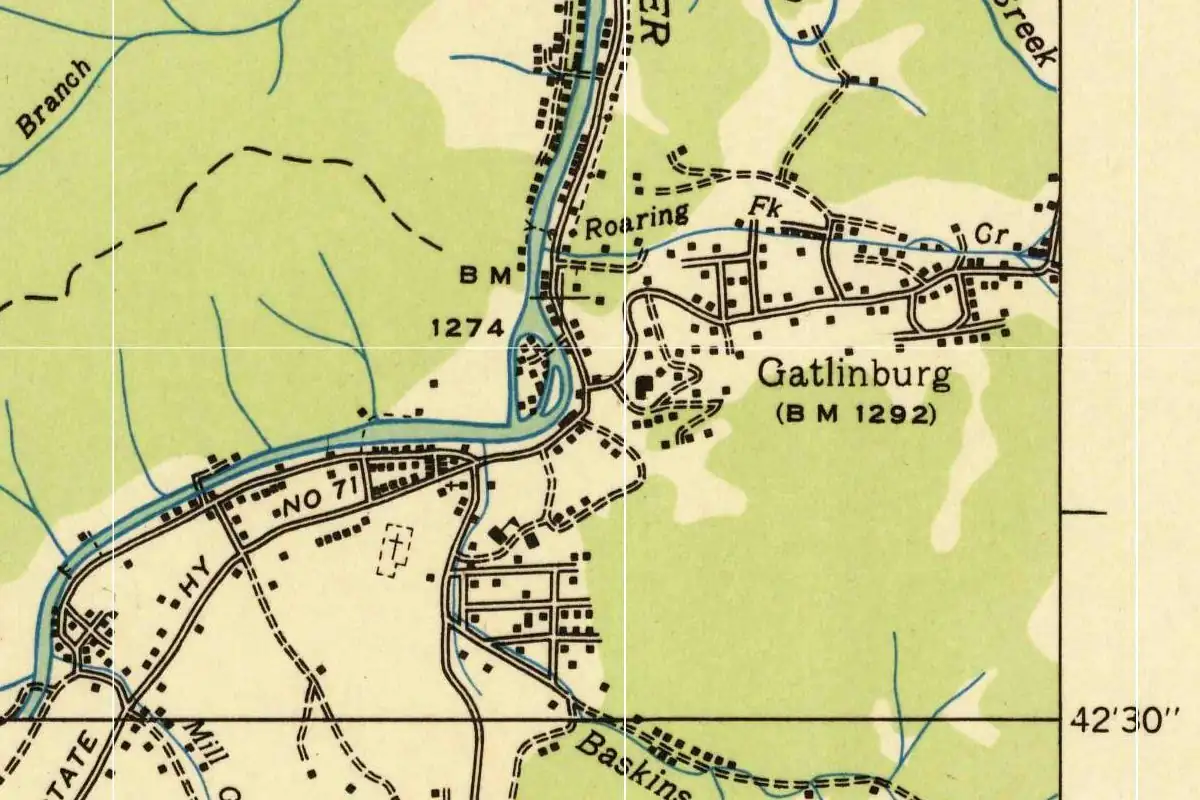
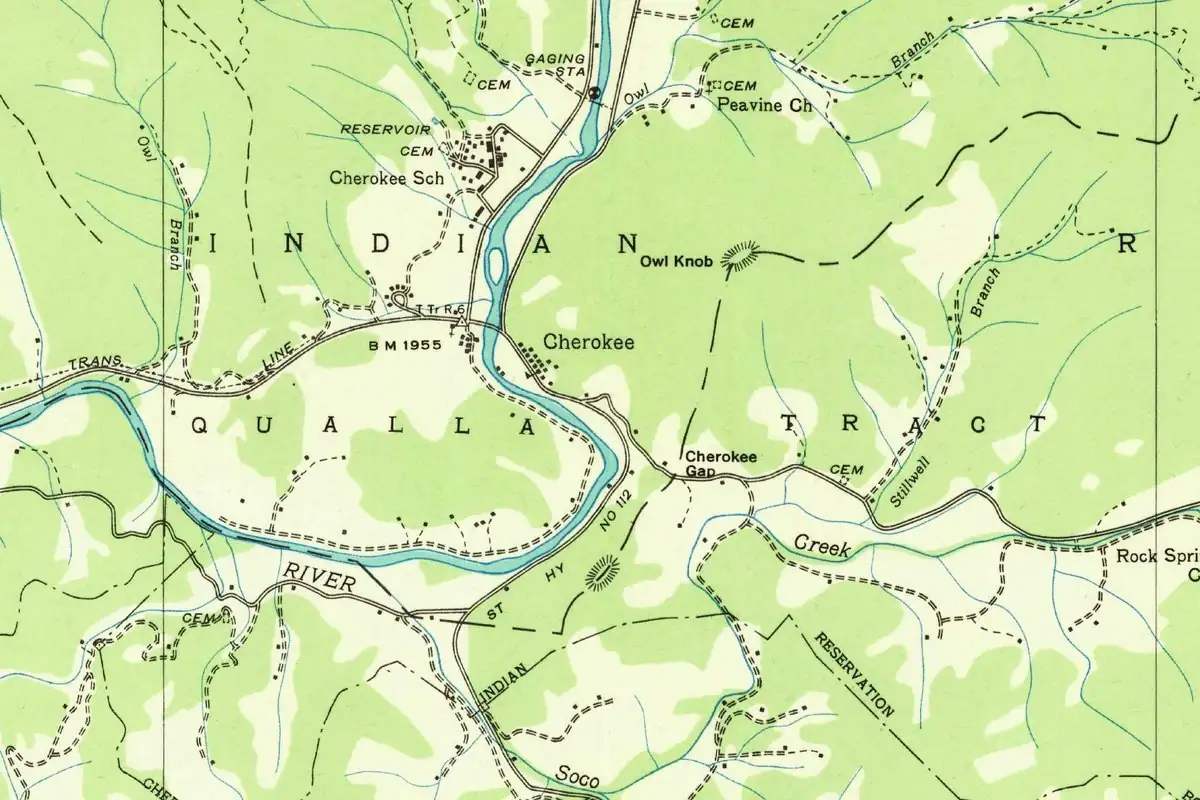
The first motor road over the Great Smoky Mountains opened in 1932 and ran from Cherokee to Gatlinburg, Tennessee, through Newfound Gap, according to the National Park Service’s historic resource study, which calls the two towns “the two main gateway communities for the park.” If you want to follow the thread, our story on Tennessee, just over the mountains, traces that state’s name to an old Cherokee town. North Carolina got its name a very different way. On the 1936 map at the top of this page, the little cluster labeled Cherokee sits right in the middle of the big letters that spell out the Qualla tract.
Quick answers
What does Cherokee mean?
No one knows for sure. James Mooney wrote in 1900 that the word “has no meaning in their own language” and probably came from outside it, perhaps from a Choctaw word for a pit or cave, while The North Carolina Gazetteer says it’s probably from a Muskogee word meaning “people of a different speech.”
What was Cherokee, NC called before?
Yellow Hill. An 1892 federal census report describes the agency and school “at Cherokee, formerly known as Yellow hill,” and Mooney recorded its Cherokee name as E’lawâ’di, “Red earth.”
When did Cherokee, NC get its name?
By 1882. The post office named Cherokee got its first postmaster, John M. Enloe, on July 25, 1882, according to the North Carolina Postal History Society’s Swain County catalog.
What do the Cherokee call themselves?
Ani’-Yun’wiya’, “real people” or “principal people,” is the proper name James Mooney recorded in 1900. Among themselves, he wrote, the name Cherokee takes the form Tsa’lagi’ or Tsa’ragi’. The tribe in Cherokee, North Carolina, is the Eastern Band of Cherokee Indians.
Key dates
- 1882The Cherokee post office opens under John M. Enloe, and the first U.S. agent to the Eastern Band is based near Chief Smith's home.
- 1892A federal census report places the agency and school "at Cherokee, formerly known as Yellow hill."
- 1900James Mooney records the Cherokee name E'lawâ'di, "Red earth," for the place, "now Cherokee post-office and agency."
- 1902Henry Gannett's USGS book says the word Cherokee comes from a word for fire.
- 1905Gannett's second edition drops the fire story and says the meaning is uncertain.
Getting there
The closest airports, Amtrak stations and intercity bus stops, measured in a straight line from the center of Cherokee.
Airports
- Asheville Regional (AVL) 44 mi 70 km
- McGhee Tyson (TYS) Alcoa 45 mi 72 km
- Charlotte/Douglas International (CLT) 134 mi 216 km
Amtrak trains
- Clemson station (CSN) 61 mi 98 km
- Toccoa station (TCA) 62 mi 100 km
Intercity buses
- Greyhound Asheville Asheland Ave 43 mi 70 km
- Sunway Charters Asheville 43 mi 70 km
Distances are as the crow flies, not by road. We don't list schedules or fares because they change; check with the airline, Amtrak or the bus company before you go. Official data (FAA commercial service airports (2025), FAA airport locations, Amtrak stations and Intercity Bus Atlas) from the FAA and the U.S. Bureau of Transportation Statistics, checked Nov 1, 2026.
Historical Sources & References
- James Mooney, Myths of the Cherokee (Bureau of American Ethnology, 1900). The name Cherokee “has no meaning in their own language”; Tsa’lagi’, Ani’-Yun’wiya’, the early spellings and the Choctaw “pit or cave” theory, and Adair’s fire link as “an error” (pp. 15-16); Thomas’s five towns, with Yellow hill’s Cherokee name E’lawâ’di, “Red earth,” “now Cherokee post-office and agency” (p. 161); “Cherokee or Yellow Hill” (p. 404).
- Frederick Webb Hodge, ed., Handbook of American Indians North of Mexico, part 1 (BAE, 1907), pp. 245-248. Mooney’s signed entry (quote on p. 245): the name “may be derived from the Choctaw chiluk-ki, ‘cave people.’”
- Henry Gannett, The Origin of Certain Place Names in the United States (USGS, 1902), p. 70. The Swain County village among places “named for an Indian tribe,” and the word “derived from cheere, ‘fire.’”
- Henry Gannett, The Origin of Certain Place Names in the United States, 2nd ed. (USGS, 1905), p. 78. The same list, now ending “The meaning is uncertain.”
- William S. Powell, ed., The North Carolina Gazetteer, “Cherokee” (NCpedia). Cherokee as “the governmental and spiritual center of the Eastern Band of Cherokee Indians” and the Muskogee “tciloki” explanation. Also online: its “Qualla Boundary” entry, listing Yellow Hill Town among the five townships.
- Donaldson and Carrington, Eastern Band of Cherokees of North Carolina, Extra Census Bulletin (1892), p. 12. The agency and training school “at Cherokee, formerly known as Yellow hill.”
- R. F. Winter, North Carolina Postmark Catalog: Swain County (NC Postal History Society, 2023). The Cherokee post office and its postmasters, starting with John M. Enloe on July 25, 1882.
- NC Department of Natural and Cultural Resources, “Nimrod Jarrett Smith 1837-1893 (Q-58)” (2024). Smith as principal chief, 1880-1891; his farm “Yellow Hill” in the Yellow Hill community; the first U.S. agent to the EBCI based near his home in 1882.
- Robert W. Blythe and others, Great Smoky Mountains National Park Historic Resource Study, vol. 1 (NPS, 2016), pp. 72-73. The 1932 motor road between Gatlinburg and Cherokee via Newfound Gap, and the two towns as the park’s main gateway communities.
- GNIS feature 1019613, Cherokee (U.S. Geological Survey). The federal record and coordinates for Cherokee, in Swain County, with the variant name Elawa diyi.
Spot something wrong, or know more? Tell us here. You can also email us or use our contact page. Corrections are noted here with their date, never made silently.