Gatlinburg, Tennessee: Named for the Neighbor Who Left
Gatlinburg, Tennessee, carries the name of Radford Gatlin, a storekeeper who lived there only four or five years and left after a feud with his neighbors. Before he came, the place was White Oak Flats, and the town that took his name was settled by families he spent his last years there fighting in court.
White Oak Flats before Gatlin
The valley on the West Prong of the Little Pigeon River had people long before it had its current name. The National Park Service’s historic resource study for Great Smoky Mountains National Park says Gatlinburg “was established as the settlement of White Oak Flats about 1800,” and that settlers had come to the site around the mid-1790s. The Tennessee Encyclopedia puts it a little later, saying White Oak Flats was “settled by the Richard Reagan and Martha Ogle families ca. 1806.” Either way, the Ogles and their neighbors were there for half a century before Gatlin showed up.
None of the sources read for this article explains the name White Oak Flats itself, so it’s best not to guess. What you can say is that it hasn’t disappeared: the federal place-names database still lists White Oak Flats as a variant name for Gatlinburg, along with an old spelling with an h on the end, Gatlinburgh.
Radford Gatlin comes to the Flats
The most detailed account of Gatlin read for this article is a history by J. A. Sharp, built on the census, land grants and county court records, which the Sevier County library once posted online. A Jefferson County genealogy site keeps a transcription of it, and it says plainly that it couldn’t identify the original source or the transcriber, or tell whether the text is complete. So the details below are Sharp’s, as that copy passes them along. Sharp found Gatlin in the 1850 census as a “Merchant,” born in Georgia about 1798. He had trouble following him, too: Gatlin, he wrote, “was truly Sevier County’s will o’-the-wisp.”
In July 1854, Gatlin sold his farm on Tuckahoe Creek, and on September 2 of that year he bought 50 acres in White Oak Flats from Elisha Ogle for $30. His land ran along the river below the mouth of Roaring Fork, and he ran a store there. Two days later he entered a land claim for 5,000 acres that, as Sharp read the grant, swept across a much larger area, “all of the White Oak Flats country” included. Sharp thought that may be why his neighbors came to believe he meant to take their land.
How the post office got his name
The name came with the mail. The Tennessee Encyclopedia says Gatlinburg “was the name given to the post office in Radford Gatlin’s store in 1856.” Sharp cites a National Archives record of a post office at “Gatlinburg, Sevier County, Tennessee, on January 29, 1856.” He also passes along that the post office was said to be in Gatlin’s store and that Richard Reagan was the first postmaster, but he flags that part as something “it was said.”
The story that he was paid to leave
You may hear that the people of White Oak Flats told Gatlin they’d name the place for him if he’d just go away. Sharp didn’t buy it. He wrote that “the oft repeated story that the natives told Gatlin they would name the place for him if he would leave does not sound very logical,” and the dates are against it: the post office got its name in January 1856, a year before the road dispute and the feud with the Ogles began in January 1857. His explanation was simpler. Gatlin “was able to get his name perpetuated before the feuding started.”
A road, a fight and a burned barn
In Sharp’s reading of the county court records, the trouble seems to have started with a road. In January 1857 and again in April 1858, Gatlin got the county court to appoint juries to move the main road through the Flats along his own fields. On June 10, 1857, a fight broke out over cattle in the road, and both Gatlin and his wife, Elizabeth, were convicted of assault on Thomas Ogle Sr. and fined a dollar each. Gatlin appealed both cases to the Tennessee Supreme Court and lost. Then his barn and stables burned, and he swore out complaints against several Ogles that went nowhere.
Sharp couldn’t find the date Gatlin left, but by 1858 or 1859 “it must have been clear to him that his presence was unwanted.” His verdict on the name: “Perhaps a more appropriate name would have been ‘Ogleburg.’”
The heirs who came back for the land
Gatlin was gone, but his claim wasn’t. When land was being bought for the national park, H. W. Lix wrote in his 1958 park history, the court in Sevierville received 441 claims from people who said they were heirs of “Radford Gatlin - the man for whom Gatlinburg, Tennessee, was named,” and so owned Champion Fibre Company land. “Not one of them could sustain his claim,” Lix wrote, because none could prove descent from Gatlin. Sharp adds that the 1931 trial took ten days and ended with the judge instructing the jury to find for the company.
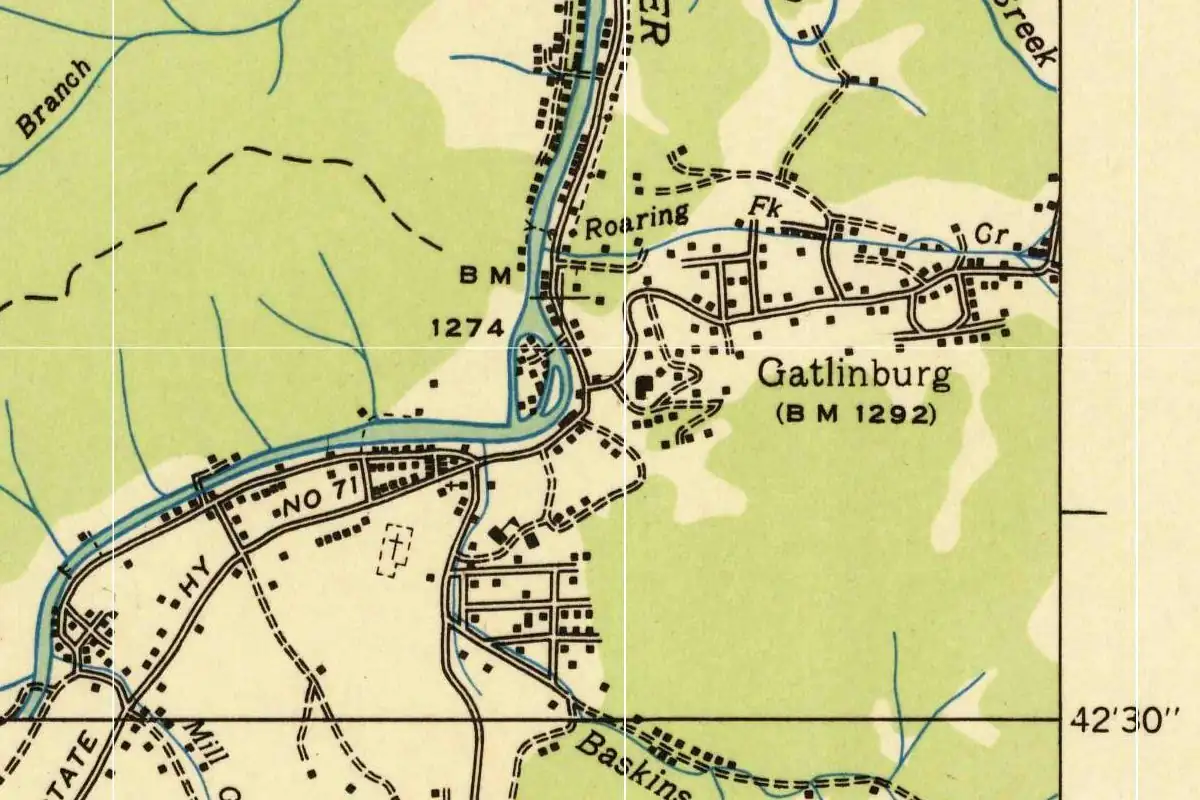
The town incorporated in 1945, according to the Tennessee Encyclopedia, and the park study calls it and Cherokee, North Carolina “the two main gateway communities” for the park in the Great Smoky Mountains. The 1936 map at the top of this page shows how small it still was then. So if you walk through Gatlinburg today, remember that the Ogles and Reagans settled it, and the name on every sign belongs to the Tennessee storekeeper they were, by Sharp’s account, glad to see leave.
Quick answers
Who is Gatlinburg named after?
Radford Gatlin, a storekeeper who bought land in White Oak Flats in 1854. The Tennessee Encyclopedia says Gatlinburg was the name given to the post office in his store in 1856.
What was Gatlinburg called before?
White Oak Flats. The National Park Service’s historic resource study says the town began as the settlement of White Oak Flats about 1800, and the federal place-names database still lists it as a variant name.
When was Gatlinburg founded?
There’s no single founding date. The park’s study dates the settlement of White Oak Flats to about 1800, while the Tennessee Encyclopedia says ca. 1806; the name Gatlinburg dates from the 1856 post office, and the town incorporated in 1945.
Did the town name itself after Gatlin to make him leave?
Probably not, according to J. A. Sharp, whose history of Gatlin is the most detailed account. He said the story “does not sound very logical,” because the post office was named Gatlinburg in January 1856, a year before Gatlin’s feud with the Ogles began.
Key dates
- 1854September 2: Radford Gatlin buys 50 acres in White Oak Flats from Elisha Ogle and sets up a store.
- 1856The post office takes the name Gatlinburg; J. A. Sharp cites a National Archives record dated January 29, 1856.
- 1857January: Gatlin asks the county court to move the road, and the feud with the Ogles begins that year.
- 1931People claiming to be Gatlin's heirs sue Champion Fibre for land in the old Gatlin grant and lose.
- 1945Gatlinburg is incorporated.
Getting there
The closest airports, Amtrak stations and intercity bus stops, measured in a straight line from the center of Gatlinburg.
Airports
- McGhee Tyson (TYS) Alcoa 28 mi 45 km
- Asheville Regional (AVL) 58 mi 93 km
- Charlotte/Douglas International (CLT) 148 mi 238 km
Amtrak trains
- Toccoa station (TCA) 79 mi 127 km
- Clemson station (CSN) 80 mi 129 km
Intercity buses
- Greyhound Knoxville Area Transit Bus Stop 28 mi 46 km
- Sunway Charters Asheville 54 mi 87 km
Distances are as the crow flies, not by road. We don't list schedules or fares because they change; check with the airline, Amtrak or the bus company before you go. Official data (FAA commercial service airports (2025), FAA airport locations, Amtrak stations and Intercity Bus Atlas) from the FAA and the U.S. Bureau of Transportation Statistics, checked Nov 1, 2026.
Historical Sources & References
- Beulah Duggan Linn, “Sevier County,” Tennessee Encyclopedia (Tennessee Historical Society, 2017; updated 2018). Gatlinburg, “originally the White Oak Flats community settled by the Richard Reagan and Martha Ogle families ca. 1806, was the name given to the post office in Radford Gatlin’s store in 1856”; incorporated in 1945.
- J. A. Sharp, “Radford Gatlin of Strawberry Plains and Gatlinburg” (Jefferson County TNGenWeb transcription, 2011). Gatlin’s arrival about 1854, the 1850 census, the Ogle deed and 5,000-acre grant, the National Archives date of January 29, 1856, for the Gatlinburg post office, the court cases with the Ogles, Sharp’s doubts about the “name it if he’d leave” story, and “Ogleburg.” The site says the original source and transcriber weren’t identified.
- H. W. Lix, Short History of the Great Smoky Mountains National Park (NPS, 1958), p. 66. The 441 claims by would-be heirs of “Radford Gatlin - the man for whom Gatlinburg, Tennessee, was named,” none of whom could prove descent.
- Robert W. Blythe and others, Great Smoky Mountains National Park Historic Resource Study, vol. 1 (NPS, 2016). Settlers at the site of Gatlinburg in the mid-1790s (p. 18); Gatlinburg “established as the settlement of White Oak Flats about 1800” (p. 22); Gatlinburg and Cherokee as the park’s two main gateway communities (p. 73).
- GNIS feature 1647737, Gatlinburg (U.S. Geological Survey). The federal record and coordinates for Gatlinburg, in Sevier County, with White Oak Flats and Gatlinburgh as variant names.
Spot something wrong, or know more? Tell us here. You can also email us or use our contact page. Corrections are noted here with their date, never made silently.