How Nome, Alaska Got Its Name: A Mapmaker's Question Mark?
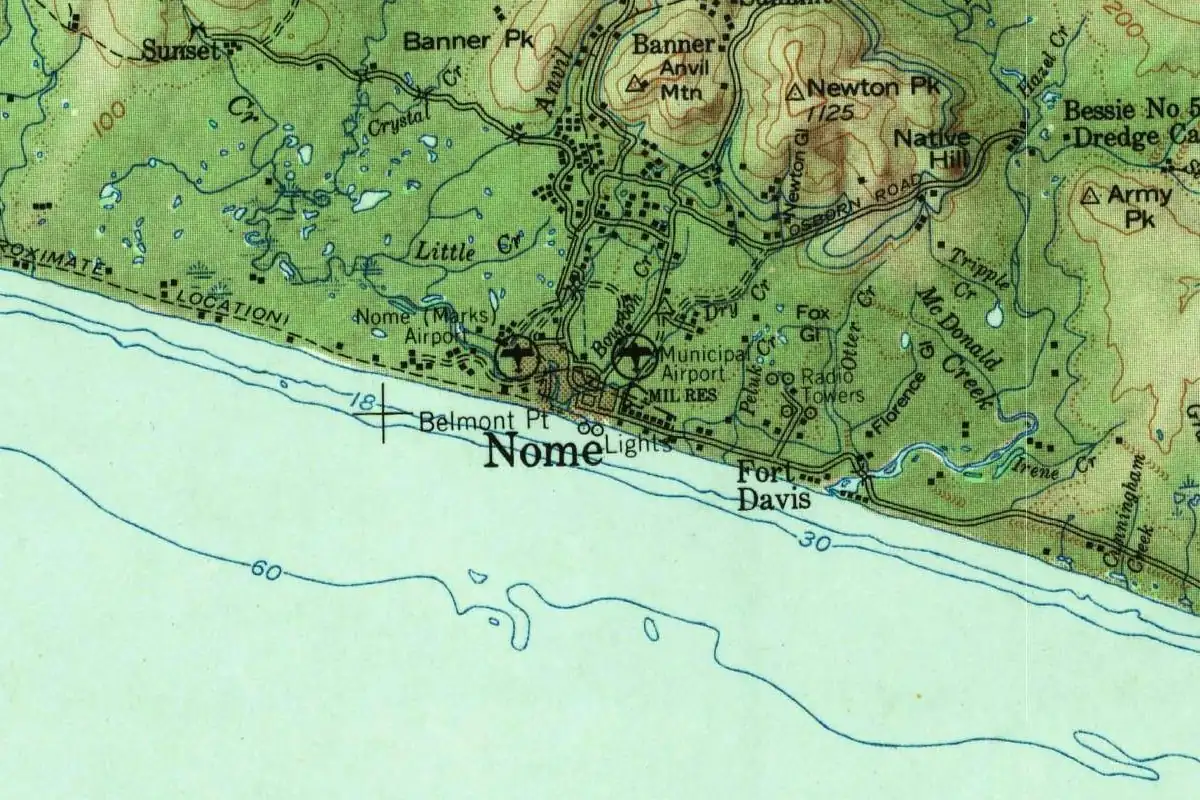
A mapmaker’s question mark may be the reason Nome, Alaska, is called Nome. The town took its name from nearby Cape Nome, and the cape’s name may come from a note that read “? name.” That’s the explanation the U.S. Geological Survey’s place-name dictionary gives, but a 1905 history of Nome had its doubts.
First it was Anvil City
The town didn’t start out as Nome. Gold turned up in the area in 1898, and on October 18 of that year a group of miners organized the Cape Nome mining district. The camp that grew up was called Anvil City, after Anvil Creek, where the first big gold was found.
That name didn’t last. Two USGS geologists, Schrader and Brooks, visited in October 1899 and wrote about the “thriving young city of Nome, first called Anvil City, now officially, Nome.” The post office had opened that June, and the town took the name of the cape about 12 miles down the coast, as Harrison’s 1905 book on the region puts it: “The town of Nome was named after the cape.”
So the real puzzle is the cape.
The question mark theory
Back in 1833, a Russian navy officer called the point Tolstoi, which means “blunt” or “broad.” The name Nome showed up later, on British Admiralty charts, after the ships that went looking for the lost Franklin expedition had been through.
Donald Orth’s 1967 Dictionary of Alaska Place Names, published by the USGS, says the name “is generally attributed to an Admiralty draftsman’s misinterpretation of ‘? name’” written on a hand-drawn chart made aboard H.M.S. Herald around 1850 to 1852. In other words, someone marked the cape as still needing a name. Orth explains the slip: “The ‘?’ mark was taken as a ‘C’ and the ‘a’ was thought to be an ‘o.’” Read that way, “? name” turns into “C. Nome,” or Cape Nome.
Marcus Baker’s 1906 Geographic Dictionary of Alaska traces the story to Professor George Davidson, who said the nameless cape bore a memo on the original sheet that the draftsman took for “C. Nome.”
The British weren’t so sure
Here’s the odd part. Baker also quotes the man in charge of those charts. In April 1901, Sir William Wharton, hydrographer to the British Admiralty, wrote that Cape Nome “first appears on our charts from an original” by Kellett in 1849. Then he added: “I suppose the town gets its name from the same source, but what that is we have nothing to show.”
Orth, writing much later, says the question-mark explanation came from the Admiralty’s chief cartographer in 1900. You can see the problem: one British official is credited with the answer, and another said a year later that the records showed nothing. The story is plausible, but none of these sources reproduces the chart with the note on it.
A different story from Nome itself
E. S. Harrison, who wrote a history of Nome and the Seward Peninsula in 1905, repeated Davidson’s theory and described him as a San Francisco man once connected with the federal geodetic survey. He called it “plausible” and said it was “generally accepted.” Then he said: “I doubt it.”
Harrison had his own idea. He wrote that “the Eskimo word for no is ‘no-me’” and that “I don’t know” was “ki-no-me.” Sailors who tried to ask local people questions, he figured, would hear those words a lot. He also said many miners called the camp “No-me” after it stopped being Anvil City.
You should take that one with a grain of salt. Harrison admitted he wished he’d learned more about native place names when he had the chance, and he wasn’t a linguist. We didn’t find a dictionary or a language expert that backs up his reading of the word.
Which story wins?
The question-mark version has the stronger backing: Davidson, Baker’s government dictionary and Orth’s all point that way. Harrison’s version is one man’s guess, and he doesn’t cite anyone who knew the language. Still, the British Admiralty itself said in 1901 that it couldn’t prove where the name came from, and that’s why we call this one disputed.
Sources & further reading
- Marcus Baker, Geographic Dictionary of Alaska, 2nd ed. (USGS Bulletin 299, 1906), pp. 464–465. Cape Nome: “Tolstoi (blunt or broad)” in 1833; the name on British charts after the Franklin search; Wharton’s 1901 letter (“what that is we have nothing to show”); Davidson’s memo theory. Town of Nome: Schrader and Brooks’s “thriving young city of Nome, first called Anvil City, now officially, Nome”; gold in 1898; the mining district organized October 18, 1898; post office June 1899.
- Donald J. Orth, Dictionary of Alaska Place Names (USGS Professional Paper 567, 1967), entries “Nome” and “Nome, Cape.” The draftsman’s misreading of “? name” on a chart from H.M.S. Herald, about 1850 to 1852; “The ‘?’ mark was taken as a ‘C’ and the ‘a’ was thought to be an ‘o.’”
- E. S. Harrison, Nome and Seward Peninsula (1905), chapter “Nomenclature.” “The town of Nome was named after the cape”; calls Davidson’s theory “plausible” but says “I doubt it”; his own “no-me” theory, not confirmed by any linguist we found.
- U.S. Geological Survey, GNIS feature 1407125. The federal record for Nome. Anvil City named after Anvil Creek.
Spot something wrong, or know more? Tell us here. You can also email us or use our contact page. Corrections are noted here with their date, never made silently.