Sitka, Alaska: The Tlingit Name That Outlasted New Archangel
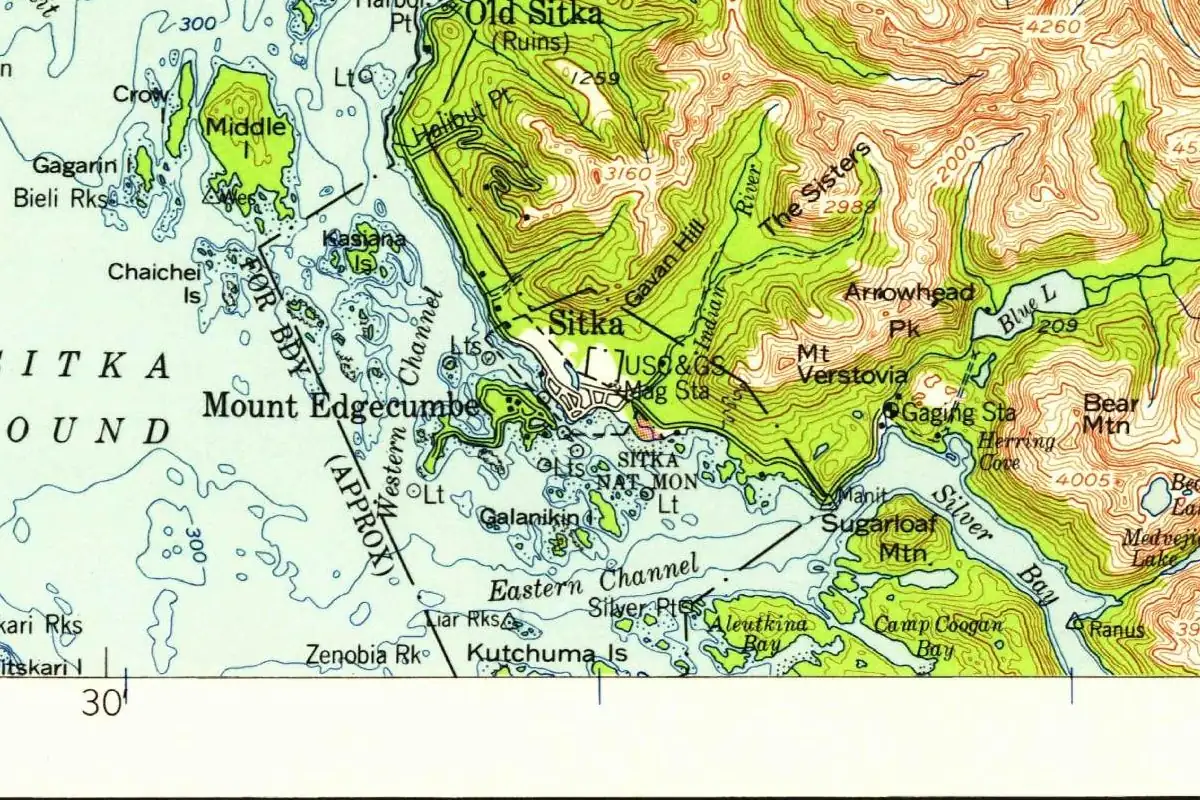
The Russians officially called their Alaska capital New Archangel, but the name that stuck was Sitka, taken from the Tlingit name for the place. The island it sits on went the other way: it once carried the Tlingit name too, and now it’s named for a Russian governor.
New Archangel on Castle Hill
The Russians got here in 1799. Marcus Baker’s 1906 Geographic Dictionary of Alaska says Alexander Baranof started a fort on Sitka Sound that year and called it Fort Archangel Gabriel. In May 1802 the local people attacked it, killed the officers and 30 men, and held their ground until 1804, when the Russians bombarded and took their stronghold.
The Russians then built a new fort several miles away, where the town is now. Baker says the town that grew around it “was called by the Russians New Archangel (Novo Arkhangelsk) or Sitka.” The U.S. Geological Survey’s record says the new settlement, built around a fort on Castle Hill, became the headquarters of the Russian American Company and the capital of Russian America.
Notice the “or Sitka.” Even the Russians didn’t stick to the saint’s name. Baker says they’d gotten the word from the people who lived there, as Shitka, “a name which, modified to Sitka, has come into general use.”
What the word means
The books don’t agree on this part. Baker, in 1906, flatly calls Shitka or Sitka a native word “of unknown meaning,” spelled over the years as Schitcha, Sitcha and Sitki.
The federal record is more willing to guess. It says Sitka is “a Tlingit Indian name, said to mean ‘by the sea’ or ‘on Shi’, the native name for Baranof Island.” Note the “said to mean.”
So depending on which government book you open, you’ll get “unknown,” “by the sea” or “on Shi.” What the federal record does pin down is the island: Shi is the Native name for Baranof Island, and one of those guesses ties the town’s name to it. Today’s Tlingit spellings and translations, from the Sitka Tlingit and from people who study the language, are worth looking up too. We couldn’t read them in full, so we’re not quoting them here.
Sitka Island becomes Baranof Island
As it turns out, the island had a name swap of its own. Baker says it was “also called Sitka island,” but in 1805 Lisianski named it for Alexander Baranof, “then Governor of the Russian American colonies,” the same man who built the forts. That name won. So the island that Shi refers to now carries a Russian’s name, while the town on its west coast kept the Tlingit one.
The flag change
Then came 1867. Donald Orth’s Dictionary of Alaska Place Names, published by the USGS in 1967, opens with the scene: at 3:30 in the afternoon of October 18, 1867, on the parade ground near Baranof’s castle in Sitka, about 580,000 square miles of Russian territory was formally handed over to the United States. The federal record says that when the United States took over, “the town was named Sitka.” You can read how the whole territory got its name in our story on Alaska.
Sitka stayed the capital until 1900, when the government moved north to Juneau, a town whose founders had set out from Sitka in the first place.
Sources & further reading
- Marcus Baker, Geographic Dictionary of Alaska, 2nd ed. (USGS Bulletin 299, 1906), pp. 116, 578. Sitka: Fort Archangel Gabriel (1799), the attack of May 1802, the capture in 1804, the new fort and the town “called by the Russians New Archangel (Novo Arkhangelsk) or Sitka”; “This native word Shitka or Sitka, of unknown meaning”; Sitka Sound: the Russians “obtained from the natives the name Shitka.” Baranof Island: “Also called Sitka island,” named by Lisianski in 1805 for Alexander Andreievich Baranof.
- Donald J. Orth, Dictionary of Alaska Place Names (USGS Professional Paper 567, 1967). The foreword’s account of the transfer at Sitka on October 18, 1867; the entry “Sitka,” which matches the GNIS record.
- U.S. Geological Survey, GNIS feature 1414736. New Archangel, Castle Hill, the Russian American Company; “a Tlingit Indian name, said to mean ‘by the sea’ or ‘on Shi’”; capital until 1900.
- Hubert Howe Bancroft, History of Alaska (1886), p. 739. The prospecting party that founded Juneau left Sitka “in charge of Joseph Juneau and Richard Harris.”
Spot something wrong, or know more? Tell us here. You can also email us or use our contact page. Corrections are noted here with their date, never made silently.