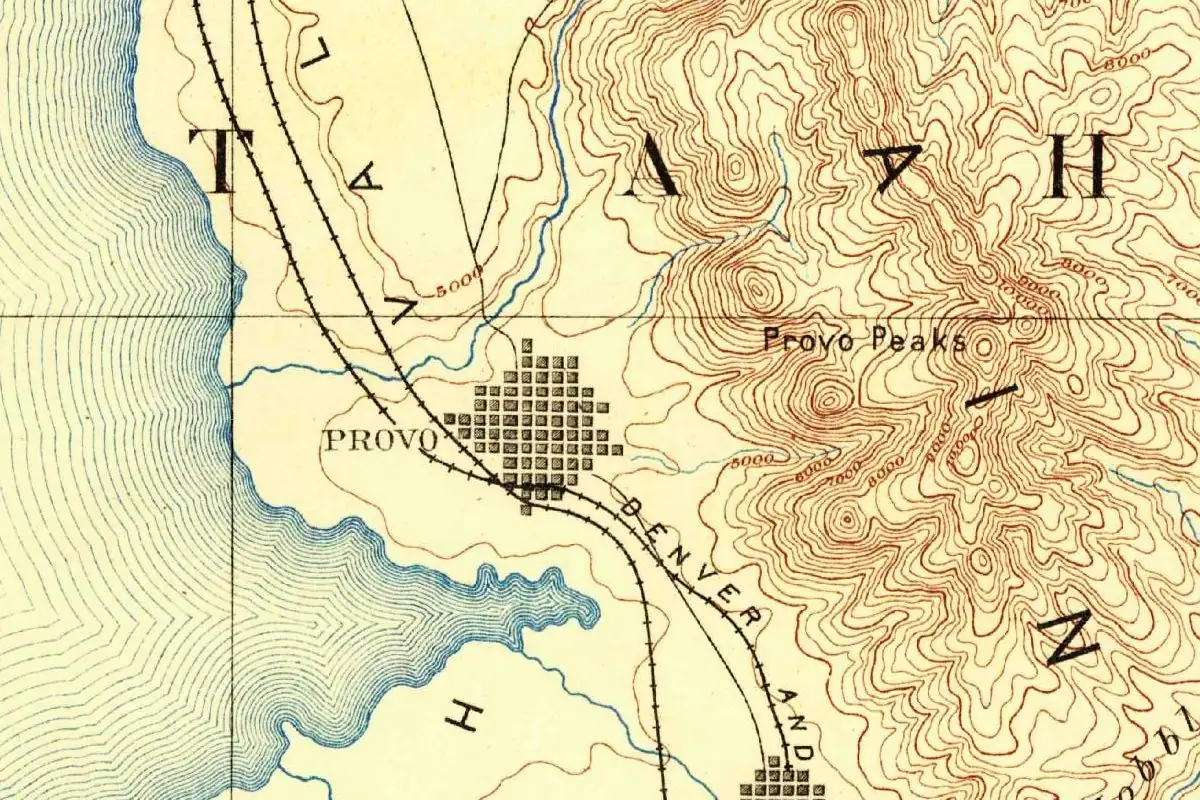
Tusayan, Arizona: The Grand Canyon Town Named for a Bar
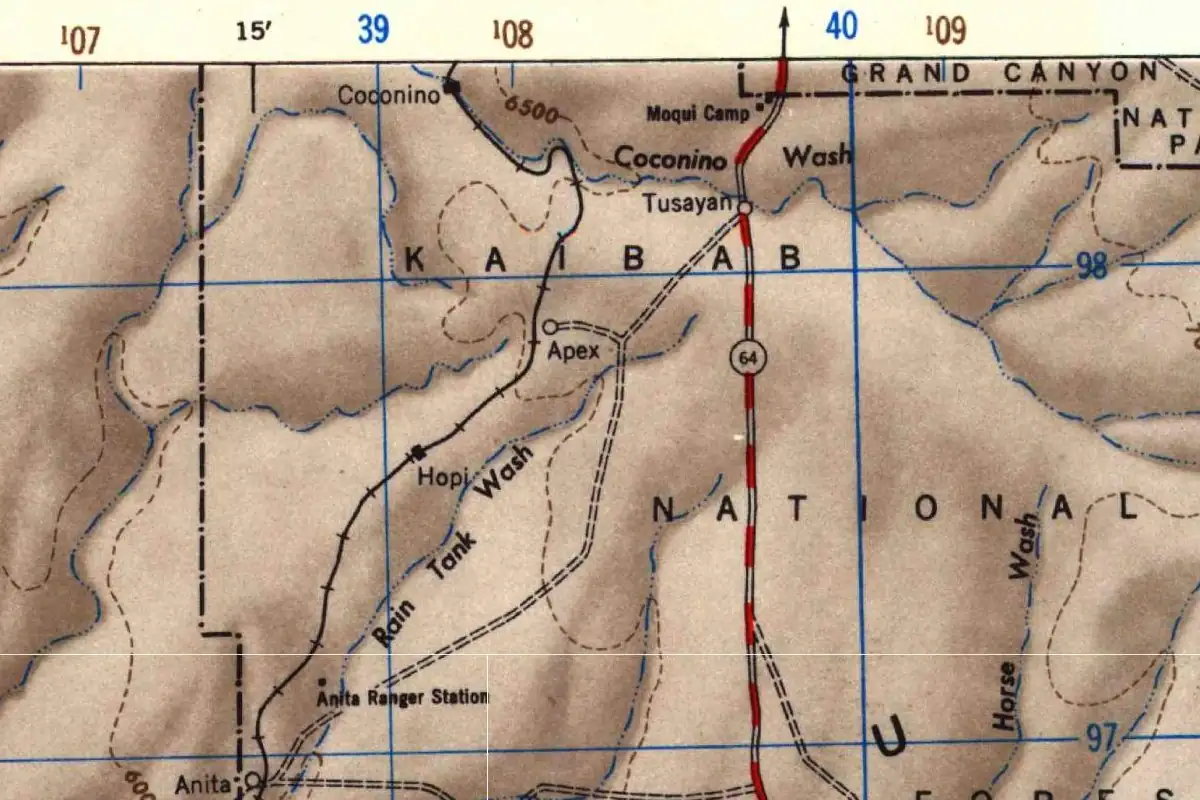
Tusayan, Arizona, got its name from a roadside bar, which took it from a national forest, which took it from the old Spanish name for the Hopi country. So the little town at the Grand Canyon’s south gate is wearing a name that started out more than 80 miles (130 km) to the east. What the word itself means is a question nobody has settled.
A highway sign by the Tusayan Bar
The town’s own history, condensed from an essay Ronald L. Warren wrote for a 1995 Coconino County plan, starts with a forest ranger. George Reed quit the Forest Service and, in April 1920, homesteaded 160 acres along the Coconino Wash, about 7 miles (11 km) south of Grand Canyon Village. He grew potatoes, mostly, and sold them to the hotels in the park.
In 1928 the federal government agreed to build a new highway to the canyon from Williams, and neighbors started showing up. First came a store and campground, which by 1934 was known as “Moqui Camp.” Then a man named Galindo opened a bar. In the town’s words, he “named the new business the ‘Tusayan Bar’ after the surrounding National Forest.” It was a payday hangout for Santa Fe Railway workers and ranch cowboys.
Here’s the part that stuck. The State of Arizona, “as was the custom,” put up a highway sign to identify the private land. “They could have used Reed’s name,” the town’s history says, “but instead, they posted a sign near the bar identifying the area as ‘Tusayan.’” An Associated Press story in 2014 told it the same way: the state “picked up the name from a local bar.”
The bar burned down after only a few years and was never rebuilt. Its rock fireplace, the town says, still stands in what’s now the Canyon Pines Mobile Home Park. If you go looking for it, you’re looking at the only piece left of the place that named the town.
A slightly different telling
A Grand Canyon tour company’s website, which doesn’t say where it got the story, gives the owner’s first name as Tony, says he built the bar “when prohibition ended,” and says he named it “in recognition of the Tusayan Pueblo” instead of the forest. Either way, the trail leads back to the same old Spanish name.
The forest called Tusayan
On June 28, 1910, President William H. Taft carved part of the Coconino National Forest, plus some land that hadn’t been reserved before, into a new forest. His proclamation says that “on and after July first, nineteen hundred and ten,” it would be the Tusayan National Forest. It also notes that the new forest overlapped the Grand Canyon National Monument and game preserve.
The proclamation doesn’t say why Tusayan. Will C. Barnes does. In his 1935 Arizona Place Names, he gives the forest’s headquarters as Williams and says it was named “After Tusayan Province of early Spanish discoverers.” By 1948, when the map at the top of this page was printed, the land around the town was labeled Kaibab National Forest, and the town’s history calls the old reserve “now called the Kaibab National Forest.” The forest lost the name, and a crossroads in the middle of it kept it.
Coronado’s men and the province of Tusayan
The name goes back to the summer of 1540. Francisco Vázquez de Coronado’s army was camped at Cibola, the Zuni towns, when the Zunis told him about another group of seven villages. Pedro de Castañeda, who rode with the expedition, wrote: “This province is called Tusayan. It is twenty-five leagues from Cibola. The villages are high and the people are warlike.”
Coronado sent Pedro de Tovar there with about 20 men. The Smithsonian’s Handbook of American Indians identifies those villages as the Hopi towns, and says that’s where the Spaniards first heard about the Grand Canyon. Castañeda tells what happened next: García López de Cárdenas was sent to find the big river, “was well received when he reached Tusayan,” and got guides from the people there. After 20 days, his party stood on the canyon’s edge and couldn’t find a way down.
So Coronado’s men reached the Grand Canyon with guides from Tusayan. The canyon’s own name came more than three centuries later, and nobody knows who first said it.
Tusayan stayed on maps of the Hopi country for a long time. In 1916 the U.S. Geographic Board still filed Hopi villages like Shongopovi and Sichomovi under “Province of Tusayan, Hopi Indian Reservation, Navajo County.” The federal place-name database still has a separate entry called Tusayan, an “Area” in Navajo County plotted near Shungopavi. That’s the spot roughly 87 miles (140 km) east of the town.
What does Tusayan mean?
You’ll see a confident answer online. The sources behind it are thinner than they look, and they don’t agree.
A Navajo word for buttes
Barnes quotes a writer he cites simply as “James”: “Ta-sa-un,” a “Navajo word meaning ‘a country of isolated buttes.’ Spanish changed it to Tusayan.” The federal place-name database gives the same idea for the Hopi-country entry: “Name derived by the Spanish from the Navajo word ‘Ta-sa-un’. It means ‘country of isolated buttes’.” And the Handbook, edited by Frederick Webb Hodge, lists “Ta-sa-un” from an 1890 Indian Affairs report, glossed as “the place of isolated buttes,” the “Navaho name of surrounding country.”
That sounds like three sources. It may be one, repeated. We couldn’t find a Navajo linguist or a Navajo Nation source that confirms the word, so treat “isolated buttes” as an old claim, not a settled translation.
A Zuni name for Hopi towns
The same Handbook entry records a different idea from Adolph Bandelier, writing in 1890. He reported “Usaya” or “Usayan” as names the Zunis gave long ago to the main Hopi pueblos, and “Usaya-kue” as “people of Usaya.” The Handbook’s short note on that is “hence T-usayan.” That would fit the story Castañeda tells, since it was the Zunis who told Coronado about the province. But it rests on one 1890 writer too, and we read him only through the Handbook.
Neither version traces the word to the Hopi language. Barnes adds that the Spanish applied the name “broadly” to “region about present Hopi villages.” What the people of those villages called themselves, the Handbook says, was Hopi.
Moqui Camp, Hopi siding and Tusayan
Look at the 1948 map again and you’ll find three names for the same people within a few miles. Moqui Camp sits just up the highway from Tusayan, and the Grand Canyon railroad runs past a stop labeled Hopi. Barnes lists Hopi as a station on the Santa Fe’s Grand Canyon branch.
Moqui was the old outsiders’ name. Barnes says “Moki or Moqui was generally used until about 1895 when Hopi was adopted by the Smithsonian,” and the Handbook says the word “means ‘dead’ in their own language,” but as a tribal name seems to be “of alien origin.” Tusayan came from the Spanish. Hopi, the Handbook says, is “their own name,” short for a word meaning “peaceful ones.”
Almost the Town of Grand Canyon
The Town of Tusayan incorporated on April 6, 2010. Four years later, Mayor Greg Bryan wanted to change the name. KJZZ reported that the town “seems to be getting confused with a much larger place in Arizona that sounds similar, the city of Tucson,” and town officials floated “The Town of Grand Canyon.” If you’ve ever said both names out loud, you can hear the problem. (Tucson has a name story of its own.)
Not everyone liked it. Clarinda Vail, whose family was among the earliest settlers, told the AP: “There is more to a town’s name than marketing. There is history.” The town still goes by Tusayan, and so does its entry in the federal database.
It’s a name with a long, odd chain behind it: a Hopi province the Spanish heard about from the Zunis, a forest Taft named in 1910, a bar that burned down. Elsewhere in Coconino County, Sedona got its name from a postmaster’s wife. Tusayan got its name from a highway sign.
Quick answers
How did Tusayan get its name?
From a highway sign. The town’s history says the State of Arizona posted a “Tusayan” sign near the Tusayan Bar, which its owner had named for the surrounding Tusayan National Forest.
What does Tusayan mean?
Nobody’s sure. Barnes and the federal database say it comes from a Navajo word, “Ta-sa-un,” for a country of isolated buttes, but that may be a single old claim repeated. The Smithsonian’s Handbook, citing Bandelier, also links it to a Zuni name for the main Hopi pueblos.
Was Tusayan the Spanish name for the Hopi?
Close. Castañeda wrote in the 1500s that the province of seven villages “is called Tusayan,” and Barnes says the Spanish used the name broadly for the region around the Hopi villages.
Did Tusayan change its name to Grand Canyon?
No. In 2014 the mayor proposed “The Town of Grand Canyon” because people kept confusing Tusayan with Tucson, but the town still uses Tusayan.
Key dates
- 1540Coronado sends Pedro de Tovar to a province of seven villages "called Tusayan."
- 1910President Taft proclaims the Tusayan National Forest, effective July 1.
- 1920Former forest ranger George Reed homesteads the land where the town now stands.
- 1928The federal government agrees to build a new highway to the canyon from Williams.
- 1934The store up the road is known as Moqui Camp.
- 2010The Town of Tusayan incorporates on April 6.
- 2014The mayor floats renaming it "The Town of Grand Canyon." The name stays.
Getting there
The closest airports, Amtrak stations and intercity bus stops, measured in a straight line from the center of Tusayan.
Airports
- Flagstaff Pulliam (FLG) - Flagstaff 63 mi 101 km
- Page Municipal (PGA) 76 mi 122 km
Amtrak trains
- Flagstaff station (FLG) 60 mi 97 km
Intercity buses
- Greyhound Williams Williams Love' 49 mi 79 km
- Route 66 Express Amtrak Connecting Service · Williams 50 mi 81 km
- FlixBus Flagstaff Train Station 60 mi 96 km
Distances are as the crow flies, not by road. We don't list schedules or fares because they change; check with the airline, Amtrak or the bus company before you go. Official data (FAA commercial service airports (2025), FAA airport locations, Amtrak stations and Intercity Bus Atlas) from the FAA and the U.S. Bureau of Transportation Statistics, checked Nov 1, 2026.
Historical Sources & References
- Town of Tusayan, “About”. The town’s history, condensed from Ronald L. Warren’s 1995 essay: Reed’s 1920 homestead, the 1928 highway, Moqui Camp by 1934, Galindo’s “Tusayan Bar” named “after the surrounding National Forest,” the state’s sign, the fire and the fireplace; incorporation on April 6, 2010.
- Grand Canyon Tour Guide, “Tusayan – Arizona’s Newest Incorporated Town”. The other telling: Tony Galindo, the end of Prohibition and a bar named “in recognition of the Tusayan Pueblo.”
- Felicia Fonseca, Associated Press, “Town wants its name to reflect Grand Canyon ties” (2014). The state “picked up the name from a local bar,” incorporation “four years ago” and Clarinda Vail’s quote. Also online: the same AP story with the pronunciation “TOO’-say-ohn”.
- KJZZ, “Tusayan Wants Town’s Name Changed To Stop Confusion” (2014). The Tucson confusion and “The Town of Grand Canyon” proposal.
- William H. Taft, Proclamation 1049 (1910). The Tusayan National Forest, made from part of the Coconino National Forest, effective July 1, 1910.
- Will C. Barnes, Arizona Place Names (1935). The forest named “After Tusayan Province of early Spanish discoverers”; James’s “Ta-sa-un”; the name applied “broadly” to the region of the Hopi villages; Hopi station; Moqui used until about 1895. Read only through the book’s full-text search (restricted loan).
- Pedro de Castañeda, in The Journey of Coronado, trans. George Parker Winship (1904), pp. 32-36. “This province is called Tusayan”; Tovar’s visit; Cárdenas “well received when he reached Tusayan” and guided to the canyon.
- Frederick Webb Hodge, ed., Handbook of American Indians North of Mexico, part 1, “Hopi”. Hopi as “their own name” (p. 560); Tovar’s 1540 visit to the province of Tusayan and the Grand Canyon news (p. 560); “Moqui” and the synonyms Ta-sa-un (“the place of isolated buttes”) and Usaya-kue (“hence T-usayan”) (p. 568).
- United States Geographic Board, Fourth Report (1916). Shongopovi and Sichomovi filed under “Province of Tusayan, Hopi Indian Reservation, Navajo County.”
- GNIS feature 42842, Tusayan (U.S. Geological Survey). The federal record and coordinates for the town in Coconino County.
- GNIS feature 42927, Tusayan, Navajo County (U.S. Geological Survey). The separate “Area” entry near Shungopavi, with the note “Name derived by the Spanish from the Navajo word ‘Ta-sa-un’.”
Spot something wrong, or know more? Tell us here. You can also email us or use our contact page. Corrections are noted here with their date, never made silently.