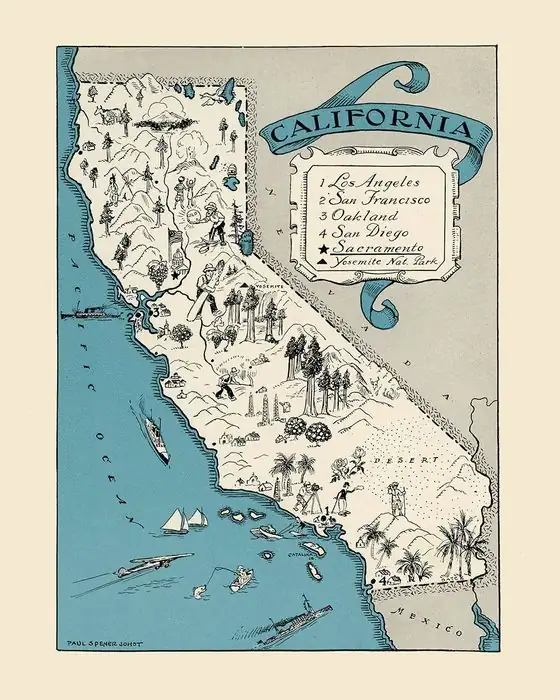
Rocklin, California: A Railroad Town Built on Granite
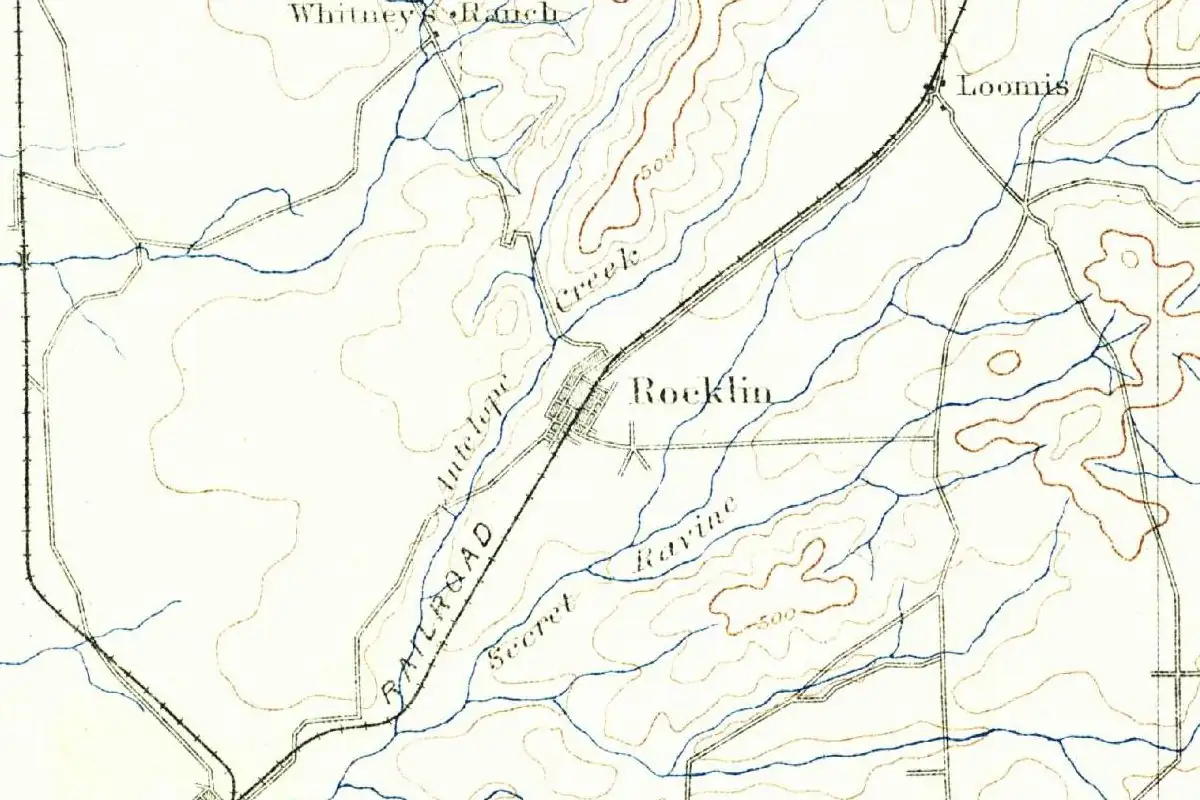
Rocklin, California, sits on granite so solid that its old wells were sunk through rock, and its name seems to have come from that same stone. Nobody seems to have written down who picked it, but every source that explains it points to the quarries.
A village in the granite
The best early picture comes from the 1882 History of Placer County, published by Thompson & West and edited by Myron Angel. Rocklin was “a thriving village on the line of the Central Pacific Railroad, fourteen miles southwest of Auburn” (about 23 km), with 624 people. “The history of the village dates from the construction of the railroad,” the book says.
Wells there struck “fair water” at 15 to 40 feet, “all in granite.” Even so, almost nobody drank from them. The engines came down from the Sierra with their tenders full of mountain water, and the railroad left a siphon on one of them so anyone could fill a bucket. Rocklin people, the book reports, credited that water for keeping fever away.
Rock, Rockland, Rocklin
So where does the name come from? A Depression-era state guide, written by the Federal Writers’ Project in 1939, put it plainly. The town’s Finnish quarry workers, it said, “work in the granite quarries from which Rocklin takes its name.”
The Rocklin Historical Society’s town history, drawn from a 1970 chamber of commerce booklet based on Lila Harman’s master’s thesis, adds one more step. It quotes Phil Townsend Hanna’s Dictionary of California Land Names calling Rocklin “a corruption of Rockland, a name applied to the community because of the extensive granite quarries in the area.” The same history says Finnish settlers wrote the name as Rocklissa.
You’ll notice that none of these sources is from the town’s first years. The oldest use of the name they show is the 1870 census, which, the historical society says, “credits Rocklin with 542 people.” They agree on the stone, but none names the person who chose the name or shows “Rockland” in use before “Rocklin.” The government’s own list doesn’t help either: the Board on Geographic Names’ database entry for Rocklin has its location and nothing about its history.
The roundhouse at the foot of the climb
The railroad and the rock grew up together. The Central Pacific reached Rocklin in May 1864, the historical society says, though quarrying there had started in 1862. By 1879 George Crofutt’s guide found a machine shop and a 28-stall roundhouse “built in the most substantial manner, of granite obtained near by,” and “the celebrated Rocklin Granite Quarries” next to the station. “The stone for the State Capitol and for many of the best buildings in San Francisco was quarried here,” Crofutt wrote. The capitol is in Sacramento. Not everything went well: in November 1873, the historical society says, a fire in the Rocklin roundhouse destroyed 10 engines.
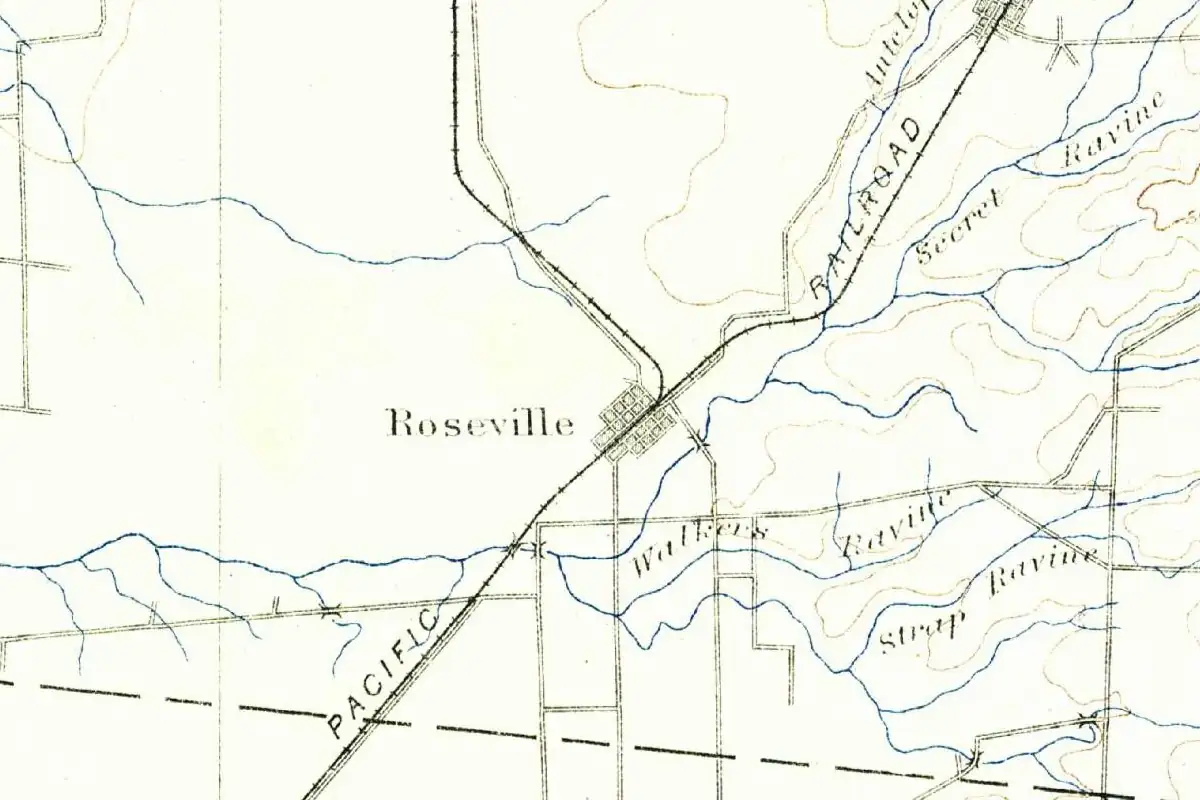
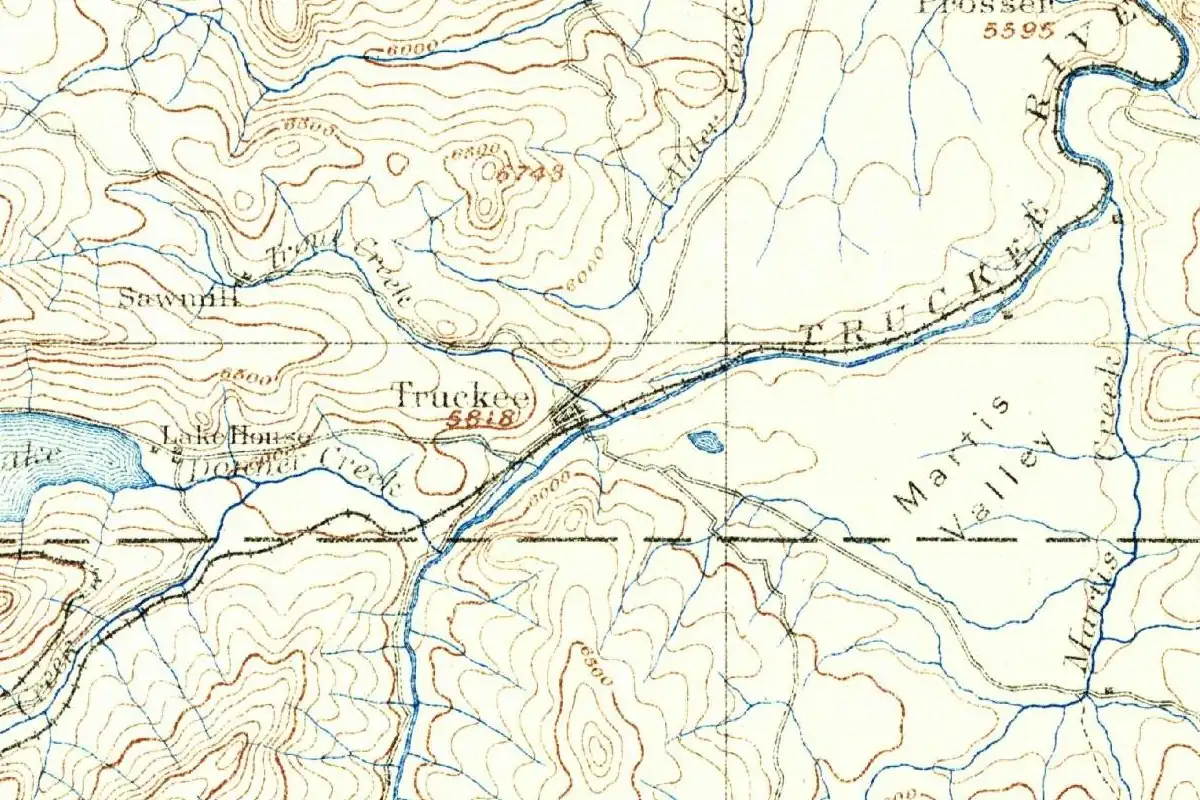
Rocklin’s real job was the mountain. Its roundhouse, the 1882 county history explains, was “where the extra locomotives are kept which are necessary to attach to trains ascending the mountain.” If you follow those tracks up into the Sierra, you reach Truckee. The engines didn’t stay at Rocklin forever. In 1906 the railroad began moving its terminal down the line to Roseville.
The roundhouse left, but the quarry pits and the name stayed.
Quick answers
How did Rocklin, California, get its name?
From its granite. The Federal Writers’ Project’s 1939 guide says the town “takes its name” from its granite quarries, and Phil Townsend Hanna, as quoted by the Rocklin Historical Society, called Rocklin “a corruption of Rockland.”
Who named Rocklin?
No source here says. The oldest use of the name in these sources is the 1870 census figure quoted by the Rocklin Historical Society, and no record of who chose it has turned up.
When did the railroad move from Rocklin to Roseville?
Starting in 1906, it moved its terminal facilities to Roseville, the next railroad town down the line toward Sacramento. Rocklin had been the place where helper engines were added for the climb into the Sierra Nevada.
Key dates
- 1862Quarrying begins at Rocklin, according to the Rocklin Historical Society.
- 1864May: the Central Pacific reaches Rocklin.
- 1873November: fire in the Rocklin roundhouse destroys 10 engines.
- 1882Thompson & West's county history counts 624 people in the village.
- 1906The railroad begins moving its terminal facilities from Rocklin to Roseville.
Getting there
Open Rocklin in Google Maps
Opens in a new tab. The pin is the center of Rocklin in the USGS place-name record.
The closest airports, Amtrak stations and intercity bus stops, measured in a straight line from the center of Rocklin.
Airports
- Sacramento International (SMF) 20 mi 33 km
- Stockton Metro (SCK) 62 mi 100 km
Amtrak trains
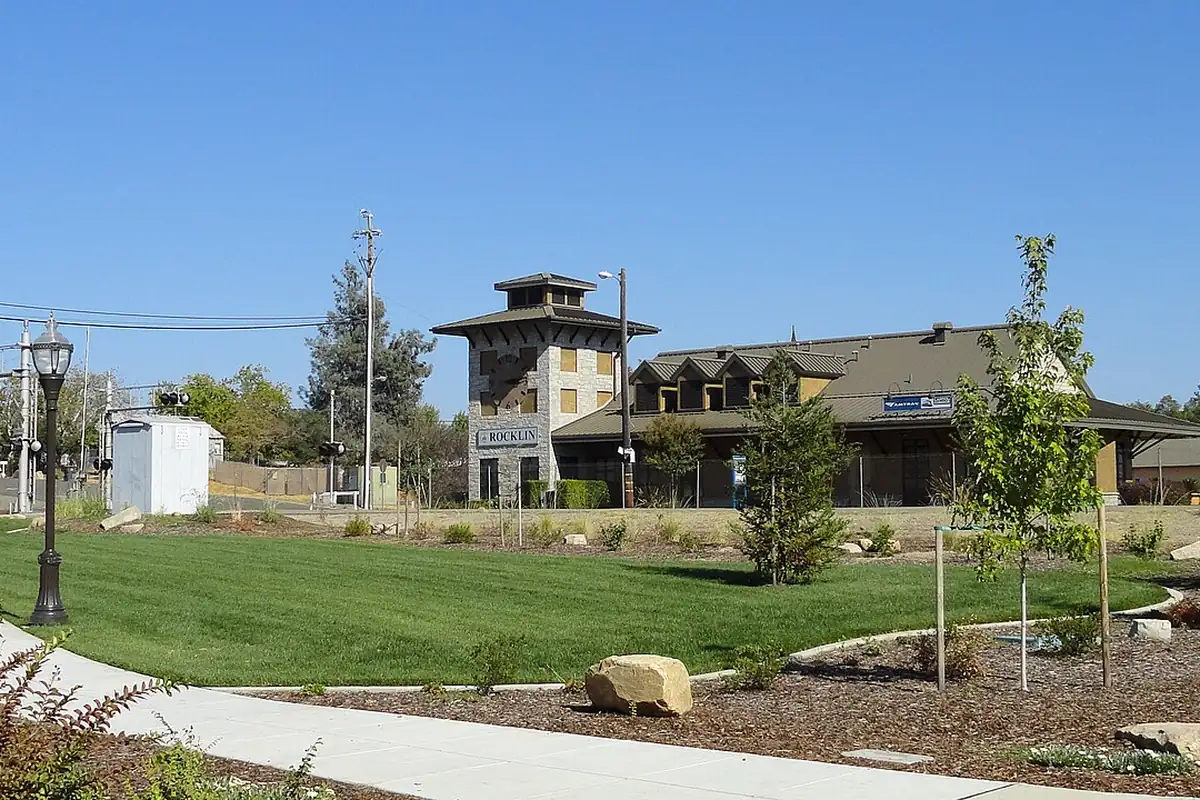
- Rocklin station (RLN) under 1 mi 0.1 km
- Roseville station (RSV) 4 mi 6 km
Intercity buses
- Amtrak Chartered Vehicle Amtrak Connecting Service · Rocklin Amtrak Station under 1 mi 0.1 km
- AVLN Amtrak Connecting Service · Rocklin Amtrak Station under 1 mi 0.1 km
- Greyhound Roseville Bus Stop 4 mi 6 km
Distances are as the crow flies, not by road. We don't list schedules or fares because they change; check with the airline, Amtrak or the bus company before you go. Official data (FAA commercial service airports (2025), FAA airport locations, Amtrak stations and Intercity Bus Atlas) from the FAA and the U.S. Bureau of Transportation Statistics, checked Nov 6, 2026.
Sponsored
Staying in Rocklin?
Compare hotels in Rocklin, California, on Expedia.
See hotels in RocklinWe may earn a commission if you buy through this link. It never changes what we write. Read our affiliate disclosure
Historical Sources & References
- Myron Angel, ed., History of Placer County (Thompson & West, 1882), p. 397. The “thriving village” 14 miles southwest of Auburn, population 624, the roundhouse for “the extra locomotives,” wells “all in granite” and a history that “dates from the construction of the railroad.”
- George A. Crofutt, Crofutt’s New Overland Tourist and Pacific Coast Guide (1879), p. 181. The granite roundhouse of 28 stalls, “the celebrated Rocklin Granite Quarries” and stone for the State Capitol.
- Federal Writers’ Project, California: A Guide to the Golden State (1939), p. 570. The Finnish population and “the granite quarries from which Rocklin takes its name.”
- Rocklin Historical Society, “A History of Rocklin” (from a 1970 chamber of commerce booklet). Hanna’s “corruption of Rockland,” the Finnish spelling Rocklissa, quarrying from 1862, the 1870 census figure, the railroad’s arrival in May 1864 and the roundhouse fire of November 1873.
- GNIS feature 277586 (U.S. Geological Survey). The Board on Geographic Names’ database entry for Rocklin, in Placer County, with no history note.
Spot something wrong, or know more? Tell us here. You can also email us or use our contact page. Corrections are noted here with their date, never made silently.