Coeur d'Alene, Idaho: The 'Heart of an Awl' Nickname
Coeur d’Alene, Idaho, carries a French fur-trade nickname, “awl heart,” and the people who wrote it down never agreed on why it was given. The city took it from the lake, and the lake took it from the people living on its shores, the tribe the French-speaking traders called the Coeur d’Alenes.
“Hearts of Awls”
One of the earliest writers to use the name was Ross Cox, a fur trader who spent six years west of the Rocky Mountains and published his memoir in 1831. He called them “The Pointed-hearts” and said the Canadians called them Les Coeurs d’Alenes, which he translated as “Hearts of Awls.” An awl is a small, sharp tool for punching holes in leather, so the picture is a heart with a point on it. Cox described them as a small tribe living around a lake about 50 miles east of the Spokane trading post, and then said something that matters for what comes next: “We found them uniformly honest in their traffic.”
Sharp traders or a stingy trader?
Nobody who repeated the name could say for sure who it was meant for. You’ll find two main stories, pointing in opposite directions:
- The tribe’s insult for a trader. The Smithsonian’s Handbook of American Indians (1910) says the name “was originally a nickname used by some chief of the tribe to express the size of a trader’s heart.” Henry Gannett’s 1905 survey of place names for the U.S. Geological Survey says “some authorities” put it down to a chief’s opinion of “the Canadian trappers’ meanness.” John Rees, writing about Idaho’s names in 1918, tells it as a trader “of so close and niggardly a disposition” that the Indians gave him an insulting name, and the interpreter’s translation, “Coeur d’Alenes,” stuck to the Indians instead.
- The traders’ name for tough bargainers. Gannett also cites the Rev. M. Eells, who said Hudson’s Bay Company men gave the tribe the name “because of their sharpness in trade.” Rees has a version of that, too: the Indians were “so sharp at bargaining” that the traders called them “Awl-hearts.”
Gannett translates the phrase as “needle hearts” or “awl hearts.” So the meaning of the words is clear enough. What’s in dispute is whose heart was pointed, and Cox, writing closest to the fur-trade days, didn’t explain it.
The tribe’s own name
The nickname was never what the people called themselves. Rees gives their name as “Skitswish,” “which they claim means ‘Camas People,’” and notes that Lewis and Clark wrote it “Skeetsomish.” The Handbook uses Skitswish too, though it lists “camas people” as the name the Yakima used for them, and it records the name as a tribal member pronounced it in 1907: “Sh-chee-tsoo-ee.” Today the Coeur d’Alene Tribe uses Schitsu’umsh, which its website translates as “Those who were found here” or “The discovered people.”
The federal place-names database also records a Native name for the city’s location, translated as “Surface on the Head of the Water.”
Fort Coeur d’Alene becomes Fort Sherman
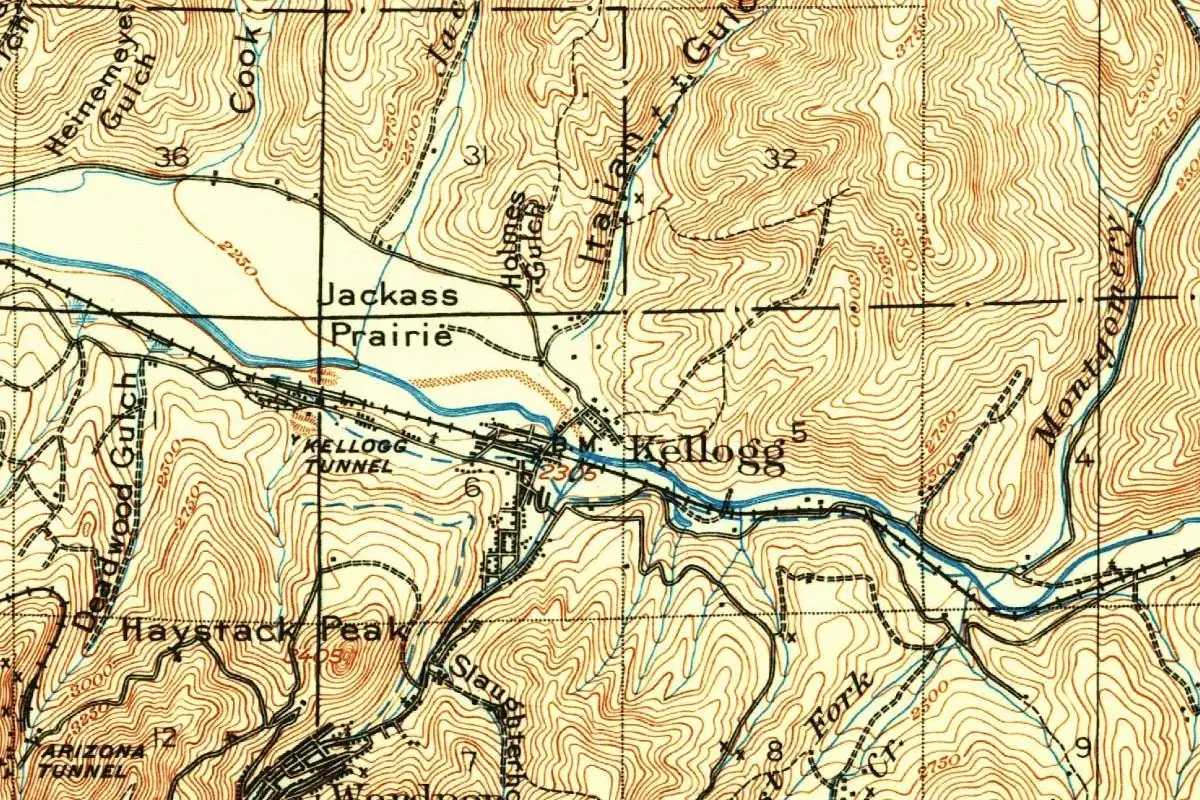
The city grew up next to an army post. In 1877, Gen. William T. Sherman toured the Northwest, came to the lake and recommended a military post at its foot, where the Spokane River leaves it. An Illustrated History of North Idaho (1903) says Sherman himself first named it Fort Coeur d’Alene. Troops arrived in 1879. Hawley’s 1920 History of Idaho says the town didn’t really start growing until after the rich mining discoveries in Shoshone County in 1883, the mining country where Kellogg would soon grow up, and the village was incorporated in 1887.
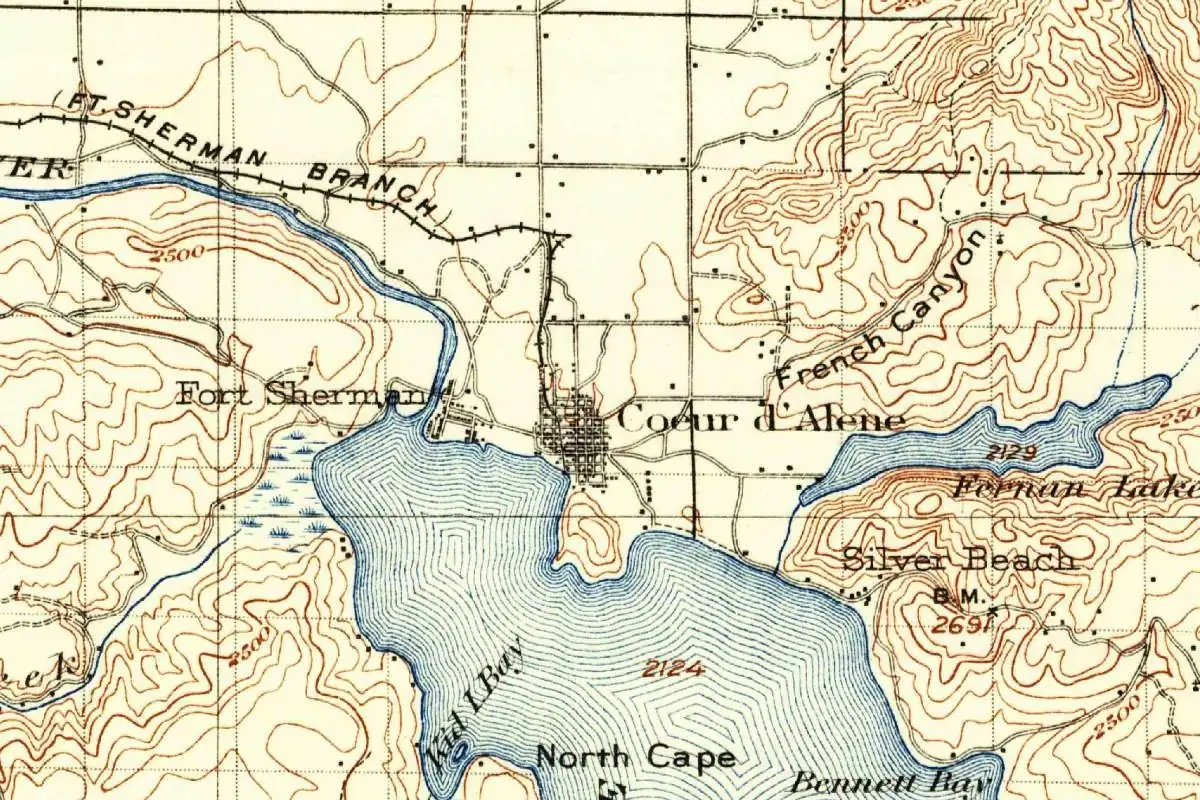
Here’s the odd part. When Sherman died in 1891, the army renamed the post Fort Sherman in his honor. The town next door kept the old name. You can see both on the 1903 map above, Fort Sherman and Coeur d’Alene side by side on the lake. The fort was abandoned in 1901, and by 1920 Hawley says a large part of the old military reservation had become “one of the finest residential districts of the City of Coeur d’Alene.” So the general gave his fort the old fur-trade name, the army renamed it for the general, and the nickname outlasted them both.
Sources & further reading
- Ross Cox, Adventures on the Columbia River, vol. 2 (1831), p. 150. “The Pointed-hearts,” the Canadian name translated as “Hearts of Awls,” and the note that they were “uniformly honest in their traffic.”
- Henry Gannett, The Origin of Certain Place Names in the United States, 2nd ed. (USGS, 1905), entry “Coeur d’Alene.” “Needle hearts” or “awl hearts,” the chief’s opinion of the trappers, and the Rev. M. Eells’s version about sharp trading.
- Frederick Webb Hodge, ed., Handbook of American Indians North of Mexico, Part 2 (1910), entry “Skitswish.” The nickname used by a chief “to express the size of a trader’s heart,” and the older spellings of the tribe’s name.
- John E. Rees, Idaho Chronology, Nomenclature, Bibliography (1918). Both traditions, the name Skitswish, and the lake and city named for the tribe.
- An Illustrated History of North Idaho (1903), p. 765. Sherman’s 1877 visit, Fort Coeur d’Alene named by Sherman, and the change to Fort Sherman after his death in 1891.
- James H. Hawley, ed., History of Idaho, vol. 1 (1920). Fort Sherman, the town’s growth after 1883, the village incorporated in 1887, and the old fort grounds turned into a neighborhood.
- The Coeur d’Alene Tribe, “Our Tribe.” The name Schitsu’umsh and its translation.
- GNIS feature 379485 (U.S. Geological Survey). The federal record for Coeur d’Alene and the translated Native name for the spot.
Spot something wrong, or know more? Tell us here. You can also email us or use our contact page. Corrections are noted here with their date, never made silently.