Kellogg, Idaho: The Prospector, the Jackass and the Mine
Kellogg, Idaho, is named for N. S. Kellogg, who found the Bunker Hill mine in 1885, though a famous story gives the credit to a jackass. The town started out as Milo and switched to Kellogg’s name later, though the old books don’t agree on exactly when.
Milo first
An Illustrated History of North Idaho, published in 1903, gets its early Kellogg history from Robert Horn, one of the town’s eight original owners. The flat below Wardner was claimed as a ranch in September 1885, four days after the Bunker Hill & Sullivan mine was discovered. In January 1886, the owners laid out a town called Milo, “named after Milo creek, along whose banks it was located.” Then, the book says, “within the year following the name ‘Milo’ was exchanged for that of Kellogg, in honor of N. S. Kellogg, discoverer of the Bunker Hill mine.”
You’ll get a different date from James Hawley’s state history, published in 1920. He says the original plat of Kellogg was filed on July 7, 1893, that the town “was at first known as ‘Milo,’” and that “the next year” it became Kellogg. Both books agree on Milo and on the man it was renamed for. They’re about seven years apart on when it happened, and the 1903 book doesn’t help Hawley’s timeline: it calls that same July 1893 plat “the original plat of the town of Kellogg.”
The jackass that found a mine
The mine is where the legend comes in. The 1903 history says the Bunker Hill was found in the late summer of 1885 by N. S. Kellogg and Phil O’Rourke, and that O’Rourke filed the location on September 10. It also admits that “many rumors” went around about the discovery, and “one of the most insistently urged is to the effect that a donkey stumbled in the snow and revealed the ledge.”
The book then hands the floor to U.S. Senator W. B. Heyburn, who flatly called “the story of the jackass” “purely a myth.” Here’s his version. Kellogg “had been furnished with the jackass to pack his provisions some weeks before the discovery,” but “the animal was not with him at the time.” Kellogg found the ledge the ordinary way, by following its outcrop across Big Creek and Elk Creek and into Milo Gulch, and the outcrop “needed no uncovering by man or animal.”
Heyburn even had an explanation for where the tale came from: a lawsuit. Two men named Cooper and Peck sued Kellogg in a grubstake case. A grubstake is when backers supply a prospector’s food and gear in return for a share of whatever he finds. The lawyers joked about the outfit Cooper and Peck had given him, and Heyburn thought that “the mirth of counsel” was “doubtless the original of the many stories told about this famous animal.”
The story wouldn’t die
Here’s the thing: the myth survived the debunking. Seventeen years later, Hawley’s state history told a version anyway, without naming anybody. Two prospectors with a burro were working the hillside near Wardner in the fall of 1885, it says, “when the burro accidentally displaced a piece of rock,” and that rock turned out to be lead ore from what became the Bunker Hill & Sullivan.
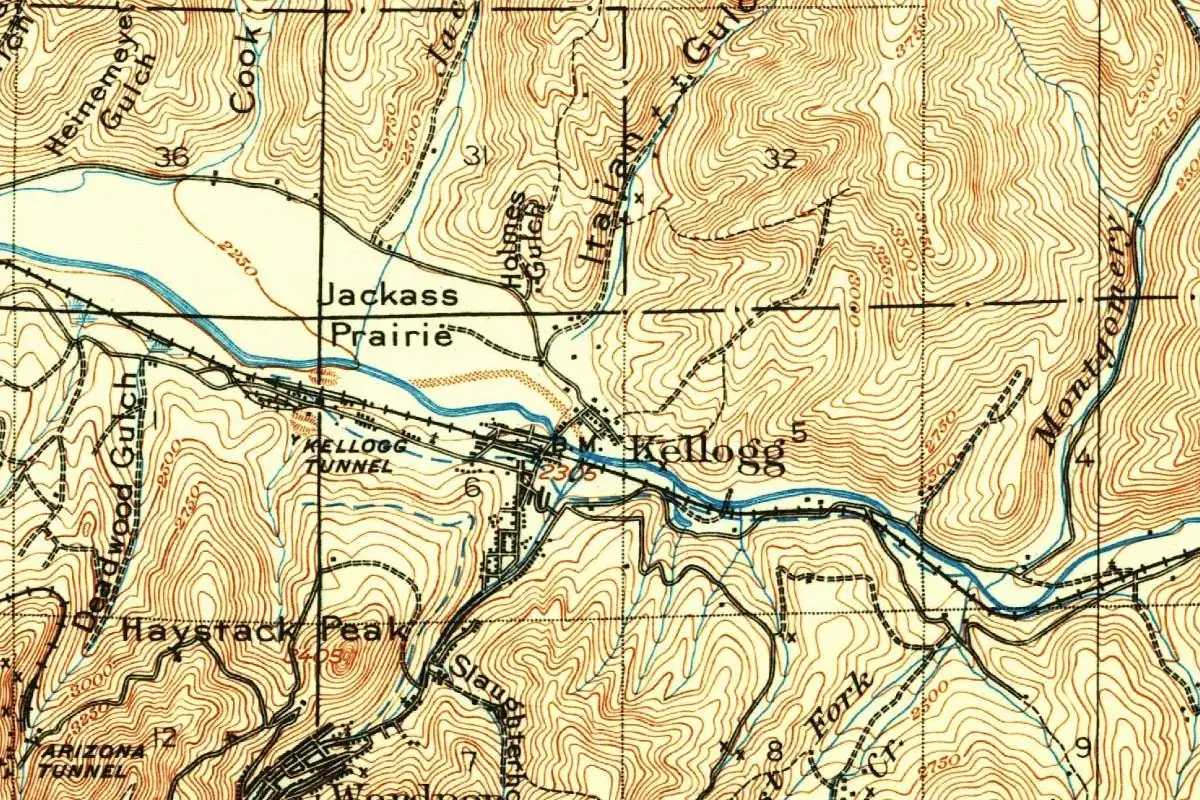
The word jackass turns up around the mine, too. The 1903 history lists a claim called the Jackass on the same ledge as the Bunker Hill. And if you look at the 1901 government map at the top of this page, right across the river from Kellogg, there’s a stretch of flat ground labeled Jackass Prairie. None of the sources we checked says how the prairie got that name, so we can’t tie it to Kellogg’s animal. The town, at least, clearly got the prospector’s name.
Sources & further reading
- An Illustrated History of North Idaho (1903). The discovery by Kellogg and O’Rourke and the Jackass claim (p. 993); Robert Horn’s account of Milo and the change to Kellogg (pp. 1043–1044); the donkey rumor and Senator Heyburn’s rebuttal, including the Cooper and Peck grubstake case (pp. 1054–1055).
- James H. Hawley, ed., History of Idaho, vol. 1 (1920). The burro story as Hawley told it (p. 492); the plat of July 7, 1893, the name Milo and the change to Kellogg the next year (pp. 736–737).
- GNIS feature 396733 (U.S. Geological Survey). The federal record for Kellogg, incorporated in 1907.
Spot something wrong, or know more? Tell us here. You can also email us or use our contact page. Corrections are noted here with their date, never made silently.