Missoula, Montana: A Salish Name With Many Meanings
For well over a century, writers have disagreed about what the Salish place name behind Missoula, Montana, actually means. You’ll find it translated as freezing water, the water of ambush, the river of awe, and even muddy water. And for a while, before the Salish name stuck, the town carried the name of one of the traders who ran its store.
Hell Gate first
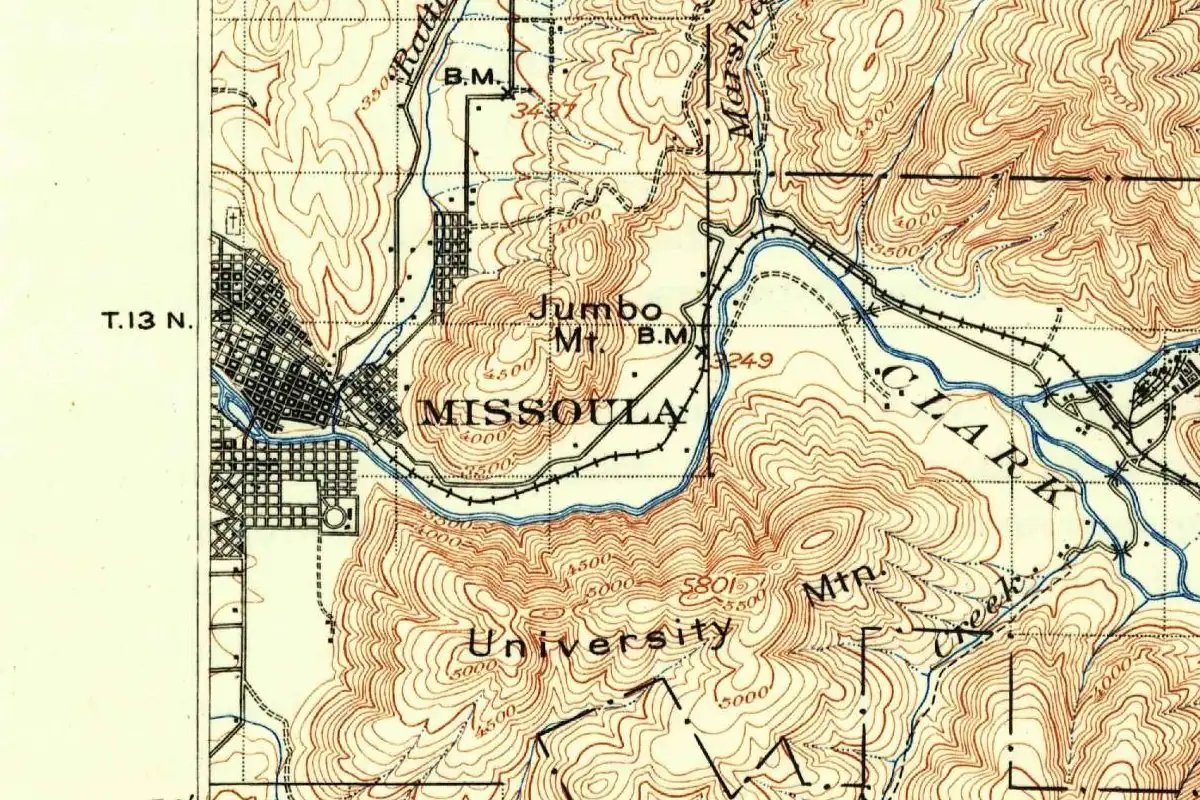
Long before there was a town, the trappers had their own name for this spot. Frank H. Woody, writing in 1876 and 1877 for the Historical Society of Montana, said early Canadian trappers called the valley “Hell’s Gate Ronde.” The canyon just above town, he wrote, was a favorite place for Blackfeet war parties to wait, and the voyageurs called it “Port d’enfer,” Gate of Hell. The river and later a village took that name too.
Woody was honest about the other word. “The writer has never been able to find a translation for the word Missoula,” he wrote. As far as he could tell, Lieutenant John Mullan was the first to use it, and “as to where he obtained it, or what it means, we are left in doubt.”
A priest’s answer: the water of surprise
The editors who printed Woody’s sketch in 1896 added a note pointing readers to Father L. B. Palladino, a Jesuit missionary in Montana. In his 1894 book Indian and White in the Northwest, Palladino traced the name to a Salish root he wrote as “i-sul,” which he said means “cold” or “chilly,” and by extension “chilled with fright.” He said the full name meant “at the stream or water of surprise, ambush.” He tied it to the same canyon mouth where the Rattlesnake meets the larger river, the place the trappers called Hell’s Gate. He also said he’d heard the name pronounced “hundreds of times” by Native people in the area.
The other translations
Not everyone landed where Palladino did. Henry Gannett, who compiled place names for the U.S. Geological Survey, says only in his 1905 book that the name “is said to have the same meaning as Missouri, ‘muddy water.’” Montana, Its Story and Biography (1921) calls it “one of the most musical words of the Salish tongue,” gives the original as “In-mis-sou-let-ka,” and translates it as “The River of Awe.”
Today, the Missoula Public Library’s land acknowledgment gives the Salish place name as Nmesulétkw and translates it as “the place of freezing water.” That’s close to the “cold” in Palladino’s root, though he read it as the chill of fear. If you want one answer, the honest version is this: the name is Salish, it belonged to this valley and its river, and its exact meaning depends on who you ask.
Wordensville, then Missoula Mills
The town itself started with two traders, Frank L. Worden and C. P. Higgins. Worden’s biographical sketch in the Historical Society’s 1896 volume says that in 1864 they moved their store from Hell Gate Ronde up to the mouth of the canyon and built a grist mill and a sawmill. The place was known “for some time as Wordensville but the name was changed by Mr. Worden to Missoula Mills, and subsequently to that of Missoula.” So Worden had a town named after himself and gave it up for the older name of the place.
Sources & further reading
- L. B. Palladino, Indian and White in the Northwest (1894), pp. 312–314. The Salish root “i-sul,” the meaning “at the stream or water of surprise, ambush,” the canyon mouth, and Missoula Mills.
- Frank H. Woody, sketch of western Montana (1876–77), in Contributions to the Historical Society of Montana, vol. 2 (1896), p. 95. Hell’s Gate, Port d’enfer, his doubts about the word, and Lieutenant Mullan; the editors’ note pointing to Palladino.
- Francis Lyman Worden sketch, in Contributions to the Historical Society of Montana, vol. 2 (1896), p. 363. Wordensville, Missoula Mills, then Missoula.
- Tom Stout, ed., Montana, Its Story and Biography, vol. 1 (1921), p. 779. “In-mis-sou-let-ka” and “The River of Awe.”
- Henry Gannett, The Origin of Certain Place Names in the United States (USGS, 1905), p. 210. The “muddy water” reading.
- Missoula Public Library, land acknowledgment. The Salish place name Nmesulétkw, “the place of freezing water.”
- GNIS feature 787504 (U.S. Geological Survey). The federal record for the city of Missoula.
Spot something wrong, or know more? Tell us here. You can also email us or use our contact page. Corrections are noted here with their date, never made silently.