Helena, Montana: Which Helena Was It Named For?
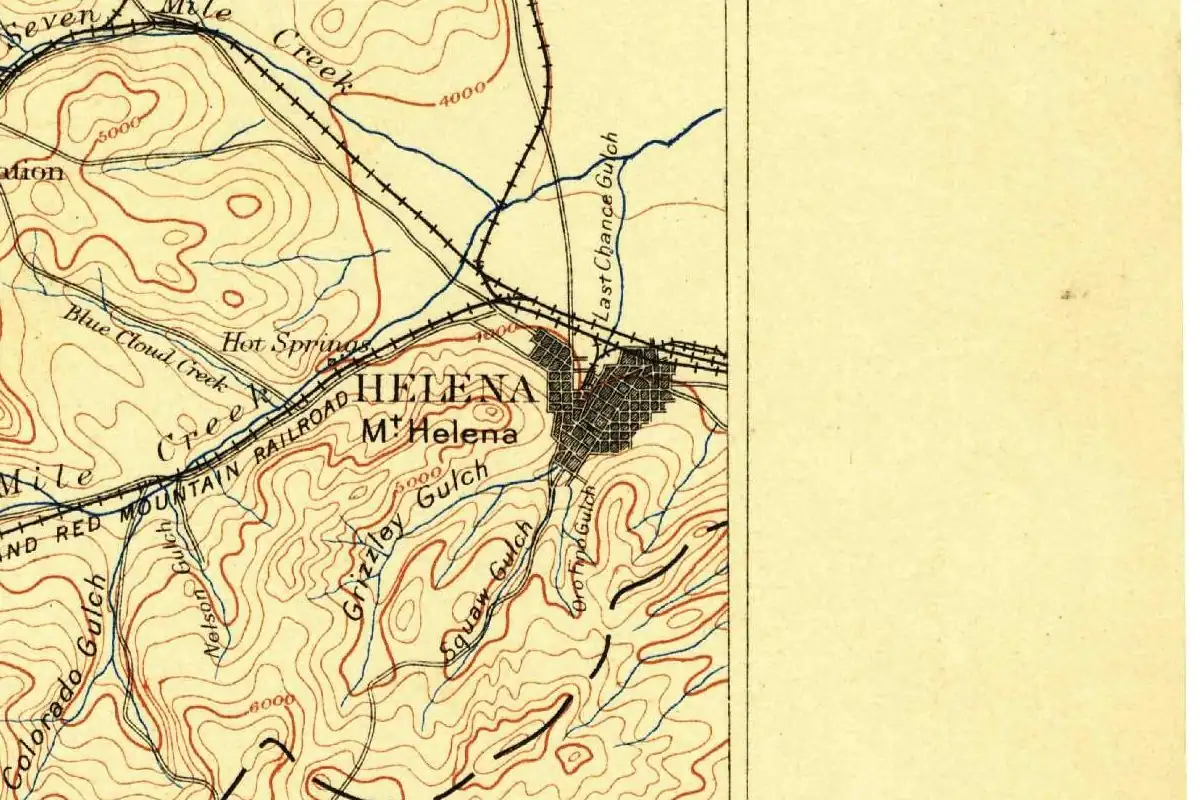
Helena, Montana, got its name from a Minnesota miner at an 1864 meeting, but the old accounts don’t agree on which Helena he had in mind. One says he named the camp after his hometown back in Minnesota. Another says he was thinking of St. Helena, the island where Napoleon died.
A gold camp called Last Chance
The town started as a gold strike. In July 1864, what Judge Cornelius Hedges later called “a party of Georgians,” John Cowan and Robert Stanley among them, found gold in a gulch off the Prickly Pear Valley. In a centennial address on July 4, 1876, Hedges said the late season and their bad luck so far “led them to christen their diggings Last Chance gulch.” The 1890 history by Hubert Howe Bancroft says they called it their “last chance.” It turned out to be a very good one, and by fall hundreds of miners had poured in.
Pumpkinville, Tomah, or Helena
On October 30, 1864, the miners met in Captain George J. Wood’s cabin to organize the camp and give it a name. Hedges says the minutes of that meeting were “still preserved” in 1876, and that Helena was picked “on motion and suggestion of Mr. John Somerville.”
It wasn’t a quick vote. A 1907 history of the Yellowstone Valley says some men wanted to name the town for Cowan, Stanley or Wood, and that the lighter suggestions included “Pumpkinville, Squashtown, Tomahawk, Tomah.” In the end, it says, Helena won “by one or two votes over Tomah.”
Somerville’s speech
Thomas E. Cooper was the secretary of that meeting, and his letter is the best-known account. Several Montana histories quote it. When the miners couldn’t agree, Cooper wrote, Somerville stood up and said he lived “in the best county (Scott) of that state, and in the best town (Helena) of that county,” and then: “by the eternal, this town shall bear that name.” You can check that the Minnesota town was real. Warren Upham’s 1920 book on Minnesota place names lists Helena township in Scott County, named for “an earlier village platted in 1856.”
Or was it Napoleon’s island?
Here’s where it gets tangled. Henry Gannett’s 1905 place-name book for the U.S. Geological Survey says “opinions differ.” It cites the Helena Historical Directory of 1879, which says Somerville named the camp “St. Helena, from the resemblance in its location to that of the original St. Helena,” and that the miners then “voted to drop the prefix Saint.” The 1907 Yellowstone Valley history tells that version too, saying Somerville picked it “in commemoration of the resemblance of the location to the home of Napoleon.” Gannett also mentions a third idea, that some people thought it was named for Helen of Troy, but he gives nothing to back it up.
So which is right? The Minnesota story comes from a man who was in the room and took the minutes. Cooper wrote his letter in 1885, according to the Yellowstone Valley history. The St. Helena story was in print six years earlier, in the 1879 directory, but none of these books says who told it to the directory. That’s why the Minnesota version carries a little more weight: it comes from a witness. But it was written down twenty-one years after the meeting, so nobody can close the case. Both versions agree on the one fact that matters most: John Somerville proposed the name. If you look the town up in the federal place-names database today, you’ll see it splits the difference and says miners named it “after Saint Helena, Minnesota.”
How the miners said it
Hedges had one more complaint in 1876. He thought that if people respected the founders’ choice of name, they should also respect how the founders said it. In the version printed in the 1921 history Montana, Its Story and Biography, he asks why not keep “the pronounciation of the name, He-le’-na, as they universally called it, and not Hel’-e-na?” So twelve years after the meeting, people were already saying the name differently from the men who chose it. If you’re keeping score, the miners won the vote on the name, and by 1876 they were already losing the argument over how to say it.
Sources & further reading
- Tom Stout, ed., Montana, Its Story and Biography, vol. 1 (1921), pp. 210–212. Last Chance Gulch, Thomas E. Cooper’s letter, and Hedges’s account with the He-le’-na pronunciation.
- Cornelius Hedges, Centennial Address (1876), in Contributions to the Historical Society of Montana, vol. 2 (1896), p. 110. The October 30, 1864, meeting in Wood’s cabin and Somerville’s motion.
- An Illustrated History of the Yellowstone Valley (1907), pp. 53, 83–84. The other names on the ballot, the close vote over Tomah, and the St. Helena version.
- Henry Gannett, The Origin of Certain Place Names in the United States (USGS, 1905), p. 154. “Opinions differ,” with the 1879 directory’s St. Helena story.
- Warren Upham, Minnesota Geographic Names (1920), p. 508. Helena township in Scott County, Minnesota.
- Helen Fitzgerald Sanders, A History of Montana, vol. 1 (1913), p. 179. Another printing of Cooper’s account.
- Hubert Howe Bancroft, History of Washington, Idaho, and Montana (1890), p. 721. The “last chance” and the founding of Helena in the fall of 1864.
- GNIS feature 802116 (U.S. Geological Survey). The federal record: “Named by miners after Saint Helena, Minnesota.”
Spot something wrong, or know more? Tell us here. You can also email us or use our contact page. Corrections are noted here with their date, never made silently.