Cody, Wyoming: Buffalo Bill Says His Friends Insisted
Buffalo Bill didn’t name Cody, Wyoming, after himself, at least by his own telling. His friends, he wrote, “insisted upon naming it Cody.” The town was laid out along an irrigation canal that William F. Cody backed in the 1890s.
A professor’s prediction
In his 1920 autobiography, Cody traces the whole thing back to a fossil-hunting trip into the Big Horn Basin with Professor Marsh and a party from Yale. Cody’s job was to pick out the horses. Around the campfire, he says, Marsh told them the basin would be one of the last parts of the West to be settled, because the mountains around it would turn travelers aside. But Marsh was sure that someday its valleys would hold “the most prosperous people in the world.”
“I never forgot what I heard around the campfire,” Cody wrote.
The canal, and a town beside it
Then came the Carey Act of 1894, which, as Cody tells it, gave each arid state a million acres of land. “I was the first man to receive a concession of two hundred thousand acres from the Wyoming State Land Board,” he says. He couldn’t get out to the basin until late that fall, so he went into partnership with George T. Beck, who headed to Wyoming and found Professor Elwood Mead, then working for the state. They picked a site and surveyed the line of an irrigation canal.
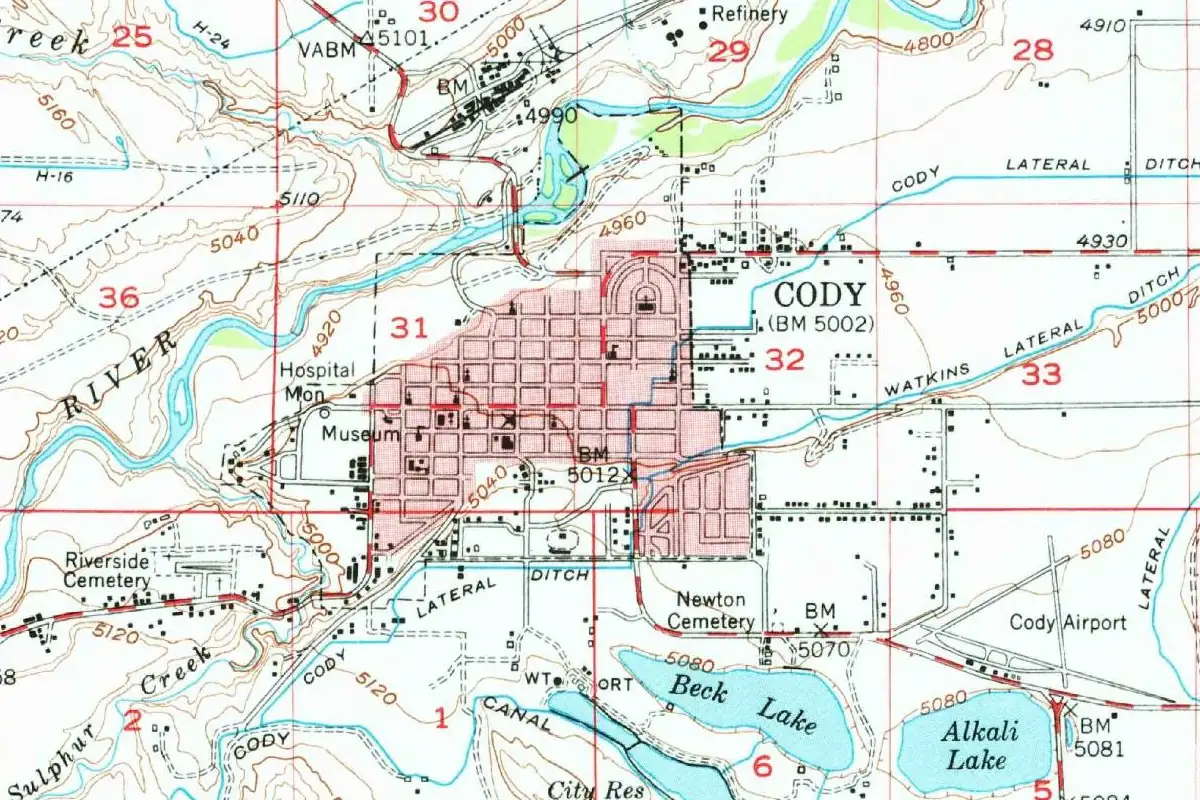
“A town was laid out along the canal,” Cody wrote, “and my friends insisted upon naming it Cody.” He doesn’t say which friends. You’ll notice the 1949 map above shows a Cody Canal and a Cody Lateral Ditch around town.
What the state history says
Keep in mind that this is Cody’s own account. If you want a second opinion, the 1918 History of Wyoming, edited by I. S. Bartlett, gives a plainer version: the town “was located by George T. Beck and named for William F. Cody, known all over the world as ‘Buffalo Bill.’” It doesn’t say who chose the name, so it doesn’t contradict Cody, but it puts Beck front and center.
Bartlett adds that as late as 1897, Cody was about a dozen frame houses. It was incorporated on August 30, 1901, with Frank L. Houx as its first mayor, and it became the seat of Park County when the county was created.
The road to Yellowstone
Cody had one more piece of the plan. In 1896, he says, he went out to scout a wagon road from Cody into Yellowstone National Park, and he pitched it as the only road into the park from the east. By 1918, Bartlett was calling that route the “Cody Way,” built by the federal government and running “through a section of country that presents some of the finest natural scenery in the world.” Cody’s autobiography, published in 1920, says it had “now become the favorite automobile route into the Park.” That’s a long way from a dozen frame houses in 1897.
Sources & further reading
- William F. Cody, An Autobiography of Buffalo Bill (Colonel W. F. Cody) (1920), pp. 209–211. The fossil trip with Professor Marsh and the prediction about the Big Horn Basin; the Carey Act, the 200,000-acre concession, the partnership with George T. Beck and Elwood Mead; “my friends insisted upon naming it Cody”; the 1896 scouting trip for a road into Yellowstone and “the favorite automobile route into the Park.”
- I. S. Bartlett, ed., History of Wyoming, vol. 1 (1918), p. 568. Located by George T. Beck and named for William F. Cody; about a dozen houses in 1897; incorporated August 30, 1901, with Frank L. Houx as first mayor; county seat of Park County; the “Cody Way” into Yellowstone.
- GNIS feature 1586861 (U.S. Geological Survey). The federal record for Cody, in Park County, with its coordinates.
Spot something wrong, or know more? Tell us here. You can also email us or use our contact page. Corrections are noted here with their date, never made silently.