Rawlins, Wyoming: A General's Wish for a Spring
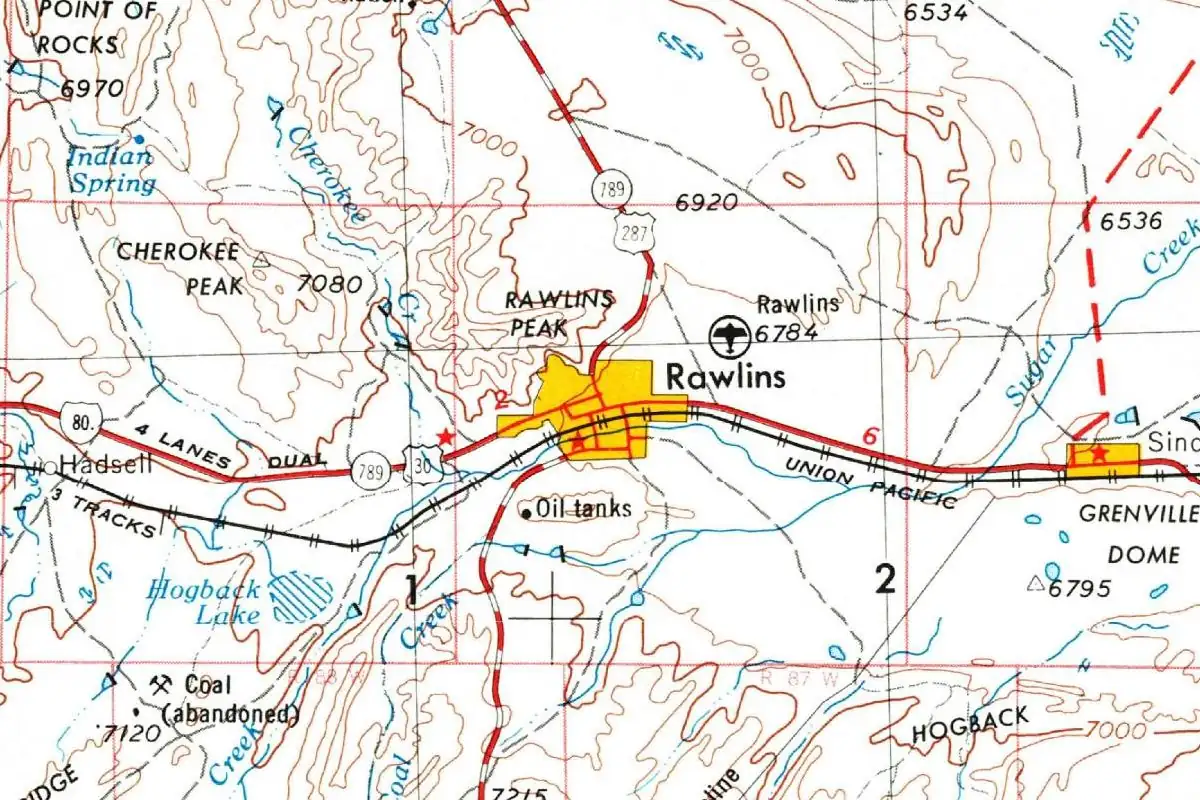
Rawlins, Wyoming, got its name because a thirsty general once said that if anything was ever named for him, he wanted it to be a spring of water. The general was John A. Rawlins, Ulysses S. Grant’s chief of staff, and the man who granted the wish was the Union Pacific’s chief engineer, Grenville M. Dodge.
Sent west for his health
In the spring of 1867, Dodge got a letter from Grant. Rawlins “had shown a tendency towards consumption,” Dodge wrote in his 1910 memoir, How We Built the Union Pacific Railway, and Grant thought three or four months of camp life on the plains would do him good. Consumption was the old word for tuberculosis. So Rawlins came along on Dodge’s survey trip that summer, with a few friends and an Army escort.
They crossed the Laramie Plains and kept going west past the North Platte River. From there, Dodge says, the country was “very dry, no running water in it.” Before they reached camp one day, Rawlins got very thirsty, and they went looking for water.
“We will name this Rawlins Springs”
Dodge found a spring in a draw, near where the town stands now. He tells the rest himself. When Rawlins reached the spring, “he said it was the most gracious and acceptable of anything he had had on the march, and also said that if anything was ever named for him, he wanted it to be a spring of water, and I said then, ‘We will name this Rawlins Springs.’”
The end of one of the railroad’s divisions happened to fall close to the spring, Dodge adds, “and I named the station Rawlins.” You’ll still find the longer name in early records. I. S. Bartlett’s 1918 History of Wyoming says that when Carbon County was organized, the county seat was put at “Rawlins Springs,” and it mentions a settler who came to Rawlins Springs in 1868. The same book says the city dates its start to the spring of 1868, when the Union Pacific was finished through Wyoming.
The general behind the name
Gannett’s 1905 list of U.S. place names and the federal place-names database agree on who he was: John A. Rawlins, “secretary of war under President Grant.” Dodge notes that consumption was the disease “of which he afterwards died.” So the trip west didn’t cure him, but the stop at the spring left his name on a town.
If you’ve read how Cheyenne got its name, this is the same trip. Rawlins was in Dodge’s camp on Crow Creek when Dodge named Cheyenne, and he gave a speech there on the Fourth of July. Later on that same trip, out in the dry country, the general got his spring.
Sources & further reading
- Grenville M. Dodge, How We Built the Union Pacific Railway (1910). Grant’s letter, Rawlins’s “tendency towards consumption,” the Fourth of July speech at Cheyenne (p. 23); the dry country west of the Platte, the spring in a draw, Rawlins’s wish and “We will name this Rawlins Springs” (p. 24); the station named Rawlins (p. 25); consumption, “of which he afterwards died” (p. 112).
- I. S. Bartlett, ed., History of Wyoming, vol. 1 (1918). The Carbon County seat located at “Rawlins Springs” and a settler arriving there in 1868 (p. 512); the city’s start in the spring of 1868 and its name, for John A. Rawlins (p. 596).
- Henry Gannett, The Origin of Certain Place Names in the United States (USGS, 1905), p. 259. “Named for John A. Rawlins, secretary of war under President Grant.”
- GNIS feature 1593213 (U.S. Geological Survey). “Named for John A. Rawlins, Secretary of War under President Grant.”
Spot something wrong, or know more? Tell us here. You can also email us or use our contact page. Corrections are noted here with their date, never made silently.