Casper, Wyoming: Named for Caspar, Spelled With an E
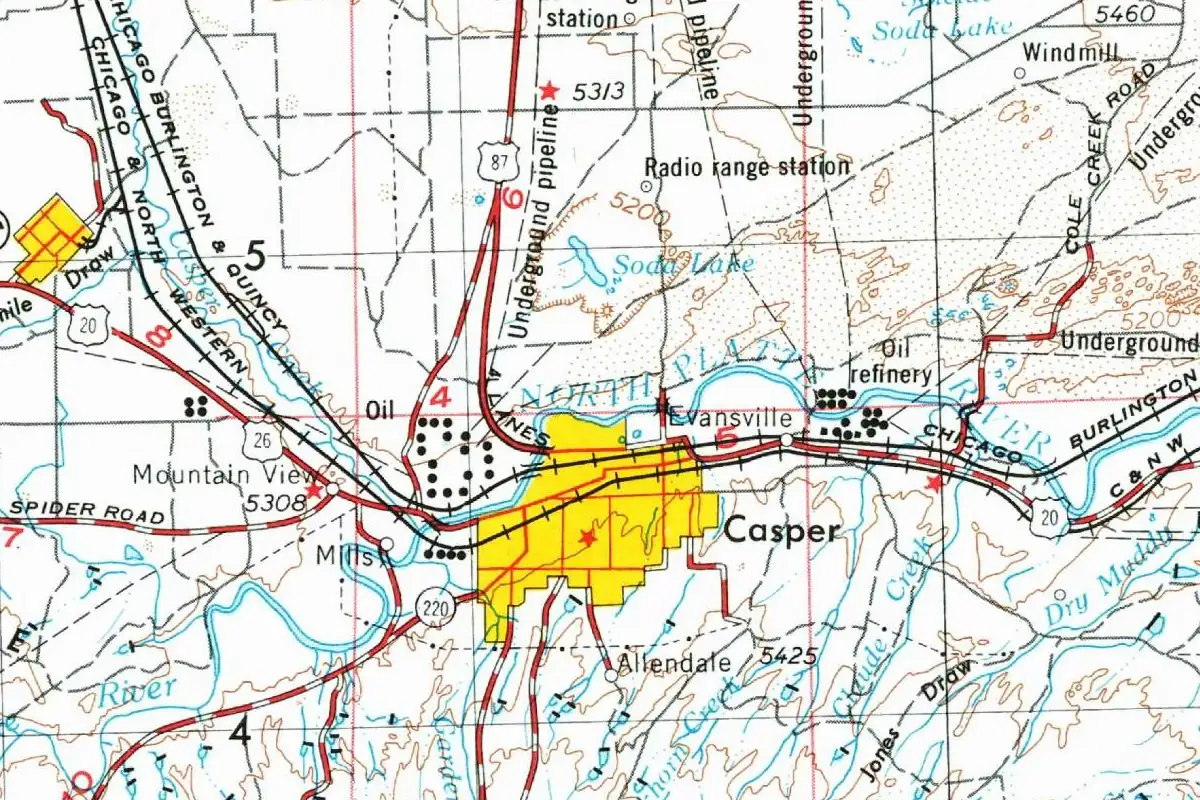
Two state histories quote the same 1865 Army order that gave Casper, Wyoming, its name, and they don’t spell it the same way. The order renamed an Army post for Lt. Caspar Collins, killed nearby that summer at the age of 20, and the town that grew up near the post took the name, with an e.
The fight at Platte Bridge
In 1865 the Army kept a small post at Platte Bridge, near where the main overland trail crossed the North Platte River. On the morning of July 26, a wagon train came into view west of the post, and soldiers were sent out to protect it. Lt. Caspar W. Collins of the 11th Ohio Cavalry, who had arrived only the day before, “begged permission to command the relief party,” according to the 1918 History of Wyoming. About half a mile from the bridge, a large force of Sioux and Cheyenne warriors surrounded them. Eight of the 25 men who rode out with Collins were killed, and Collins was one of them.
C. G. Coutant, writing his own History of Wyoming in 1899, adds the personal side. Collins was born in Hillsboro, Ohio, on September 30, 1844, and he was the son of Lt. Col. William O. Collins of the same regiment. That’s the colonel Fort Collins, Colorado, is named for, and you can read about him in Fort Collins, Colorado.
One order, two spellings
On November 21, 1865, Maj. Gen. John Pope renamed the post. Here’s how Coutant prints the order: the post “will be hereafter known as Fort Caspar, in honor of Lieutenant Caspar Collins, Eleventh Ohio Cavalry, who lost his life while gallantly attacking a superior force of Indians at that place.”
Bartlett’s 1918 book quotes the same order almost word for word, but its version reads “Fort Casper, in honor of Lieut. Casper Collins.” Elsewhere in the same book, Bartlett spells the man’s name Caspar.
Coutant had noticed the problem and picked a side. “It will be observed that the spelling is with an ‘a,’” he wrote. The town, he said, “derived its name from the same source and should be spelled in the same way. In this work I have uniformly used the ‘a’ so as to properly honor the gallant hero.” If you open his book, you’ll find “Caspar” nearly all the way through, city included.
He didn’t win. The town is Casper. The sources used here don’t say who first wrote the e, and accounts you’ll find online don’t agree on it either.
From fort to railroad town
Bartlett says the fort was abandoned in 1867. The town came two decades later. William H. Stennett, who wrote a 1908 book on the place names along the Chicago & North Western Railway, says Casper was platted by the Pioneer Town Site Company in 1889 and “takes its name from Fort Casper.” Bartlett says the city sits near the site of the old fort, so “the origin of the city’s name is therefore apparent.”
Stennett’s version of the battle is shakier, though. He says the troops were commanded by a colonel whose son “asked permission of his father” to go out and fight. Bartlett tells it differently: the post commander, Major Howard, gave Collins permission, and Collins’s father had already gone back east, leaving his son with his company on the plains. Somewhere between the battle and the railroad book, the story had drifted.
The spelling came back, partly
The city never changed its name, but the old fort got its a back. When the fort was rebuilt as a museum in 1936, it took the spelling Fort Caspar. That’s how both the City of Casper’s Fort Caspar Museum and WyoHistory.org, an online encyclopedia of Wyoming history, tell it. So today Fort Caspar sits in the city of Casper, both named for the same young officer.
Sources & further reading
- C. G. Coutant, The History of Wyoming from the Earliest Known Discoveries, vol. 1 (1899), pp. 476–478. Collins’s birth in Hillsboro, Ohio, on September 30, 1844, and his father, Lt. Col. William O. Collins, for whom “Fort Collins, Colorado was named”; Pope’s order of November 21, 1865, printed as “Fort Caspar”; and Coutant’s note that the town “should be spelled in the same way.”
- I. S. Bartlett, ed., History of Wyoming, vol. 1 (1918). The fight of July 26, 1865, and Collins’s request to lead the relief party, and the same order printed as “Fort Casper” (pp. 280–281); Collins coming west with his father in 1862, the father’s return east, and the fort abandoned in 1867 (p. 320); the city near the old fort site (pp. 566, 568).
- William H. Stennett, Place Names of the Chicago & North Western (1908), p. 52. The town platted by the Pioneer Town Site Company in 1889 and named from Fort Casper, plus the railroad’s own version of the battle.
- Fort Caspar Museum, frequently asked questions (City of Casper). The museum founded in 1936 with the “Caspar” spelling.
- WyoHistory.org, “Fort Caspar.” The fort rebuilt in 1936 and named Fort Caspar, with the officer’s first name spelled correctly.
- GNIS feature 1586424 (U.S. Geological Survey). The federal record for Casper, with its coordinates.
Spot something wrong, or know more? Tell us here. You can also email us or use our contact page. Corrections are noted here with their date, never made silently.