Cheyenne, Wyoming: A Sioux Name, Not a French Dog

Cheyenne, Wyoming, is named for the Cheyenne people, and the word has nothing to do with the French chien, or dog, despite an old guess that it did. The man who put the name on the map was Grenville M. Dodge, chief engineer of the Union Pacific, in the summer of 1867.
Dodge’s camp on Crow Creek
Dodge tells it himself in his 1910 memoir, How We Built the Union Pacific Railway. That summer he was out locating the line across the plains with an Army escort, and General C. C. Augur joined him at the east base of what Dodge called the Black Hills, the range just west of where the city now stands. Augur’s orders were to put a military post wherever Dodge put the end of the railroad division. “I located the division point on Crow Creek, where Cheyenne now stands, and named it Cheyenne,” Dodge wrote, “and General Augur immediately located just north of the town the military post of D. A. Russell.” The party spent the Fourth of July there.
That’s the whole naming scene, as far as Dodge’s account goes. He doesn’t say why he picked the name. The 1918 History of Wyoming, edited by I. S. Bartlett, dates the city’s start to July 27, 1867, “when the Union Pacific engineers completed the survey of the town.”
What the word means
Henry Gannett’s 1905 list of place names for the U.S. Geological Survey says the city was named for the tribe, and adds that “the Cheyennes call themselves Dzitzistas.” The popular name, he wrote, “is a corruption of the name given them by the Sioux, and said to signify ‘aliens.’”
The Smithsonian’s Handbook of American Indians North of Mexico (1907) goes a step further. It traces the word to a Sioux name meaning “people of alien speech,” from a Sioux word for “to speak a strange language.” In other words, it’s what a neighbor called them, not what they called themselves. The handbook says their own name seems to mean something close to “our people,” and it floats a couple of other readings too.
And about that dog. If you’ve ever heard that Cheyenne comes from chien, the handbook answers it directly: “The popular name has no connection with the French chien, ‘dog,’ as has sometimes erroneously been supposed.”
The name that almost went statewide
A year after Dodge camped on Crow Creek, Congress was arguing over what to call the new territory. When the bill reached the Senate, Bartlett’s history says, there was “a spirited discussion” over the name, with a number of senators “favoring ‘Cheyenne.’” Wyoming won. You can read that fight in How Wyoming Got Its Name.
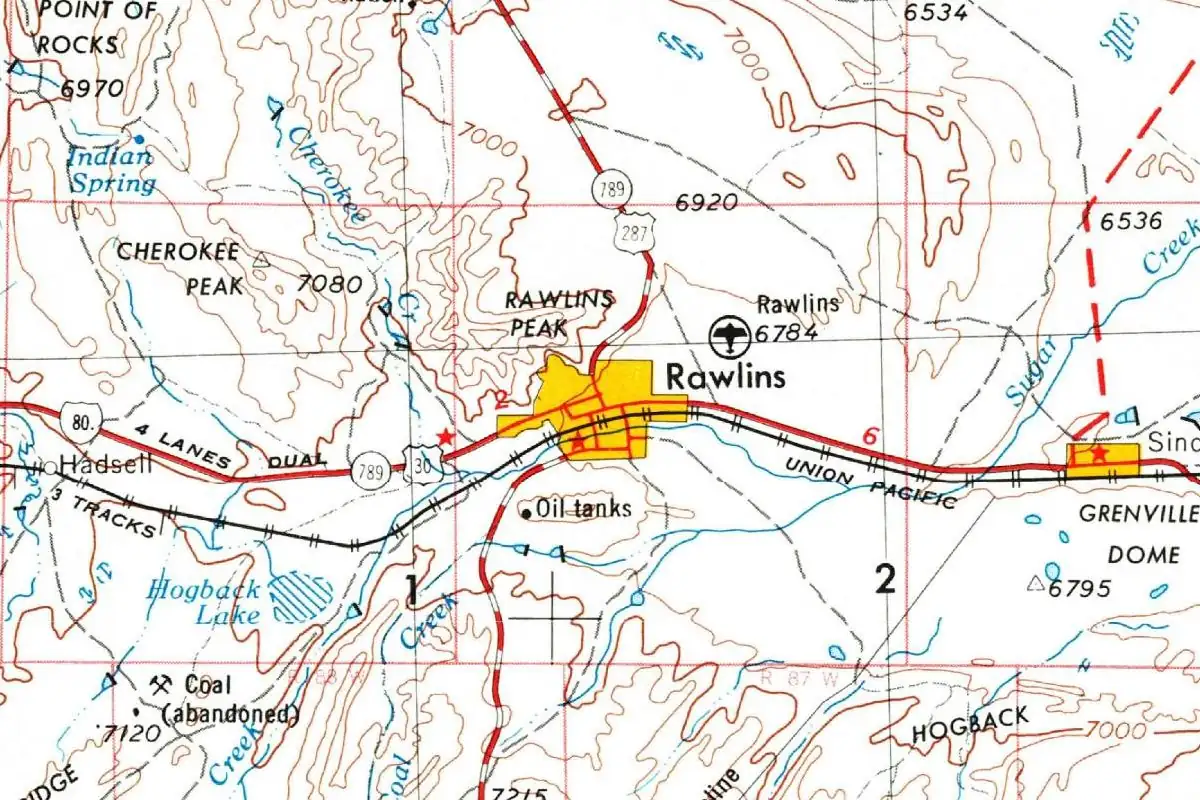
So the territory passed on the name, and the railroad camp kept it. Today Cheyenne is the capital, and the seat of Laramie County, which has its own naming story over in Laramie. On the same 1867 trip, Dodge also named a spring for one of his guests, and that’s how Rawlins got its name.
Sources & further reading
- Grenville M. Dodge, How We Built the Union Pacific Railway (1910), pp. 23–24. General Augur at the east base of the Black Hills, the division point on Crow Creek “named it Cheyenne,” Fort D. A. Russell just north of town, and the Fourth of July in camp.
- Frederick Webb Hodge, ed., Handbook of American Indians North of Mexico, part 1 (Bureau of American Ethnology, 1907), pp. 250–251. The Sioux origin of the name, “people of alien speech,” the Cheyenne name for themselves, and the note that the name has no connection with the French chien.
- Henry Gannett, The Origin of Certain Place Names in the United States (USGS, 1905), p. 79. The city named for the tribe, “Dzitzistas,” and the Sioux name “said to signify ‘aliens.’”
- I. S. Bartlett, ed., History of Wyoming, vol. 1 (1918). The Senate debate with senators “favoring ‘Cheyenne’” (p. 165); the survey finished July 27, 1867, and Cheyenne as capital and seat of Laramie County (p. 547).
- GNIS feature 1609077 (U.S. Geological Survey). The federal record for Cheyenne, “Capital of State of Wyoming,” with its coordinates.
Spot something wrong, or know more? Tell us here. You can also email us or use our contact page. Corrections are noted here with their date, never made silently.