Billings, Montana: Named for the Father, Not the Son
A 1905 federal book said Billings, Montana, was named for Parmly Billings, but the record points to his father, railroad president Frederick Billings. Every other source in this story names the father. The son’s story is worth telling anyway, because he really did live in Billings, and in 1900 the town got a library built in his memory.
A railroad town on Clark’s Fork bottom
Billings was a railroad project from the start. Before it existed, settlers had a small village called Coulson a couple of miles down the Yellowstone. A big 1921 state history edited by Tom Stout says the Minnesota & Montana Improvement Company tried to buy that site, couldn’t make a deal with the Coulson people, and laid out its own town a short way up the river instead.
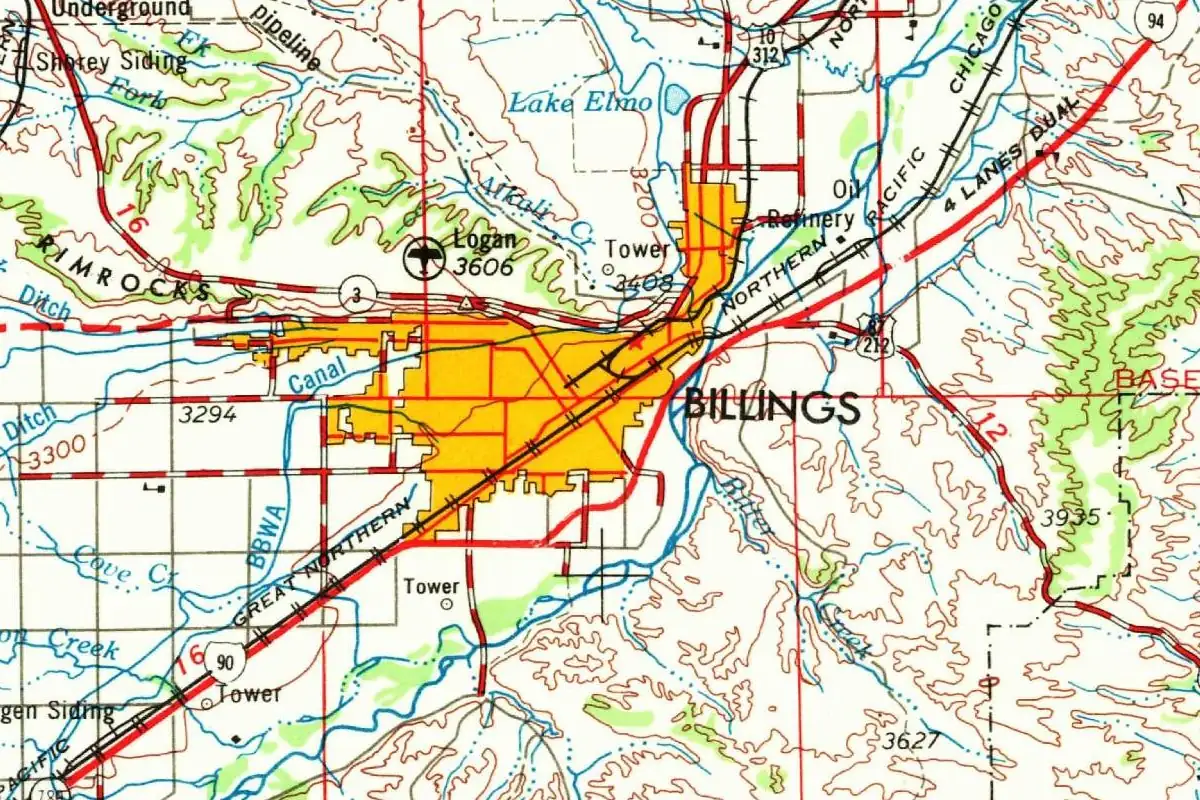
The spot came down to a creek you’d barely notice. An Illustrated History of the Yellowstone Valley (1907) quotes Mayor Fred H. Foster: Alkali Creek “commands the only practicable northern outlet from the Yellowstone valley,” and that “caused Heman Clark and Frederick Billings to locate Billings on its present site rather than at Canyon Creek or Laurel.” The townsite was platted in March 1882. When it was, there wasn’t a single building on it.
The father: Frederick Billings
The 1907 history is plain about the name: “The town was named in honor of Frederick Billings, who was the president of the Northern Pacific Railway company from May 24, 1879, until June, 1881.” Stout’s 1921 history says the same thing. So did Henry Gannett, the U.S. Geological Survey’s place-name expert, in the first edition of his book in 1902. He listed Billings, Montana, alongside Billings County, North Dakota, both named for Frederick Billings, “at one time president of the Northern Pacific Railroad.”
The son: Parmly Billings
Then Gannett changed his answer. In his 1905 second edition, he split the two entries. The North Dakota county still went to Frederick. The Montana city, he now wrote, was “named for Parmley Billings, son of the first president of the Northern Pacific Railroad.” He didn’t say why he’d changed it.
Parmly (the local histories spell it that way) wasn’t a made-up name. A biography in the second volume of Stout’s history says that around 1882, Frederick’s son Parmly was on a Billings family horse ranch in the area. The 1907 history calls him “a resident of Billings in the early days” and says he died in 1887. In 1900, his brother, Frederick Billings Jr., paid for the Parmly Billings Memorial Library in his memory.
Why the father wins
You can see how Gannett might have gotten mixed up. There was a Billings son living in Billings, and a library with his name on it. But the town was named when it was platted in 1882, and the man it honored had been running the railroad until the year before. Every local history in this story, and Gannett’s own first edition, gives the name to Frederick. The same 1907 book that tells you about Parmly’s library calls Frederick the man “after whom the city was named.” So the son got a library, and the father got the whole city.
Sources & further reading
- An Illustrated History of the Yellowstone Valley (1907), pp. 292, 302. Alkali Creek, the March 1882 plat, Frederick Billings and the dates of his presidency (p. 292); the Parmly Billings Memorial Library and Parmly’s death in 1887 (p. 302).
- Tom Stout, ed., Montana, Its Story and Biography, vol. 1 (1921), p. 851. Coulson, the Minnesota & Montana Improvement Company, and the name.
- Tom Stout, ed., Montana, Its Story and Biography, vol. 2 (1921), p. 384. Parmly Billings on the family’s horse ranch around 1882, in a biography of I. D. O’Donnell.
- Henry Gannett, The Origin of Certain Place Names in the United States (USGS, 1905), p. 47. The second edition’s “Parmley Billings” entry.
- Henry Gannett, The Origin of Certain Place Names in the United States (USGS, 1902), p. 43. The first edition’s entry, naming Frederick Billings.
- GNIS feature 802034 (U.S. Geological Survey). The federal record for the city of Billings.
Spot something wrong, or know more? Tell us here. You can also email us or use our contact page. Corrections are noted here with their date, never made silently.