How Bozeman, Montana Got Its Name From a Trail Guide
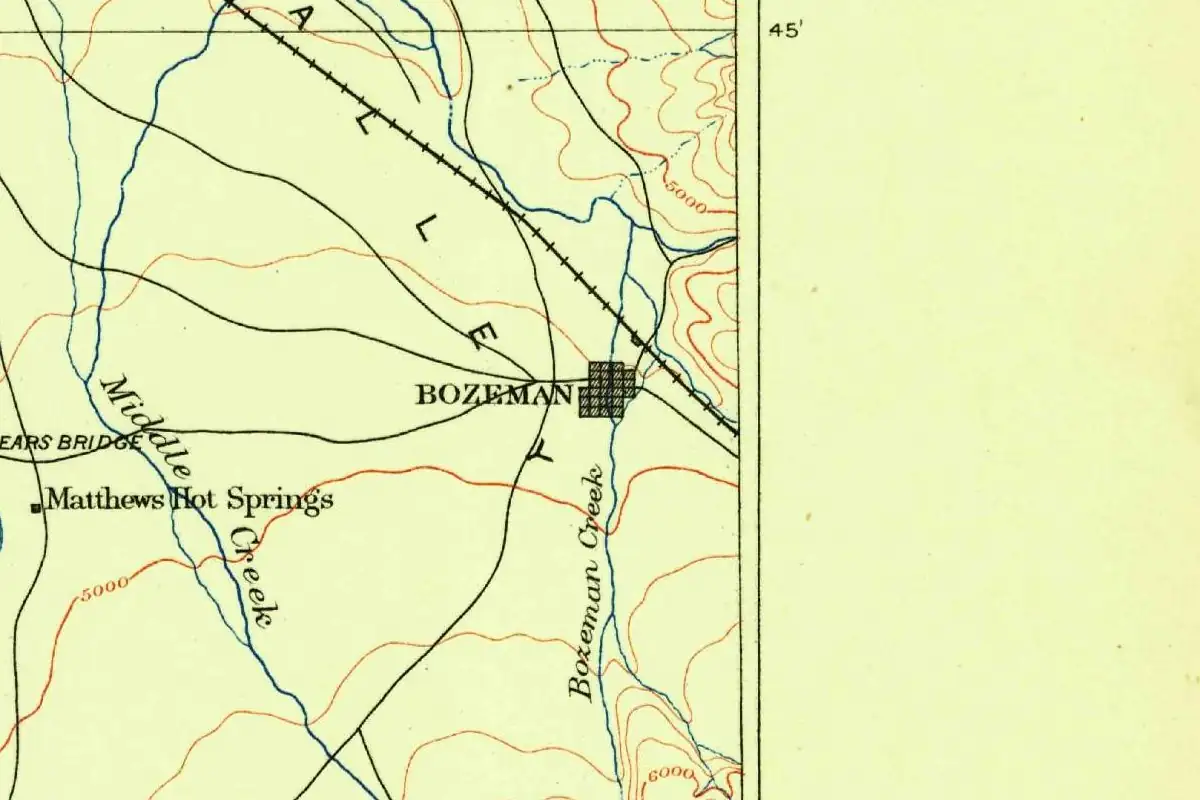
Bozeman, Montana, is named for John M. Bozeman, the trail guide who in 1864 urged two farmers to start a town there and stake a claim for him. He was killed three years later, and the town kept his name.
A shortcut to the gold fields
Bozeman first shows up in the Montana record as a gold seeker. Montana, Its Story and Biography (1921) has him arriving at Gold Creek in June 1862 with a party from the Pike’s Peak mines. What made his name was a road.
Pioneer Peter Koch, quoted at length in the same book, tells it this way. In the winter of 1862 and 1863, Bozeman and John M. Jacobs left Bannack to find a shorter route for emigrants than the long way around by the Platte. The Sioux took their horses on the Powder River, and the two were “reduced to a diet of grasshoppers” before they made it to Missouri. In 1864, Bozeman led a large wagon train over his new route. James Bridger was bringing a train in by a different road at the same time, and Koch says the two of them ended up racing into Virginia City, “within a few hours of each other.”
“Start a town”
Here’s how the town itself began. Mrs. W. J. Beall, writing for the Historical Society of Montana in 1917, says that in early July 1864, her husband and D. E. Rouse were coming home from selling potatoes in Virginia City when they ran into Bozeman, who’d come ahead of his wagon train. “He advised them to come and take up land and start a town on the location now known as Bozeman. He asked them to locate a claim for him, which they did.”
Beall and Rouse built the first two houses, out of logs they hauled from the mountains. Mrs. Beall says the line between their two claims was Bozeman Street, with Beall’s land to the west and Rouse’s to the east. So if you like, you can say the town grew up on both sides of the man’s name. Bozeman’s own claim was staked out on the south side of Main Street.
Killed on the Yellowstone
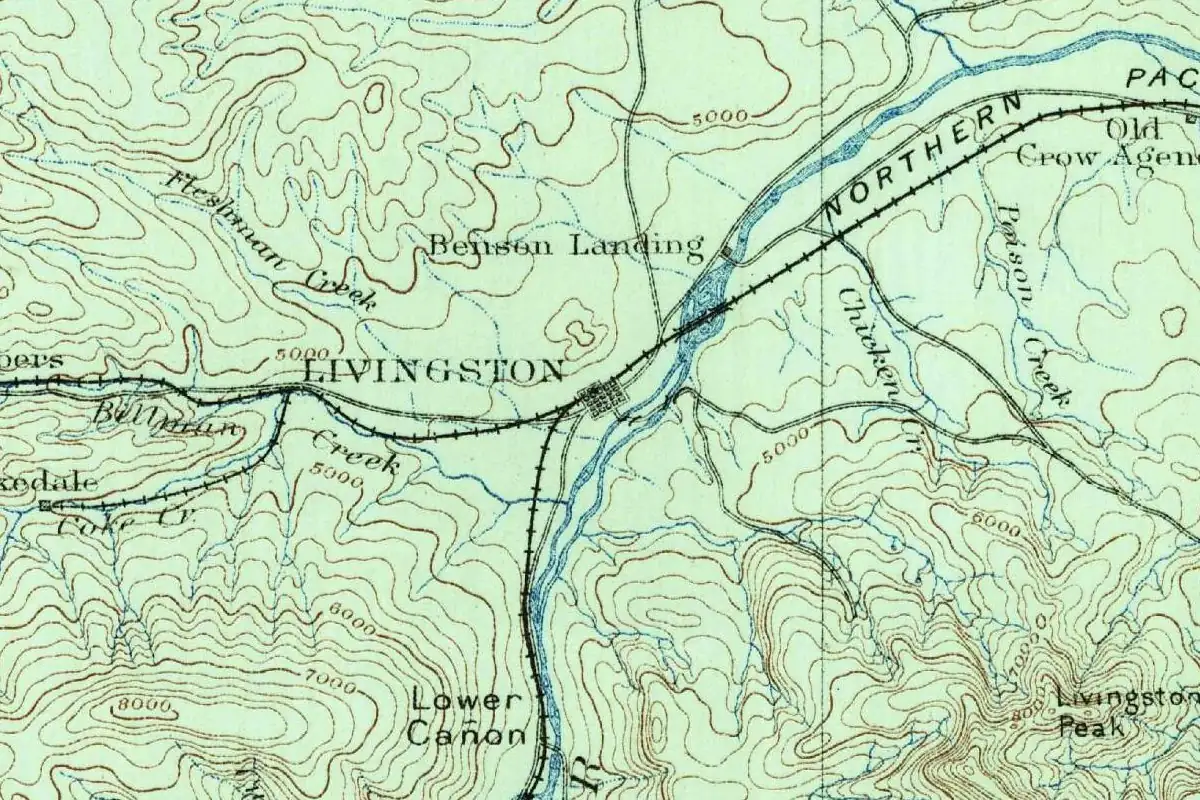
Bozeman didn’t get long to enjoy it. Koch says that in April 1867, he and Tom Coover set out down the Yellowstone. They stopped at Nelson Story’s cattle camp near Benson’s Landing, close to where Livingston would later grow up, and the next day they camped below the old Crow agency. Five Indians came toward them, leading horses that had been stolen from Story’s camp the day before. Thinking they were Crows, Bozeman and Coover let them come up and gave them dinner. Then two of them shot Bozeman. Coover got away with a grazed shoulder. Koch says it later came out that the attackers were Blackfeet who’d fled their own tribe and were living with the Crows.
Bozeman was first buried where he fell. In 1869, a Major Camp brought his body back to the town, and Nelson Story later put up a monument over the grave. “There he rests,” Koch wrote, “on the hill yonder, in sight of Bozeman, deservedly named after him.”
Trapper, pioneer, James or John?
You’ll find him described a few different ways. Henry Gannett’s 1905 place-name book for the U.S. Geological Survey says the city was “named for J. M. Bozeman, an early trapper.” Helen Fitzgerald Sanders’s 1913 History of Montana calls him “the famous pioneer, James M. Bozeman.” The pioneers who knew him, Beall and Koch, call him John M. Bozeman, and they describe a man who guided wagon trains, not one who trapped beaver. Nobody disputes that he’s the man the town is named for. The books just couldn’t agree on his first name.
Sources & further reading
- Mrs. W. J. Beall, in Contributions to the Historical Society of Montana, vol. 8 (1917), pp. 295–297. Bozeman’s advice to “start a town,” the first two houses, and the claim lines along Bozeman Street.
- Tom Stout, ed., Montana, Its Story and Biography, vol. 1 (1921), pp. 189, 306–308. Bozeman’s arrival in 1862, and Peter Koch’s account of the Bozeman road, the race with Bridger, his death in April 1867, and his reburial in 1869.
- Henry Gannett, The Origin of Certain Place Names in the United States (USGS, 1905), p. 54. “Named for J. M. Bozeman, an early trapper.”
- Helen Fitzgerald Sanders, A History of Montana, vol. 1 (1913), p. 728. “Named for the famous pioneer, James M. Bozeman.”
- An Illustrated History of the Yellowstone Valley (1907), p. 150. Benson’s Landing, where the camp that became Livingston started out.
- GNIS feature 769173 (U.S. Geological Survey). The federal record for the city of Bozeman.
Spot something wrong, or know more? Tell us here. You can also email us or use our contact page. Corrections are noted here with their date, never made silently.