Broken Arrow, Oklahoma: A Creek Town Name Older Than the Legend
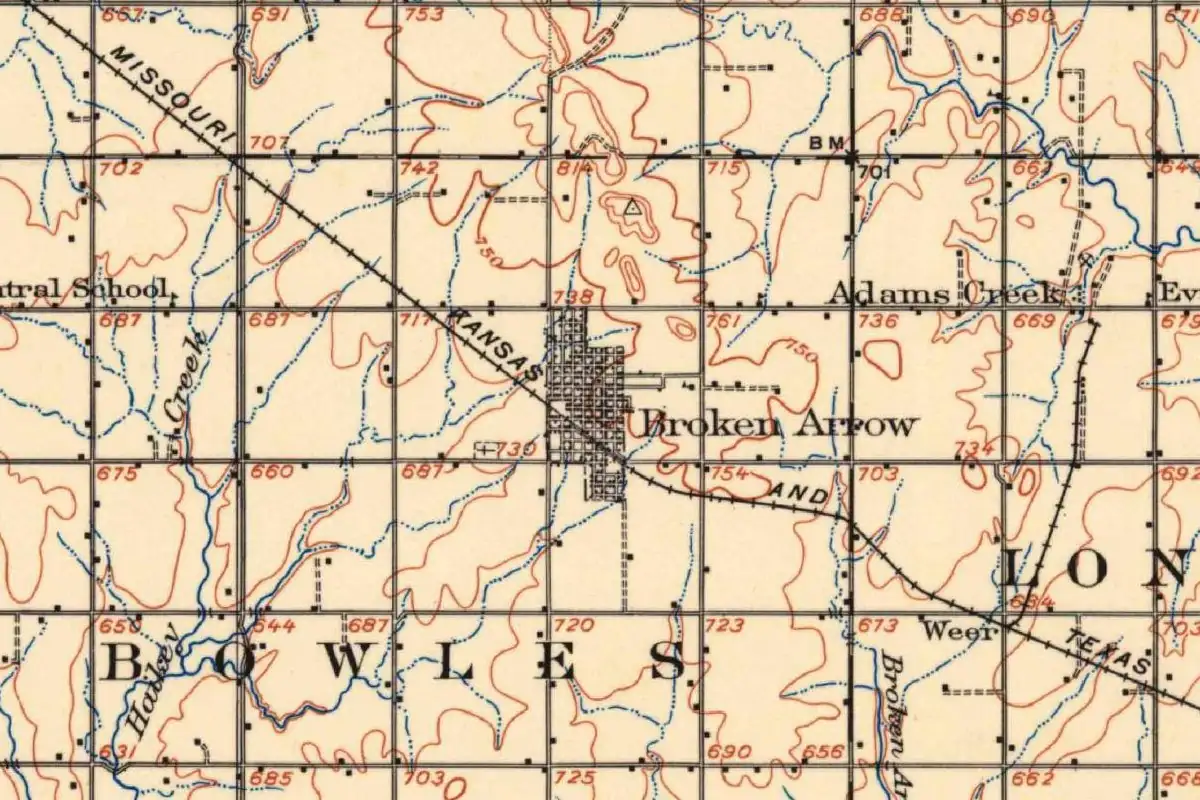
A story says Broken Arrow, Oklahoma, got its name when Creek leaders broke an arrow after the Civil War. The name is far older than that: it belonged to a Muscogee (Creek) town back in the Southeast, long before the Creeks were moved west.
The arrow on the Arkansas
The legend goes like this. After the Civil War, members of the Upper and Lower Creeks met on the banks of the Arkansas River and broke an arrow in a ceremony, and the town took its name from that. In 1976 a history of Broken Arrow came out, and a short notice in the Chronicles of Oklahoma said the book “apparently refutes” that story. According to the notice, the name came from a tribe in Georgia that found a tree good for making arrows along the Chattahoochee River bottom and learned it could break the limbs off instead of cutting them. That, it said, is how they became known as the “Broken Arrow” tribe.
So the ceremony on the Arkansas is the version you’ll hear, and the paper trail points much farther back.
A town on the Chattahoochee
The older town shows up in the Smithsonian’s Handbook of American Indians North of Mexico, from 1907, under the name Hlekatchka. The entry breaks the word down: li, “arrow,” and katchka, “broken.” It places the town on a trail and a ford of the Chattahoochee River, 12 miles below the Creek town of Kasihta, probably in what’s now Russell County, Alabama. (The 1976 notice says Georgia. The river runs along the line between the two states, and the Handbook puts the town on its west bank.)
English records were already calling it Broken Arrow in the 1790s. The Handbook lists a “Broken Arrow” from 1792 and a “Broken Arrow Old Field” from 1796. It also notes that the town was destroyed in 1814 and was apparently rebuilt, since it was represented at a treaty signed on November 15, 1827.
Broken how?
John R. Swanton, writing Early History of the Creek Indians and Their Neighbors for the Smithsonian’s Bureau of American Ethnology in 1922, says the town grew out of Coweta, one of the big Creek towns. He calls it Likatcka, “or ‘Broken Arrow’ as the name has been rudely translated into English,” and he gives two explanations:
- Reeds for arrows. The town “is said to have been founded by some families who went off by themselves to a place where they could break reeds with which to make arrows.”
- Breaking away. According to William Berryhill, whom Swanton calls “an old Coweta,” it was more because they “considered themselves to have ‘broken away’ from the parent band in much the same manner as a reed is broken.”
The 1976 notice adds a third take, the one about tree limbs snapped off for arrows. All three turn on something that breaks, and none of them needs a ceremony on the Arkansas.
West to Indian Territory
Swanton writes that after the Creek removal, Coweta “and its branches settled in the northern part of the new country on the Arkansas.” The name came along. When Army surveyors marked the Creek boundary in August 1850, their diary called Broken Arrow “the nearest Indian settlement,” and the editors who printed that diary in 1949 placed it about thirty miles southeast of present-day Tulsa. That’s a little farther out than today’s city, so you shouldn’t read it as the exact same spot.
The post office records keep the thread going. In 1948 the attorney and historian George H. Shirk printed the Indian Territory post offices as the Postmaster General had recorded them, and his list shows a Broken Arrow in the Creek Nation opened on June 9, 1881. It “did not operate” from August 21, 1882, to November 19, 1902. The town you can visit today got going right about then. A biography in Clarence B. Douglas’s 1921 The History of Tulsa, Oklahoma says a few settlers had “just started it in October” 1902, and “the railroad was not built through until July, 1903.” On the 1914 map above, it sits right on the Missouri, Kansas and Texas line.
The sources here don’t say who picked the old name for the new railroad town. What they do show is that the name was already about a century old by then. Just up the road, Tulsa also carries the name of an old Creek town; you can read how Tulsa got its name.
Sources & further reading
- Chronicles of Oklahoma, “Broken Arrow History Published” (Fall 1976), p. 401. The legend of the arrow broken on the Arkansas, and the older “Broken Arrow” band.
- Frederick Webb Hodge, ed., Handbook of American Indians North of Mexico, pt. 1 (Bureau of American Ethnology, 1907), p. 552. The entry Hlekatchka: “arrow” plus “broken,” the town on the Chattahoochee, and the English spellings of 1792 and 1796.
- John R. Swanton, Early History of the Creek Indians and Their Neighbors (Bureau of American Ethnology, 1922), p. 229. Likatcka as an offshoot of Coweta, the reeds and William Berryhill’s “broken away,” and the move to the Arkansas.
- Carl Coke Rister and Bryan W. Lovelace, eds., “A Diary Account of a Creek Boundary Survey, 1850,” Chronicles of Oklahoma (1949), p. 294. Broken Arrow as “the nearest Indian settlement” in 1850.
- George H. Shirk, “First Post Offices Within the Boundaries of Oklahoma,” Chronicles of Oklahoma (1948). The Broken Arrow post office of 1881 and its return in 1902.
- Clarence B. Douglas, The History of Tulsa, Oklahoma, vol. 3 (1921), p. 764. The town started in October 1902 and the railroad in July 1903.
- GNIS feature 1090512 (U.S. Geological Survey). Broken Arrow’s map coordinates and county.
Spot something wrong, or know more? Tell us here. You can also email us or use our contact page. Corrections are noted here with their date, never made silently.