Okemah, Oklahoma: The Chief and the Empty Shotgun
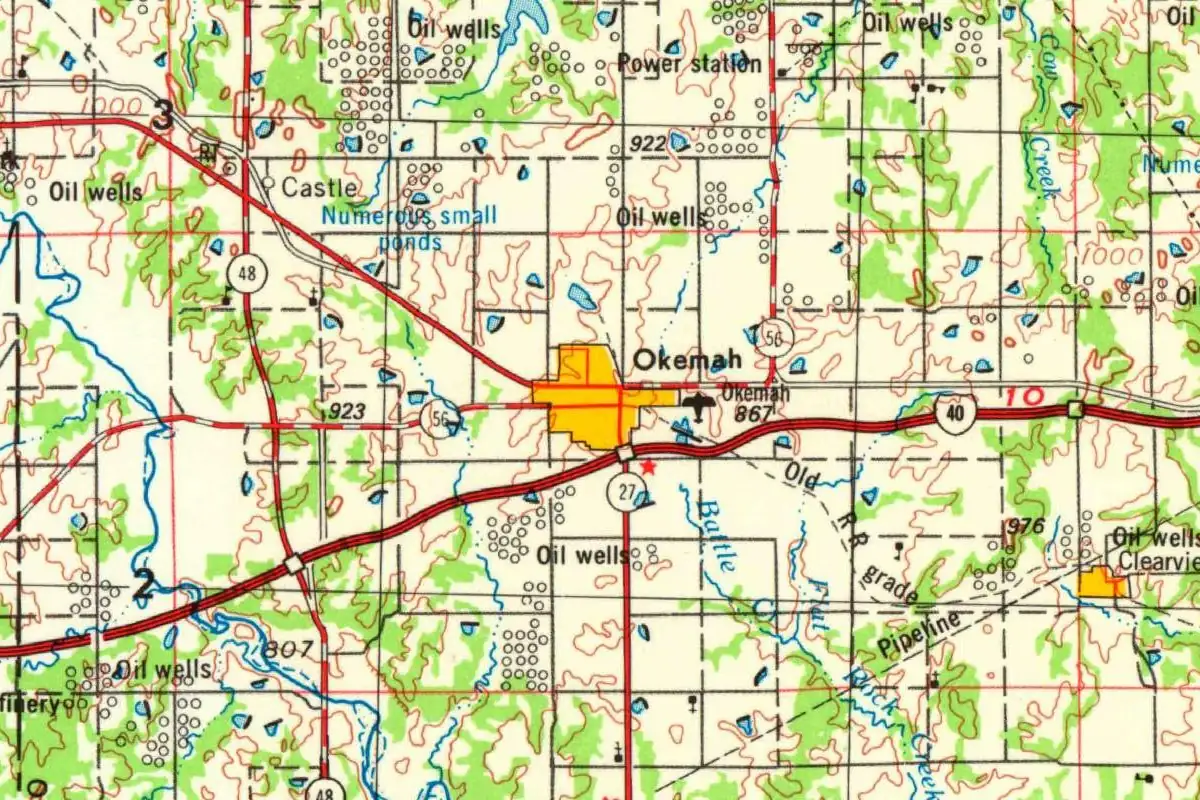
Okemah, Oklahoma, is named for a chief called Okemah. A history printed in the town’s 1952 high school yearbook says he helped scare off rowdy cowboys with a shotgun that had no shells, though who he was depends on which book you open.
A bark house on the townsite
The yearbook’s “History of Okemah” puts the chief right on the land before the town existed. He lived on the townsite from March 1902 until a week after the town opened on April 22, 1902, in “a bark house constructed in the fashion of the Kickapoos during that period,” just north of Ash Street, halfway between South 6th and 7th streets.
The history is clear about why the name went to him: “The agreeable and fine temperament of this old chief was really the cause of naming the town for him.” It also says his presence gave the camp “the appearance of substantiality,” which mattered, because the cattlemen grazing that prairie resented the “intruders” laying out a town on it.
The gun by the gate
Before the opening, the history says, cowboy gangs would ride through the town organizers’ camp “shooting and whooping, but at no one in particular.” Perry Rodkey, one of the surveyors, had an old double-barreled shotgun that didn’t work. He gave it to Chief Okemah and told him to stand by the wire gate on the east side of the townsite, or at least lean the gun there where the cowboys would see it.
“The effect was efficient,” the yearbook says. “The cowboys didn’t know that there were no shells in the gun nor that the gun wasn’t in working order.”
You can check one piece of this against the federal records. The yearbook names Rodkey as Okemah’s first postmaster, and the Postmaster General’s own records, which George H. Shirk published in 1948, show the Okemah office in the Creek Nation opening on May 16, 1902, with Perry Rodkey in charge.
Kickapoo, Creek, or a friend of the founder
Here’s where the sources part ways, and none of them backs its answer with a record from 1902.
The 1952 history calls him “Kickapoo Chief Okemah.” It says his original allotment was a mile and a half east and a mile north of Harrah, and that he died there in 1936. It’s the only source here that tells the chief’s story in any detail, but it was written fifty years after the town opened and doesn’t say where its information came from.
Shirk, the same man who published that post office list, gives a different answer in his book Oklahoma Place Names. In the 1974 edition, the name was “selected by H. B. Dexter, town developer, for Okemah, a Creek chief.” Dexter isn’t a stranger to the yearbook, either: it says he and Rodkey surveyed the land, though it never says who picked the name.
The oldest of the three is Charles N. Gould’s Oklahoma Place Names, from 1933, and Gould doesn’t give a tribe at all. He says Okemah “was from a Shawnee word meaning ‘chief,’ and was named for an Indian of the same name who was a friend of the founder of the town.”
Both of those books are lending-library copies at the Internet Archive, so their Okemah entries could only be pieced together here from the archive’s search excerpts, not read on the page. Keep that in mind with their exact wording.
So which way should you lean? On who chose the name, Shirk’s entry weighs the most, because it’s the only source that names someone. On the chief’s tribe, it’s one unsourced line in Shirk against one unsourced local history, with the oldest book of the three not taking a side, so the record here can’t settle it. The meaning is just as unsettled. Shirk says “The word is Creek and may be rendered ‘big chief,’” Gould calls it a Shawnee word for “chief,” and no dictionary or linguist among these sources confirms either one.
A song in the town’s future
Ten years after the chief’s shotgun stood by the gate, Woody Guthrie was born in Okemah. Harry Menig’s 1975 article in the Chronicles of Oklahoma follows Guthrie’s years there, from 1912 to 1929. During World War II, by then a merchant seaman, Guthrie wrote a letter from the Atlantic to the people of Okemah, and you can hear the town in it: “There is a look and a smell about your smoking timbers that even is good away out here.”
Sources & further reading
- “History of Okemah,” 1952 Okemah High School yearbook. Chief Okemah as a Kickapoo, his bark house, the empty shotgun, why the town was named for him, H. B. Dexter and Perry Rodkey as surveyors, and the chief’s allotment near Harrah.
- George H. Shirk, “First Post Offices Within the Boundaries of Oklahoma,” Chronicles of Oklahoma (1948). The Okemah post office, Creek Nation, May 16, 1902, Perry Rodkey.
- George H. Shirk, Oklahoma Place Names (University of Oklahoma Press, 1974). The name chosen by H. B. Dexter for “a Creek chief,” and the meaning “big chief.” Entry pieced together from search excerpts.
- Charles N. Gould, Oklahoma Place Names (1933). “A Shawnee word meaning ‘chief’” and “a friend of the founder of the town.” Entry pieced together from search excerpts.
- Harry Menig, “Woody Guthrie: The Oklahoma Years, 1912-1929,” Chronicles of Oklahoma (1975). Guthrie’s birth in Okemah and his wartime letter to the town.
- GNIS feature 1096198 (U.S. Geological Survey). The federal record for Okemah.
Spot something wrong, or know more? Tell us here. You can also email us or use our contact page. Corrections are noted here with their date, never made silently.