How Pawhuska, Oklahoma Got Its Name (and the Wig Story)
The first Osage chief called White Hair got his name, an old story goes, by grabbing an enemy’s hair in battle and coming away with a white wig. Pawhuska, Oklahoma, carries that chief’s name, Pah-hue-skah, and the name of the line of Osage leaders who held it after him.
A family of chiefs
White Hair wasn’t one man. Frank F. Finney, who wrote about the Osages for the Chronicles of Oklahoma, explained in 1958 that from the time of the Louisiana Purchase until shortly before the tribe moved from Kansas to the Indian Territory in 1871, “some Indian of the White Hair lineage held the rank and title of Head Chief of the Great Osages.” The line, he wrote, “faded out” with the death of the last White Hair near the Gray Horse trading post on July 27, 1894.
The first one has his own entry in the second volume of the Handbook of American Indians North of Mexico, from 1910. It calls him an influential Osage chief “known also as Teshuhimga, Cahagatonga, and Pahuska or Pawhuska, and by the French as Cheveux Blancs.” He was head man of the Great Osage, “seems to be identical” with a “Papuisea (Pahusca?)” who signed treaties from 1808 on, and died, probably soon after 1825, at his village in what’s now Vernon County, Missouri. The entry isn’t all praise. It also says the hereditary right to lead the Grand Osage belonged to Clermont, and that White Hair took it over while Clermont was still an infant. And it ends with a line that ties him to Oklahoma: “The name Pawhuska survives in that of a town in Oklahoma, the present Osage agency.”
From the agency to the town
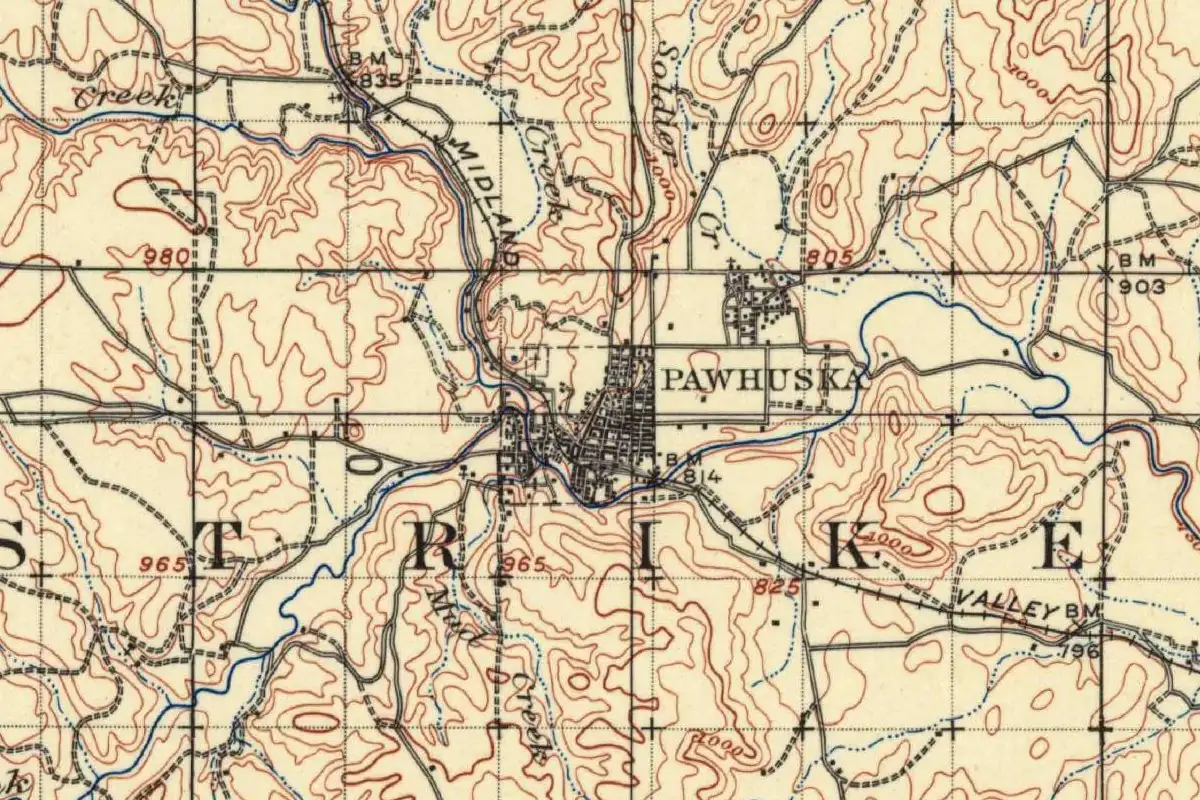
Finney filled in how that happened in a second article, in the winter 1958-59 issue. The town grew out of the Osage Agency, set up in 1872 by agent Isaac T. Gibson on Bird Creek near the middle of the reservation. A post office opened on May 4, 1876, with Lizzie Hiatt as postmistress, and “the Agency then became officially Pawhuska, from the name of the famous Pah-Hue-Skah (White Hair) chiefs.” The name, he wrote, was “suggested by Mr. John Fergusson, an employee of the trading firm of Hiatt and Company.” The Postmaster General’s records, as Shirk listed them in 1948, have the same date and the same postmistress. Bill Burchardt, writing in the Chronicles in 1963, tells it another way: an Osage clan set up a village near the center of the reservation and called it Pawhuska in honor of the chief. Either way, the name points back to the same White Hair.
What “Pawhuska” means, and that wig
The sources agree on the plain meaning. Francis La Flesche’s Dictionary of the Osage Language, published by the Smithsonian in 1932, gives pa-hiu as “the hair of a man’s head” and lists Pa-hiu’-çka, “White-hair,” as a personal name. A 1906 History of the Osage Nation by Philip Jackson Dickerson says the same: Pa-hu-ska, “the name of a chief, means White Hair.”
How the first chief got the name is where the stories split.
- A wig from St. Clair’s troops. Finney tells it “according to a legend.” In a fight with American troops led by General St. Clair, the chief wounded an officer, grabbed for his hair, and it “turned out to be a white wig.” After that, Finney says, whenever the chief went into a fight he wore the wig tied to his scalp lock as “good medicine.”
- A wig in the Revolution. Burchardt’s 1963 article moves the story to a different war and a different side. His version has the chief fighting “in alliance with the colonies during the American Revolution” and pulling the wig off a British officer.
- A sacred buffalo. La Flesche’s dictionary doesn’t mention a wig at all. Next to Pa-hiu’-çka it says: “Refers to the sacred white buffalo.”
Two wig stories that don’t agree on the war, and a dictionary that points somewhere else entirely. Finney himself added a footnote that’s worth keeping in mind if you go looking for more: “There is some confusion regarding the White Hair family.”
A vice president in the family tree
Finney’s 1958 article ends up somewhere you might not expect. “Also out of the Pah-hue-skah heritage,” he wrote, came “the late Honorable Charles Curtis, Vice-President of the United States,” and he quoted a 1930 letter from Curtis tracing his family back to a marriage with one of White Hair’s daughters. So the same name sits on the old Osage agency town and in a vice president’s family tree.
Sources & further reading
- Frank F. Finney, “Old Osage Customs Die With the Last Pah-hue-skah,” Chronicles of Oklahoma (Summer 1958), pp. 131-132. The White Hair line of head chiefs, the city named in its honor, the wig legend and the Charles Curtis letter.
- Frank F. Finney, “The Osages and Their Agency During the Term of Isaac T. Gibson, Quaker Agent,” Chronicles of Oklahoma (Winter 1958-1959), p. 416. The agency of 1872, the post office of May 4, 1876, and John Fergusson’s suggestion.
- Frederick Webb Hodge, ed., Handbook of American Indians North of Mexico, pt. 2 (Bureau of American Ethnology, 1910), p. 944. The entry White Hair, “Pahuska or Pawhuska,” and the town that keeps the name.
- Francis La Flesche, A Dictionary of the Osage Language (Bureau of American Ethnology, 1932), p. 126. Pa-hiu, “the hair of a man’s head,” and the personal name Pa-hiu’-çka, “White-hair,” tied to the sacred white buffalo.
- Bill Burchardt, “Osage Oil,” Chronicles of Oklahoma (Autumn 1963), p. 255. The clan village called Pawhuska and the Revolutionary War version of the wig story.
- Philip Jackson Dickerson, History of the Osage Nation (1906). “Pa-hu-ska, the name of a chief, means White Hair.”
- George H. Shirk, “First Post Offices Within the Boundaries of Oklahoma,” Chronicles of Oklahoma (1948). The Pawhuska post office, Osage Nation, May 4, 1876.
- GNIS feature 1096476 (U.S. Geological Survey). Pawhuska’s place in Osage County and its coordinates.
Spot something wrong, or know more? Tell us here. You can also email us or use our contact page. Corrections are noted here with their date, never made silently.