Tahlequah, Oklahoma, and the "Two Are Enough" Legend
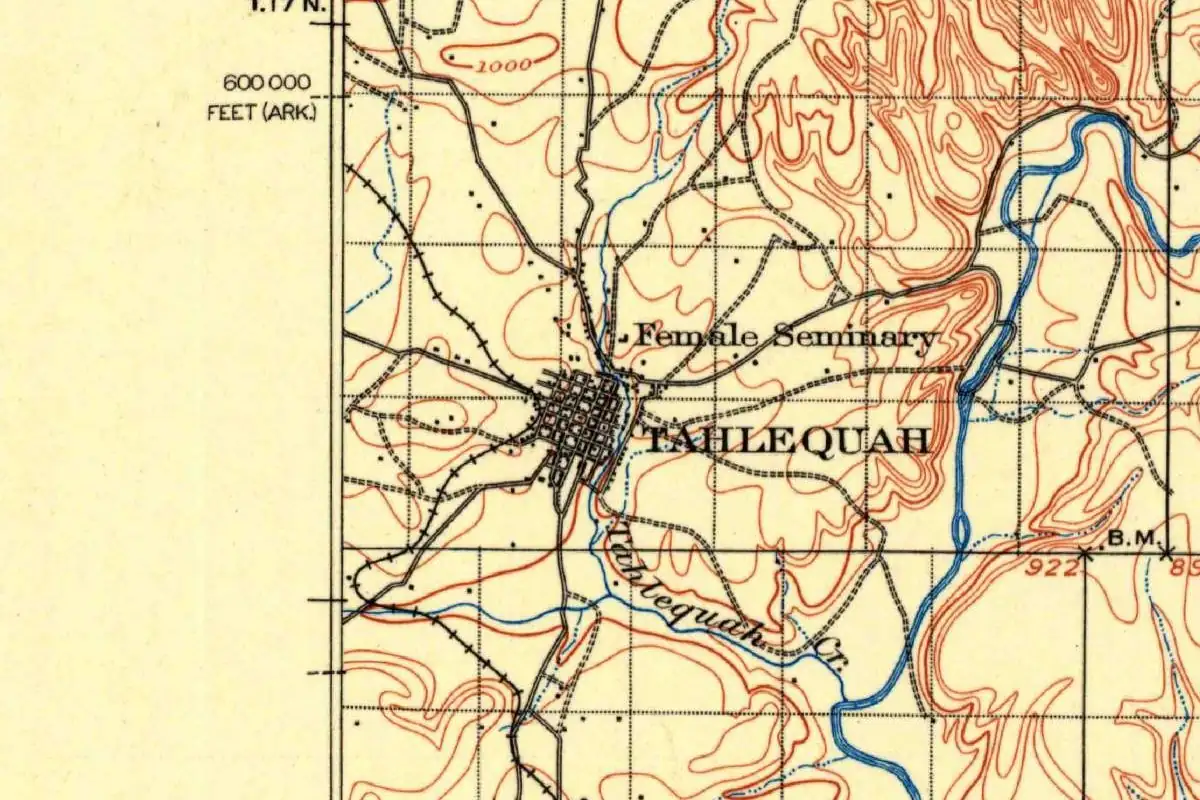
The AP told newspapers in 1963 that Tahlequah, Oklahoma, meant “two are enough.” The name really came from Tellico, an old Cherokee town name from back East, and the scholars who traced it there said its meaning had been lost.
Three men, two showed up
The Associated Press story ran that spring in papers from Missouri to Wisconsin. It told it like this: after the Trail of Tears journey from Georgia to Indian Territory, the Cherokees sent three commissioners out to find a site for a new capital. Two of them met on the Illinois River. After a wait for the third, one of the two finally said “Tah-le-quah,” or “two are enough,” and the town site was settled.
Notice the words the AP itself used to set it up: “According to legend.” That’s the right way to read it. It’s a good story, but the AP didn’t point to any record of anyone actually saying it.
An old name from Tennessee
James Mooney studied the Cherokees for the Smithsonian’s Bureau of American Ethnology, and he talked with old men and women at Tahlequah along the way. In 1900 he published Myths of the Cherokee. He says that when the Cherokee Nation reunited in the West in 1839, the council ground at Tahlequah became the seat of government, and the town laid out there took “its name from the old Cherokee town of Talikwa’, or Tellico, in Tennessee.”
His glossary goes further. Talikwa’, “commonly written Tellico, Telliquo or, in the Indian Territory, Tahlequah,” was the name of several Cherokee settlements over the years: Great Tellico, at Tellico Plains in Monroe County, Tennessee; Little Tellico, in Macon County, North Carolina; a town on Valley River in North Carolina; and Tahlequah, “established as the capital of the Cherokee Nation, Indian Territory, in 1839.” Then comes the line that matters most here: “The meaning of the name is lost.”
Frederick Webb Hodge’s Handbook of American Indians North of Mexico said the same in 1910. Its Tahlequah entry calls it “an old Cherokee town name,” says it was “corrupted in the E. to Tellico,” and puts “meaning lost” right next to the Cherokee form.
How it sounded in 1849
You can almost hear the connection in a letter a traveler wrote from Tahlequah in 1849. Melissa Moore, headed for Texas, wrote to her family in Illinois and put the pronunciation right in the heading: “Tahlequah= pron’ced Taleko.” When the Chronicles of Oklahoma printed the letter in 1955, the editors pointed out that “Taleko” is nearly “Tellico.”
The post office had trouble with the spelling too. According to the Postmaster General’s books, as Shirk transcribed them in 1948, Park Hill changed its name to Tahlequah on May 6, 1847. The office was first written down as “Tallequah,” and sometime between August 1855 and May 1856, someone in the Postmaster General’s office corrected the books “by pen” to read Tahlequah.
What it means
Put the two versions side by side and you get this:
- Meaning lost. Mooney (1900) and the Handbook (1910), the two sources that trace the name to Tellico, both say nobody knows what the word meant anymore.
- “Two are enough.” The legend of the three commissioners, which the 1963 AP story itself labeled as legend.
So the name is an old one the Cherokees brought west with them. What it first meant was already lost when Mooney went looking more than a century ago. The story of the two tired commissioners is a legend about the name, not the place it came from.
Sources & further reading
- Associated Press, “Quorum Present, Town Is Named” (Appleton Post-Crescent, May 8, 1963), and the same AP story in the Sikeston Daily Standard (March 21, 1963). The “two are enough” legend, told “according to legend.”
- James Mooney, Myths of the Cherokee (Bureau of American Ethnology, 1900), p. 147 and glossary, p. 533. Tahlequah named for the old Cherokee town of Talikwa’, or Tellico; “The meaning of the name is lost.”
- Frederick Webb Hodge, ed., Handbook of American Indians North of Mexico, pt. 2 (Bureau of American Ethnology, 1910), pp. 671 and 726. The entries Tahlequah (“meaning lost”) and Tellico.
- Chronicles of Oklahoma, “A Letter from Tahlequah, Cherokee Nation, 1849” (1955). Melissa Moore’s “pron’ced Taleko” and the editors’ note on Tellico.
- George H. Shirk, “First Post Offices Within the Boundaries of Oklahoma,” Chronicles of Oklahoma (1948). Park Hill renamed Tahlequah in 1847 and the “Tallequah” spelling fixed by pen.
- GNIS feature 1098721 (U.S. Geological Survey). Where the federal database places Tahlequah: Cherokee County, with its coordinates.
Spot something wrong, or know more? Tell us here. You can also email us or use our contact page. Corrections are noted here with their date, never made silently.