Park City, Utah: The Park Was a Meadow Named for Parley
The “Park” in Park City, Utah, is Parley’s Park, a mountain meadow named for Parley P. Pratt, the Mormon apostle who cut a toll road through the canyon. So the ski town got its name secondhand: from the meadow next door, which got its name from the man who made the road.
A park that’s really a meadow
Parley’s Park isn’t a park in the city sense. Andrew Jenson, the assistant church historian who wrote a long series on the origins of Western place names for the Utah Genealogical and Historical Magazine, called it “a beautiful meadow on the east of the Wasatch mountains.” In 1920 he put the town’s story in one line: “Park City takes its name from its location adjacent to Parley’s Park.”
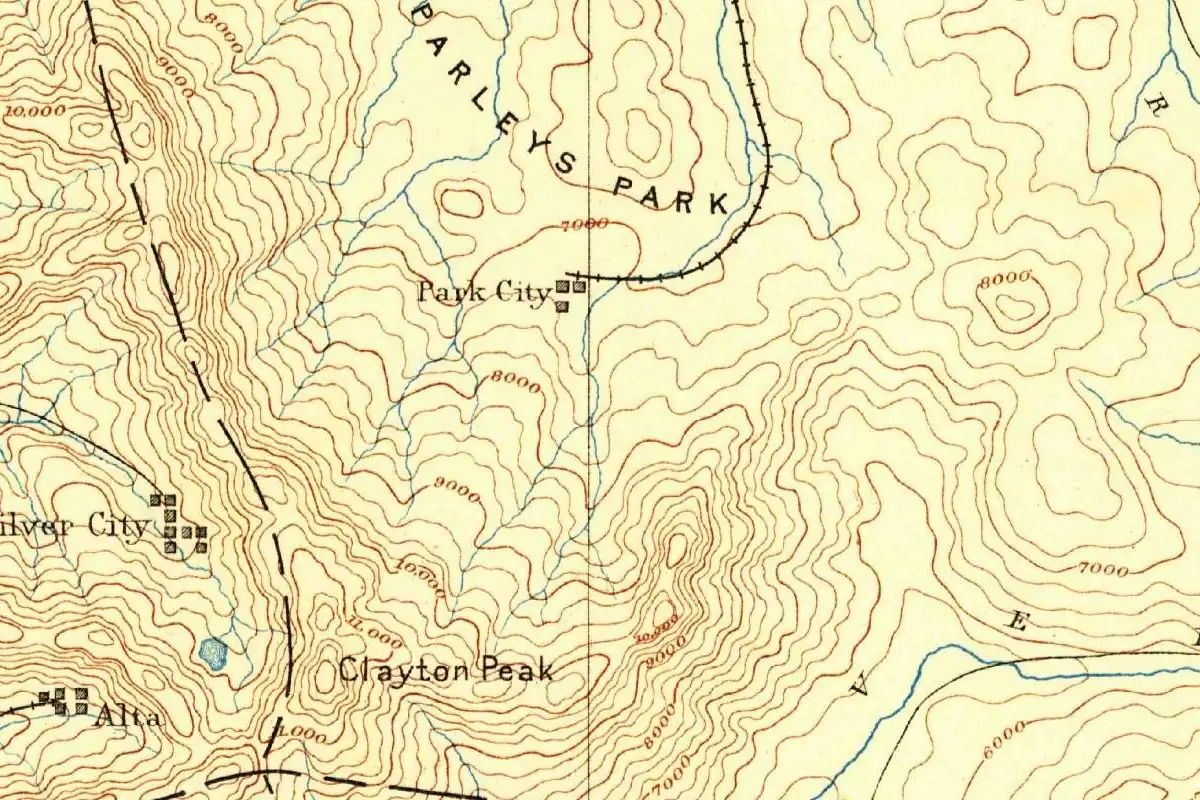
You can see that on the 1885 U.S. Geological Survey map at the top of this page. The words PARLEYS PARK run across the sheet, and the little cluster of blocks labeled Park City sits right below them.
Parley Pratt’s road
Pratt was one of the Twelve Apostles of the Church of Jesus Christ of Latter-day Saints, and he was living in the new settlement in the Salt Lake Valley by 1848. His autobiography, published in 1874, years after his death, tells how the park entered the picture. In the summer of 1849, his crops failed, so he went to work on a road up a rugged canyon east of Salt Lake City. He’d explored it the year before, he wrote, along with “a beautiful park” beyond it. A footnote in the book adds: “Since called Parley’s Park.”
The timing was good. “Emigrants now came pouring in from the States on their way to California to seek gold,” Pratt wrote, and those were the people his road ended up serving. In July 1850 he opened it “for the California emigration,” and he says the tolls that first season came to about $1,500. Jenson adds that the road opened on July 4, 1850, under the name of the Golden Gate, and that the canyon itself became Parley’s Canyon.
Who put Parley’s name on the park?
Here the sources don’t quite line up. Jenson says that in 1850, while Pratt was building the road, he camped overnight in that meadow “and called the place Parley’s Park,” then laid claim to the valley and had a small cabin built on Spring Creek. Pratt’s own book puts his first look at the park two years earlier and never says he named it. It just calls it “a beautiful park,” and the footnote says it was “since called” Parley’s Park. Rufus Wood Leigh’s 1961 guide to Utah place names, which describes “lush meadows on the highland,” says the same: the canyon and meadow “have since been known” by Pratt’s name.
Either way, the Parley is Pratt. Jenson also says Pratt sold his claim to Samuel Snyder, who wanted the spot for a sawmill, for a yoke of cattle. Jenson puts Pratt’s little cabin on what he calls “the present site of Snyderville,” a village in the park.
The silver camp up the creek
For about twenty years, the park was a place for a sawmill, a handful of settlers and Kimball’s station on the overland mail route. Then came the miners. According to the Utah History Encyclopedia, the first recorded claim in the district, the Young American lode, was filed on December 23, 1869. The big one came on July 19, 1872, when, by Edward Tullidge’s account in his 1889 history, a prospector named Herman Budden “drifted to Parley’s Park,” spotted some promising rock, and staked a claim he called the Ontario. H. H. Bancroft’s 1889 History of Utah calls it “the famous Ontario mine” at Park City, and by the end of 1883 its total output had passed $17 million.
The camp that grew around the Ontario became one of Utah’s great silver towns, and it belongs with the other mining boomtowns on this site. It incorporated as a city in 1884.
The longer name in later histories
The Park City Museum says the town carried Parley’s name until it incorporated in 1884. That’s when “Parkites decided to drop Parley’s name from the town, but kept the latter half of the name, officially becoming Park City.” Leigh’s book gives the naming of the camp to George Gideon Snyder, “drawing on the name of Parley’s Park to the north.” We didn’t find any 1870s paperwork to confirm either detail, so take them as the version later historians tell.
The man who isn’t in the name anymore
So where did Parley go? He’s still on the map, just not on the town. The Park City Museum says his toll road is now Route 80, through Parley’s Canyon, so if you drive up from the valley, you’re more or less following his route, minus the toll. And Leigh was still calling the meadow north of town Parley’s Park in 1961.
That’s the odd thing about the name. The town kept the half that described the land and let go of the half that honored the man, which is why this Utah town sounds like it’s named for a park, when the story really starts with Parley.
Quick answers
Is Park City named after a park?
Yes, but not a city park. It’s named for Parley’s Park, a mountain meadow next to town, according to Andrew Jenson’s 1920 list of Western place names.
Who was Parley’s Park named for?
Parley P. Pratt, a Mormon apostle who built a road through the canyon east of Salt Lake City in 1849 and 1850. Jenson says Pratt named the meadow himself, while Pratt’s own autobiography only says it was “since called” Parley’s Park.
Was Park City ever called Parley’s Park City?
Possibly. The Park City Museum says the town dropped Parley’s name when it incorporated in 1884 and kept the “Park City” half, but we didn’t find early documents that show the longer name in use.
Was Park City a mining town?
Yes. It grew up around the Ontario silver mine, staked in 1872, and the first claim in the district was recorded in 1869.
Key dates
- 1848Parley P. Pratt explores the canyon east of Salt Lake City and the meadow beyond it, later called Parley's Park.
- 1849In July, Pratt starts building a road up the canyon.
- 1850In July, Pratt opens his road to California-bound emigrants and collects about $1,500 in tolls that season.
- 1869December 23: the Young American lode becomes the first recorded claim in what turned into the Park City mining district.
- 1872July 19: Herman Budden stakes the Ontario, the silver mine Park City grew up around.
- 1884Park City incorporates as a city.
- 1885A U.S. Geological Survey map prints Parleys Park just above Park City.
Getting there
The closest airports, Amtrak stations and intercity bus stops, measured in a straight line from the center of Park City.
Airports
- Salt Lake City International (SLC) 27 mi 43 km
- Provo Municipal (PVU) 32 mi 51 km
Amtrak trains
- Salt Lake City station (SLC) 23 mi 37 km
- Provo station (PRO) 30 mi 49 km
Intercity buses
- Salt Lake Express Park City 6 mi 10 km
- Greyhound Salt Lake City UT - Intermodal Trans. Hub (SLB) 23 mi 37 km
Distances are as the crow flies, not by road. We don't list schedules or fares because they change; check with the airline, Amtrak or the bus company before you go. Official data (FAA commercial service airports (2025), FAA airport locations, Amtrak stations and Intercity Bus Atlas) from the FAA and the U.S. Bureau of Transportation Statistics, checked Oct 31, 2026.
Historical Sources & References
- Andrew Jenson, “Origin of Western Geographic Names,” Utah Genealogical and Historical Magazine, vol. 11 (1920), pp. 171-172. The key source: Park City “takes its name from its location adjacent to Parley’s Park”; Pratt camping in the meadow and calling it Parley’s Park; the sale to Samuel Snyder for a yoke of cattle; and the road through Parley’s Canyon opened July 4, 1850, as the Golden Gate.
- The Autobiography of Parley Parker Pratt (1874), pp. 407 and 413. Pratt’s own account: exploring the canyon and “a beautiful park” the year before 1849, the footnote “Since called Parley’s Park,” and opening the road in July 1850 with about $1,500 in tolls.
- Rufus Wood Leigh, Five Hundred Utah Place Names (1961), pp. 73-74. Dates Pratt’s exploration to 1848, says the canyon and meadow “have since been known” by his name, and credits George Gideon Snyder with naming the mining camp.
- Edward W. Tullidge, Tullidge’s Histories, vol. 2 (1889), p. 605. Herman Budden in Parley’s Park and the staking of the Ontario on July 19, 1872.
- H. H. Bancroft, History of Utah, 1540-1886 (1889), p. 744. The Ontario mine at Park City, discovered in 1872, and its output through 1883.
- Philip F. Notarianni, “Park City,” Utah History Encyclopedia (1994). The Young American lode as the district’s first recorded claim, December 23, 1869, and Park City’s incorporation in 1884.
- Diane Knispel, “A Brief Look at Parley Pratt’s Life,” Park City Museum (2021). The museum’s account of the name Parley’s Park City and of dropping Parley’s name at incorporation in 1884.
- GNIS feature 1444206 (U.S. Geological Survey). The federal record, county and coordinates for Park City.
Spot something wrong, or know more? Tell us here. You can also email us or use our contact page. Corrections are noted here with their date, never made silently.