Flagstaff, Arizona: Which Flagpole Gave the Town Its Name?
Old-timers in Flagstaff, Arizona, never agreed on which pine tree the town is named for, and one of the candidates ended up as firewood in a saloon. They all agreed on the basic idea: somebody stripped a pine of its branches and flew the American flag from it, and the spot became known as the flagstaff. The version most people tell credits a party of settlers from Boston on the Fourth of July, 1876, the country’s 100th birthday.
The Boston party’s centennial pole
The town’s own paper settled the question, or tried to, in February 1894. Under the headline “How Flagstaff Was Named,” the Coconino Sun said it had gotten the facts from three early settlers: Frank Hart, the wool grower Thomas F. McMillan and a Flagstaff builder named Wilson. Its story goes like this. A few days before the Fourth of July, 1876, “a party of settlers on their way from Boston, Mass., to Prescott, Ariz.” was camped at McMillan’s corral, by a spring just north of town. They decided to rest and celebrate the republic’s 100th birthday “amid the pines of Arizona.”
The party’s carpenters picked a pine, trimmed it and smoothed it, and put a gilt ball on top. On the morning of the Fourth they raised it “with the proper ceremony,” with a coin under the base, a nickel the paper believed. The flag flew for the two weeks or so the party stayed. Hart and McMillan said the pole stood for several years until it rotted off at the ground. “But the location was known by all the old settlers as ‘The Flagstaff,’” the Sun wrote, “and with the advent of the railroad and the locating of a station here it was called Flagstaff.”
Who were these people? James H. McClintock, writing a big history of Arizona in 1916, says they came out with a Boston company that planned a colony at the base of the San Francisco Mountains and set out in the late spring of 1876. The rich farmland and the minerals didn’t pan out, he says, so the colonists moved on to Prescott, where the expedition broke up. McClintock’s verdict was that the trip left “one permanent record,” the name of Flagstaff, and he reprinted the Sun’s story to explain it.
Chopped down, or left standing?
Even the people who agreed on the Boston party didn’t agree on the tree. In 1899 the Sun went after another paper, the Pick and Drill, which had a member of the party climbing “a young pine tree” and cutting off the branches so the flag could fly from the top. The Pick and Drill said the tree was a big one, about 18 inches (46 cm) across, near Antelope Spring west of town, and that a scrap of cloth still waved from it in 1882. The Sun reprinted that to “show their inaccuracy” and repeated its own account, now saying the pine was “cut down, trimmed and smoothed” before it went up.
Then there’s Horace E. Mann, one of the Bostonians himself. McClintock, who called Mann’s “the best story at hand,” wrote in his 1921 book on Mormon settlement that there were actually two Boston parties, and Mann was with the first. He said he and a few others went ahead, camped at a small spring where Flagstaff is now, and late in June 1876, mostly for something to do, cut the limbs off “a straight pine tree that was growing by itself.” The flag belonged to a Rhode Islander named Tillinghast. “The tree was not cut down,” McClintock writes. “It was left standing upon its own roots.” Mann was sure he reached Prescott in June, so he wasn’t there for the Fourth. According to McClintock, the main group arrived a few days later and held its centennial celebration around that pole.
One man who would have known was John A. Wilson, a carpenter from Maine. When he died in 1908, the Sun’s obituary said he’d come to Flagstaff with the Boston party and “was one of the party that peeled and topped the tree, and raised the stars and stripes over our city, hence the name, Flagstaff.” Peeled and topped, it says. It doesn’t say cut down.
Lieutenant Beale’s tree and the saloon firewood
The Boston story wasn’t the first one in circulation. The 1894 article opens by knocking down what it calls “the commonly accepted story”: that Lieutenant Beale and his escort trimmed a pine on the town site and ran the stars and stripes up it on some Fourth of July. That tale, the Sun said, came from “the imagination of some newspaper writer.” Beale may have celebrated the holiday in the San Francisco Mountains, it allowed, but not near Flagstaff.
Not everybody bought that. In 1926 the Sun ran a long piece by Colonel George Hochderffer, who’d come to town in April 1887, under the headline “In Flagstaff’s Baby Days It Had Numerous Flagstaffs.” He remembered several trimmed pines with flags on them, and he described a dead, wormy tree on a knoll just north of the tracks, with stubs of its limbs left on for steps. He said it was the pine Beale’s survey party had trimmed and that people back then took it for “the flagstaff of Flagstaff.” In January 1888 a local character known as Old Bismarck cut it down, and it was burned in Sandy Donahue’s saloon. Hochderffer kept some of the wood. His brother turned a piece into a rolling pin for Hochderffer’s wife.
He granted that the 1876 Boston pole near the Clark ranch spring mattered to history. But in his opinion the name came from the Beale tree, because it stood on such a prominent rise for so many years. He also passed along a story from a man named Bill Hull: the Boston pole was taken down soon after, for the five-dollar gold piece that was supposed to be at the bottom of it. The coin turned out to be a quarter.
Flagpole or Flagstaff?
Whatever tree it was, the name had to stick to a post office. Will C. Barnes, in his 1935 book of Arizona place names, says old-timers insisted the first postmaster was “Doc” Brannen, but “Washington records tell a different story”: the office was established on February 21, 1881, with Thomas McMillan (Barnes spells it McMillen) as postmaster, and Brannen succeeded him on May 23, 1881. The federal place-names database also calls McMillan the first permanent settler and first postmaster of Flagstaff, in its record for McMillan Mesa.
Brannen still turns up when it comes to the name itself. Hochderffer had heard, secondhand, that at a meeting in Old Town to set up a post office, Ed Whipple suggested “Flagpole” and Brannen moved to amend it to “Flagstaff,” which carried. One of the accounts Barnes prints also has “Doc Brannen” asking, “how about calling it Flagstaff.” Hochderffer was careful to say he got his version “from hearsay,” and we didn’t find any record of that meeting. As for the Boston story, Barnes quoted a chamber of commerce account of the 1876 party and called it “undoubtedly correct.”
From the flagpole to Route 66
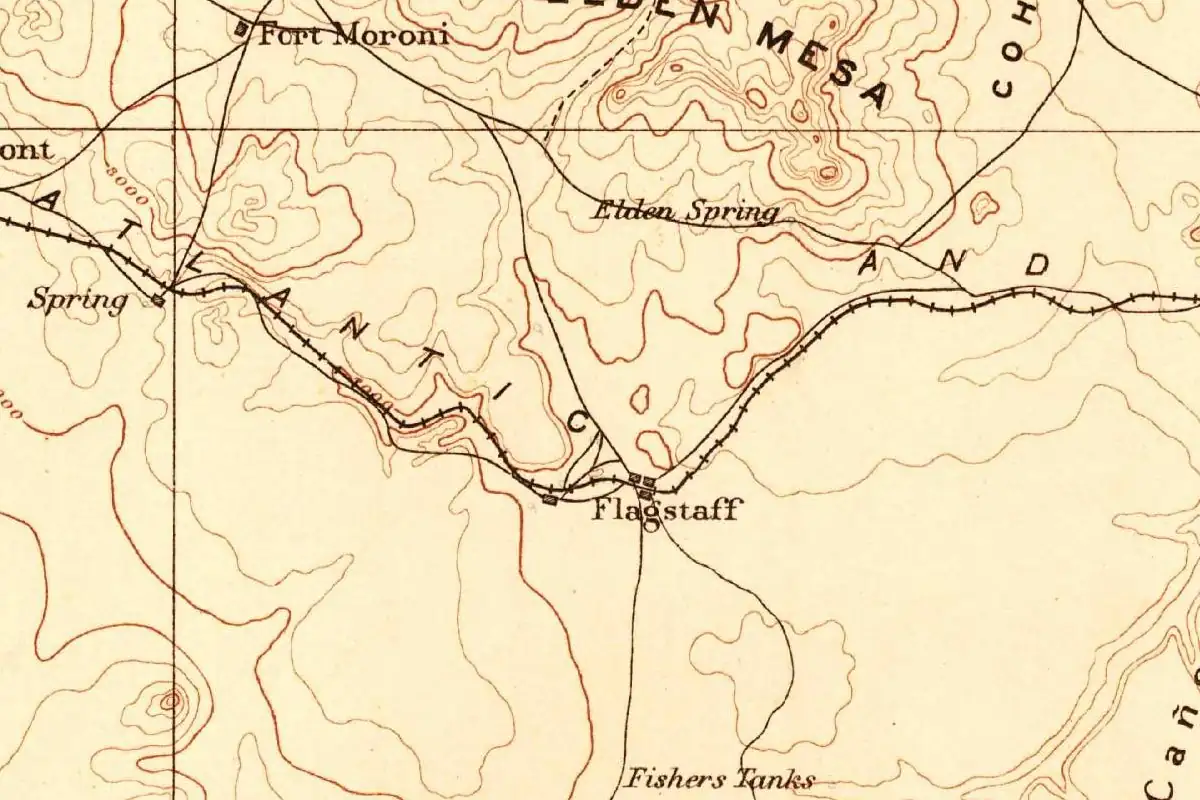
The railroad is what turned the spot by the spring into a town. The Discover Flagstaff history page says the Atlantic and Pacific tracks reached Flagstaff on August 1, 1882, and you can see the line on the 1886 Geological Survey map at the top of this page, with Flagstaff marked right where the roads meet the rails.
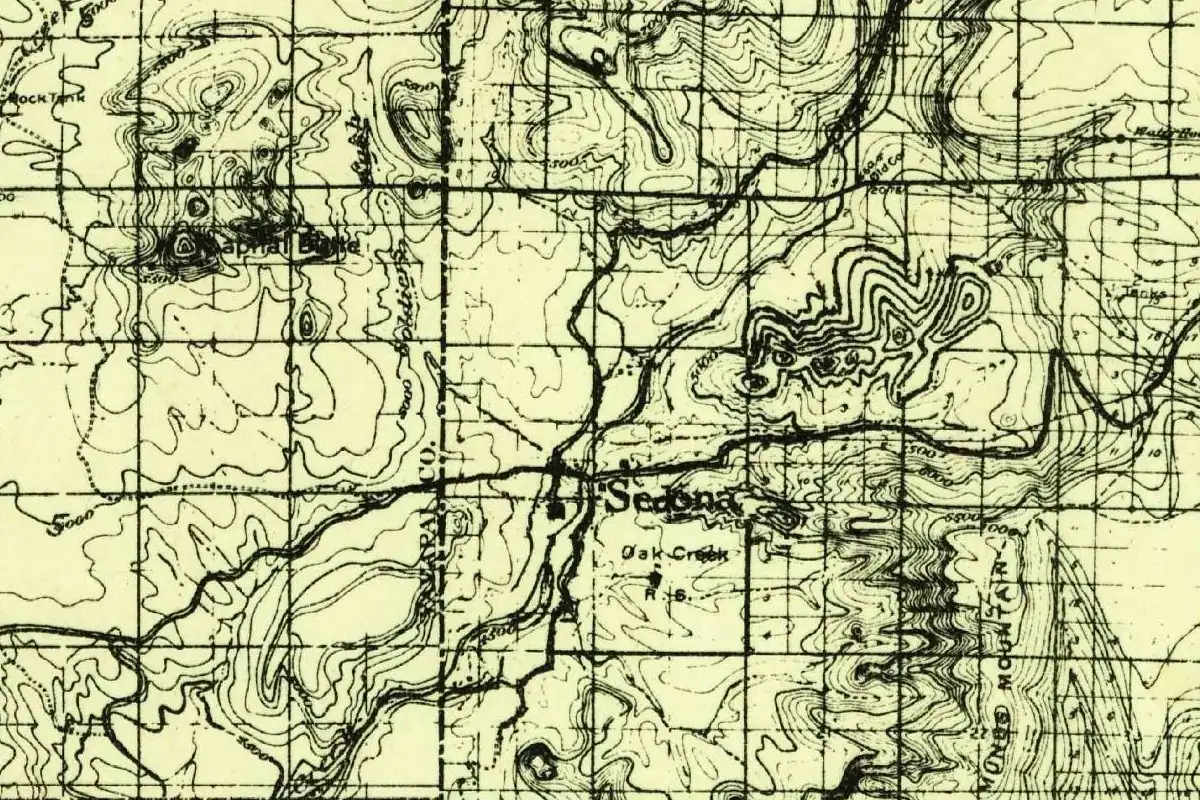
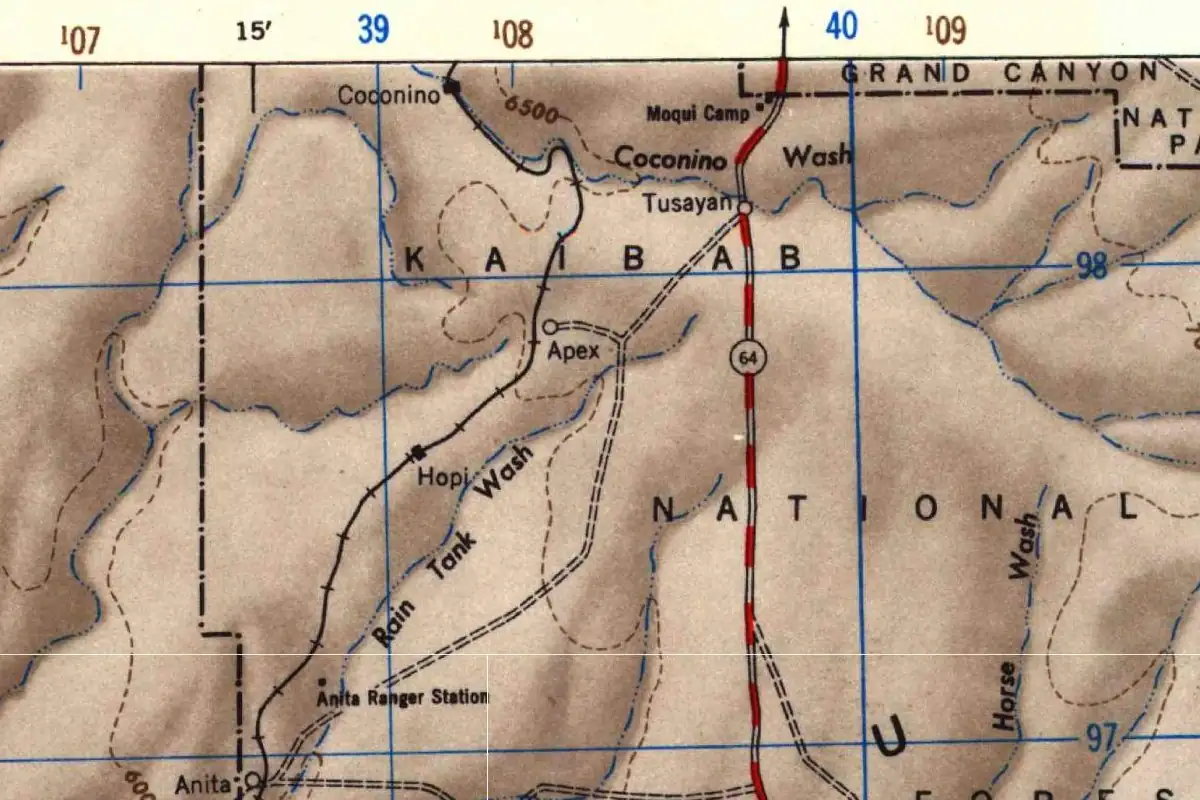
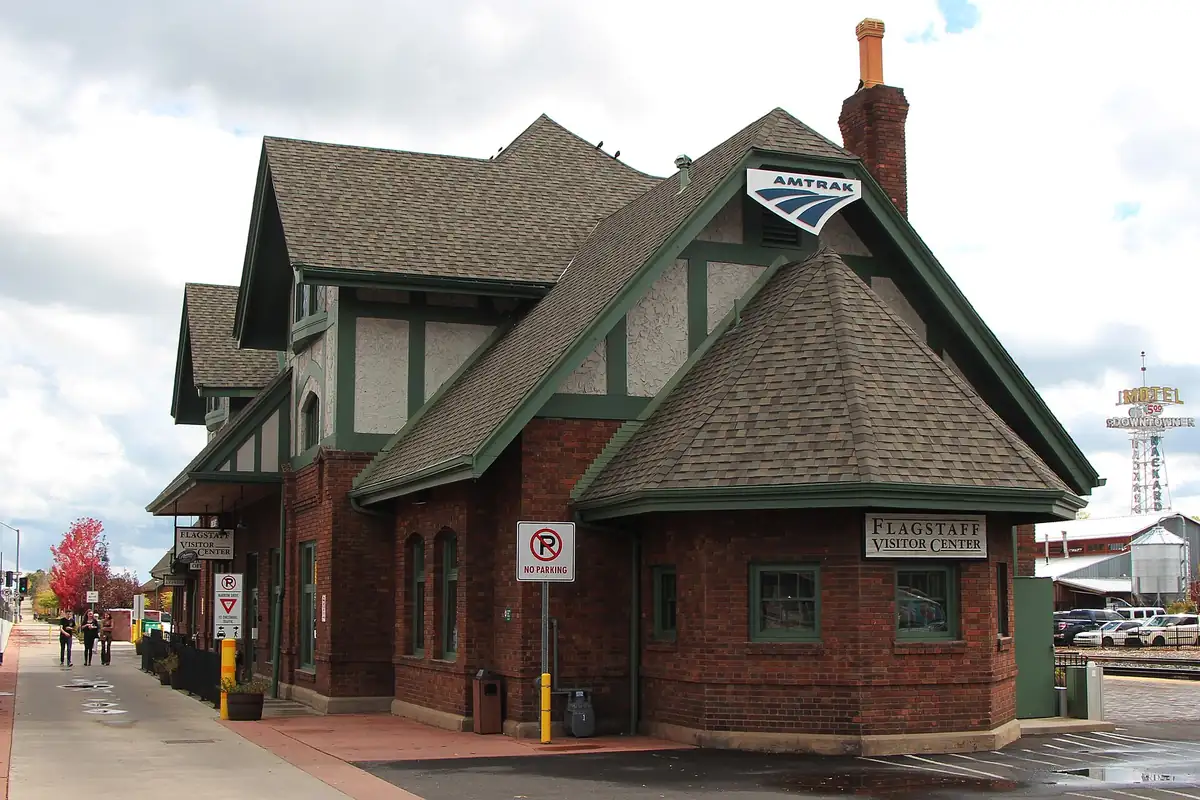
Route 66 followed the same corridor. The National Park Service says the National Old Trails Road came through Flagstaff along the railroad in the 1910s, and in 1926 two things happened at once: the Santa Fe built a new depot, now the Flagstaff Visitor Center, and U.S. Highway 66 through Arizona was commissioned. In town the highway soon moved to Santa Fe Avenue, right beside the tracks. The Park Service’s page on the downtown Railroad Addition Historic District, listed on the National Register in 1983, calls it a historic stop along Route 66 and a gateway to the Grand Canyon. That puts Flagstaff on our list of Route 66 towns, and it’s in the same county as Sedona and Tusayan, two more Coconino County names with stories of their own.
So which pine was it? The Boston story has more people behind it: two settlers the Sun said were in the area at the time, a Bostonian who said his own group trimmed the tree, and Wilson’s obituary. Hochderffer only got to town in 1887, and he never said how he knew his tree was Beale’s. Still, he had a suggestion in 1926. The few remaining old-timers, he wrote, should “get together to fight it out,” and then let the newcomers decide which story was most plausible. A century later, you’re the newcomer, and you’ve now heard their side.
Quick answers
Why is Flagstaff, Arizona, called Flagstaff?
Because of a pine tree trimmed into a flagpole. Early accounts agree on that, but not on which tree: the Coconino Sun (1894) credits a party of Boston settlers on July 4, 1876, while George Hochderffer (1926) thought the name came from an older tree he tied to Beale’s survey party.
Did a Boston party really raise a flag there on July 4, 1876?
Most early accounts say so. The Sun’s 1894 story, based on settlers who were there, puts the flag-raising on the morning of July 4, 1876. Horace Mann, one of the Boston colonists, said his advance group trimmed the tree in late June and the main party celebrated the Fourth around it.
What happened to the original flagpole?
Nobody knows for sure. The Sun said the Boston pole stood for several years and rotted off at the ground, while Hochderffer heard it was taken down soon after, for a gold piece supposed to be under it. The tree he believed was the Beale pole was cut down in January 1888 and burned in a saloon.
Who chose the name Flagstaff for the post office?
Nobody can say for certain. Hochderffer had heard secondhand that Ed Whipple proposed “Flagpole” and P. J. Brannen amended it to “Flagstaff,” and an account Barnes prints also credits “Doc” Brannen. The Washington records Barnes cites show the post office was established on February 21, 1881, with Thomas McMillan as postmaster.
Key dates
- 1876July 4: Settlers bound from Boston to Prescott celebrate the nation's 100th birthday under a flag on a trimmed pine, most accounts say.
- 1881February 21: The Flagstaff post office is established, with Thomas McMillan as postmaster, according to Washington records.
- 1882August 1: The Atlantic and Pacific Railroad reaches Flagstaff.
- 1888January: A pine some took for the original flagstaff is cut down and burned in a saloon, George Hochderffer recalled.
- 1894February 15: The Coconino Sun prints what it calls the correct story of the naming and credits the Boston party.
- 1926A new Santa Fe depot opens and U.S. Highway 66 through Arizona is commissioned.
- 1983Flagstaff's Railroad Addition Historic District, along Route 66, is listed on the National Register.
Getting there
The closest airports, Amtrak stations and intercity bus stops, measured in a straight line from the center of Flagstaff.
Airports
- Flagstaff Pulliam (FLG) - Flagstaff 4 mi 7 km
- Prescott Regional/Ernest A Love Field (PRC) 57 mi 92 km
- Phoenix Sky Harbor International (PHX) 124 mi 199 km
Amtrak trains
- Flagstaff station (FLG) under 1 mi 0.2 km
- Winslow station (WLO) 55 mi 89 km
Intercity buses
- FlixBus Flagstaff Train Station under 1 mi 0.1 km
- Route 66 Express Amtrak Connecting Service · Flagstaff under 1 mi 0.2 km
- Greyhound Flagstaff AZ - Greyhound Station (FGG) under 1 mi 1 km
Distances are as the crow flies, not by road. We don't list schedules or fares because they change; check with the airline, Amtrak or the bus company before you go. Official data (FAA commercial service airports (2025), FAA airport locations, Amtrak stations and Intercity Bus Atlas) from the FAA and the U.S. Bureau of Transportation Statistics, checked Nov 2, 2026.
Historical Sources & References
- The Coconino Weekly Sun, February 15, 1894, p. 2. “How Flagstaff Was Named”: the Boston party camped at McMillan’s corral, the pole raised on the morning of July 4, 1876, the gilt ball and the coin, the spot known as “The Flagstaff,” the station named for it, and the Beale story dismissed as “the imagination of some newspaper writer.” Based on Frank Hart, Thomas F. McMillan and a builder named Wilson.
- The Coconino Sun, April 29, 1899, p. 3. “That Flagstaff Again”: the Pick and Drill’s version (a young pine climbed and trimmed near Antelope Spring, a scrap of cloth still on it in 1882) and the Sun’s reply, now with the pine “cut down, trimmed and smoothed.”
- The Coconino Sun, March 19, 1908, p. 2. Obituary of John A. Wilson, “one of the party that peeled and topped the tree, and raised the stars and stripes over our city, hence the name, Flagstaff.”
- George Hochderffer, The Coconino Sun, December 3, 1926, section two, p. 7. “In Flagstaff’s Baby Days It Had Numerous Flagstaffs”: the Beale tree, Old Bismarck cutting it down in January 1888, the saloon and the rolling pin, the coin under the Boston pole, the hearsay about Whipple and Brannen, and the “fight it out” suggestion.
- James H. McClintock, Arizona, Prehistoric, Aboriginal, Pioneer, Modern, vol. 2 (1916), pp. 555-556. The Boston colonization company, the colonists moving on to Prescott, “one permanent record of the trip,” and a reprint of the Sun’s story.
- James H. McClintock, Mormon Settlement in Arizona (1921), pp. 149-151. Horace E. Mann’s account: two Boston parties, the advance group’s pine trimmed in late June 1876, Tillinghast’s flag, and the tree “left standing upon its own roots.”
- Will C. Barnes, Arizona Place Names (1935). The post office established February 21, 1881, with Thomas McMillan as postmaster, and Brannen as his successor on May 23, 1881; “Doc Brannen” in one of the naming accounts; and a chamber of commerce account of the Boston party, called “undoubtedly correct.” Read only in search excerpts (the scan is a restricted loan).
- Discover Flagstaff, “Flagstaff, Arizona History”. The railroad reaching Flagstaff on August 1, 1882.
- National Park Service, “Railroad Addition Historic District and Boundary Increase”. The National Old Trails Road, the 1926 depot, the commissioning of U.S. 66 in Arizona that year, Santa Fe Avenue, and the 1983 National Register listing. Also online: Route 66: Arizona, the Park Service’s overview of the road through the state.
- U.S. Geological Survey, San Francisco Mountains sheet (1886). The map at the top of this page, with Flagstaff on the Atlantic and Pacific line.
- GNIS feature 29046, Flagstaff (U.S. Geological Survey). The official name and coordinates of the city. The record for McMillan Mesa, feature 24861, names Thomas F. McMillan as Flagstaff’s first permanent settler and first postmaster.
Spot something wrong, or know more? Tell us here. You can also email us or use our contact page. Corrections are noted here with their date, never made silently.