Mariposa, California: Named for Butterflies, or a Lily?
Mariposa, California, means butterfly in Spanish, and nobody agrees on whether the name came from a cloud of real butterflies or a wildflower. The oldest record points to the insects. A Yosemite guidebook from the 1880s and the U.S. Geological Survey went with the flower.
A swarm in the corporal’s ear
The best evidence for the butterflies is a diary from 1806. That fall, Lieutenant Gabriel Moraga, the same officer who turns up in the story of Sacramento, led a Spanish expedition into the San Joaquin Valley, and the chaplain, Father Pedro Muñoz, wrote down each day. On September 27 the party camped at a dry stream with a few pools of water. Muñoz wrote, in the translation S. F. Cook published in 1960, that “This place is called the Mariposas [‘the butterflies’] because of their great number, especially at night.”
They were a nuisance, too. By morning, Muñoz says, they were so thick they blocked out the sun, and “one of them flew into the ear of a corporal of the expedition.” It took him a lot of effort to get it out. The next day’s entry has the men waiting “at the place on the Mariposa” for the rest of the troops.
Here’s the catch. Cook added a note saying that, judging by the distance from the Merced River, this camp was probably on what’s now Bear Creek, not Mariposa Creek. So the butterflies are real and on paper, but you can’t be sure they were on the creek that kept the name.
The creek of the butterflies
By the time county historians got to the story, the details had drifted. An 1881 history of Merced County says Moraga’s men found “myriads of beautifully variegated butterflies” along a small stream, “hence Moraga named the creek El Arroyo de Las Mariposas, which name it has borne ever since.” A Lewis Publishing history from 1892 tells it the same way and translates it as “the creek of the butterflies.”
Both books put the trip around 1835 or 1836, though. The diary says 1806. That’s a gap of about 30 years, and neither book mentions the diary.
Or was it the mariposa lily?
The other version comes from J. M. Hutchings, the Yosemite publisher and guidebook writer. Describing the road in from Merced, he mentions a wildflower called the mariposa, or “Butterfly Tulip,” and writes: “From the great abundance of this beautiful lily, the county, with its county town, received its musical name ‘Mariposa.’” Later in the same book he calls it “the flower after which this county was named.”
Henry Gannett of the Geological Survey picked up the same idea in 1905. His entry says Mariposa’s river, county and town were “named for a flower which grows abundantly there. A Spanish word, meaning ‘butterfly.’” Neither man says where he got it, and we didn’t find anything older that ties the name to the lily.
So which one wins? The butterfly story has a firsthand Spanish diary behind it, while the lily story shows up decades later in a guidebook with no source. We give the butterflies the edge, but you should know the link between the 1806 camp and today’s creek isn’t airtight.
From a land grant to a county seat
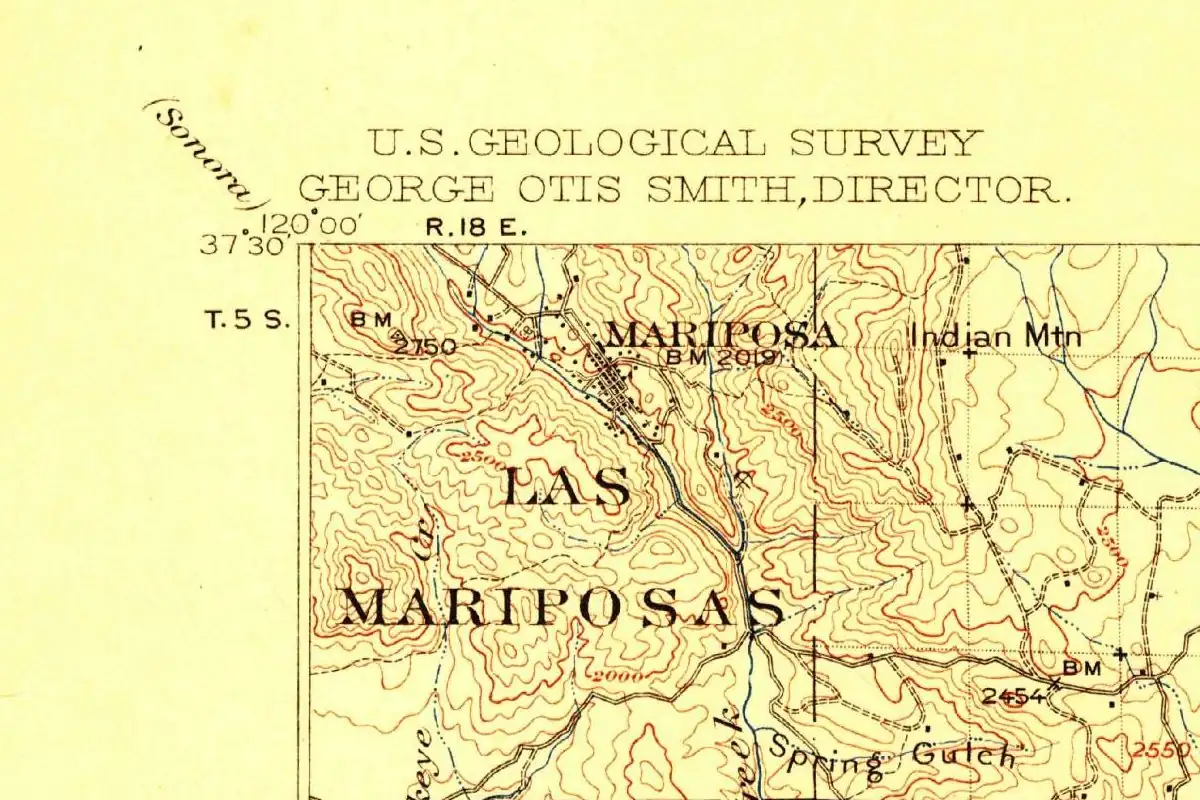
Long before the gold rush, the name was already on a big piece of land. In February 1844, Governor Micheltorena granted Las Mariposas, ten square leagues between the Sierra Nevada and the Chowchilla, Merced and San Joaquin rivers, to Juan B. Alvarado. John C. Frémont, the explorer behind the name of Fremont, Nebraska, bought it in 1847. You can still see LAS MARIPOSAS spread across the hills below the town on the 1912 Geological Survey map at the top of this page.
Mariposa County was created on February 18, 1850. The 1892 history says Archie Stevenson, one of the county’s first merchants, opened a store there in 1849. It also says the town became the county seat in the county’s second year. Before that, the seat was the mining camp of Agua Fria.
The battalion that named Yosemite
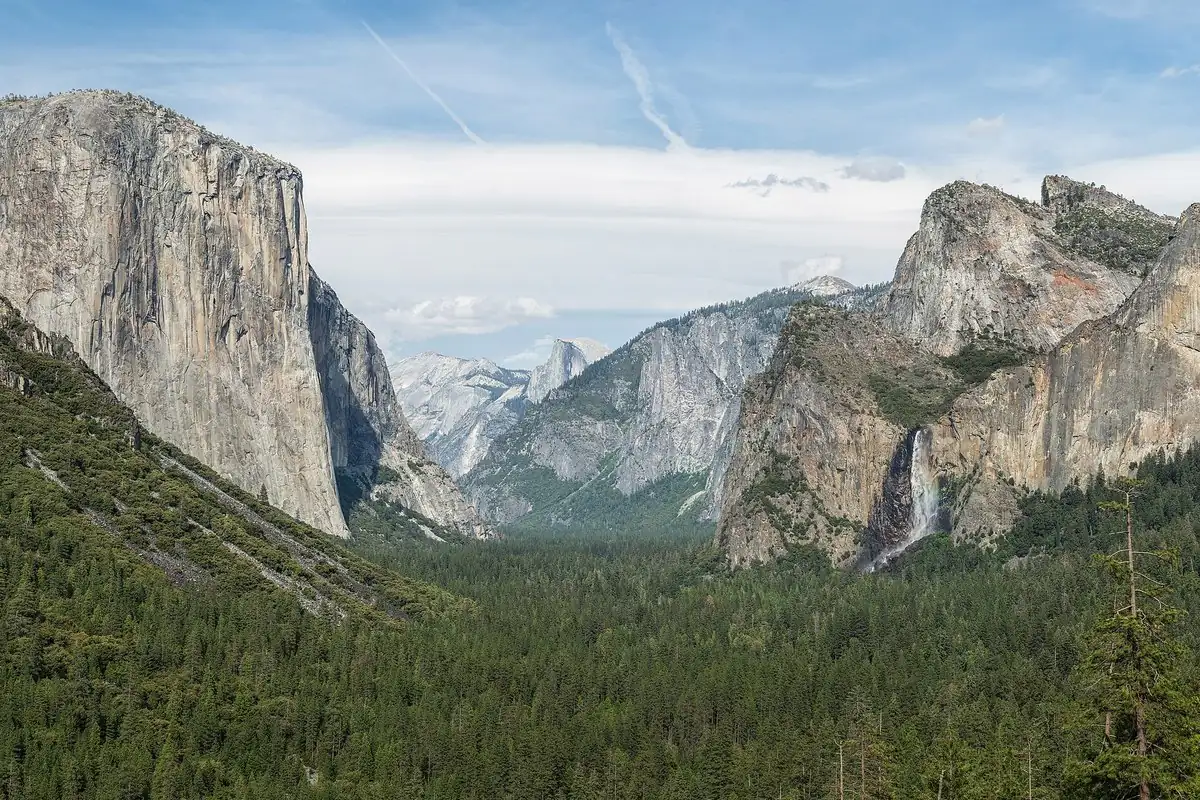
The Mariposa Battalion was raised in that county. Lafayette Bunnell, who served in it, says that when the governor called for volunteers early in 1851, the settlers’ informal company “formed the nucleus of the volunteer force in Mariposa county.” The National Park Service describes the battalion as a militia “formed to drive the native Ahwahneechee people onto reservations.” That spring, its men named Yosemite Valley by a campfire vote.
The town stayed tied to the valley after that. Hutchings, writing in 1888, called the road through Mariposa and Wawona “the Mariposa Route” and said it was the first route ever traveled to the valley. His table of distances put the town about 53 miles from the valley by carriage road. So if you drove up from Merced back then, you passed through a town named for a butterfly, or a lily, on your way to a valley named by a vote.
Quick answers
What does Mariposa mean?
Butterfly. Hutchings, Gannett and the county histories all agree on the Spanish meaning. They just don’t agree on whether the name came from the insects or from a flower.
Was Mariposa, California, named after butterflies?
Possibly. A Spanish diary from 1806 calls a camp “the Mariposas” because of swarms of butterflies, and county histories from 1881 and 1892 say Moraga named Mariposa Creek for them. But Hutchings (1888) says the name came from the mariposa lily, and Gannett (1905) says “a flower which grows abundantly there.”
Is the Mariposa Battalion named after the town?
Not exactly. Bunnell doesn’t explain the name, but he says the battalion grew out of “the volunteer force in Mariposa county.” When it was organized, the county seat was Agua Fria, not the town of Mariposa.
Key dates
- 1806September 27: Father Pedro Muñoz writes that a camp is called the Mariposas for its swarms of butterflies.
- 1844February: Governor Micheltorena grants Las Mariposas to Juan B. Alvarado.
- 1847John C. Frémont buys the Las Mariposas grant.
- 1849Archie Stevenson, one of the county's first merchants, opens a store at Mariposa.
- 1850February 18: California creates Mariposa County.
- 1851The Mariposa Battalion, raised in the county, enters Yosemite Valley.
- 1881A Merced County history credits Lieutenant Moraga and a creek full of butterflies.
- 1888J. M. Hutchings credits the mariposa lily instead.
Historical Sources & References
- S. F. Cook, Colonial Expeditions to the Interior of California: Central Valley, 1800-1820 (1960). Father Pedro Muñoz’s diary of the Moraga expedition: the camp “called the Mariposas [‘the butterflies’] because of their great number” on September 27, 1806, the butterfly in the corporal’s ear, and “the place on the Mariposa.” Cook’s note 18 places the camp on Bear Creek rather than Mariposa Creek.
- History of Merced County, California (Elliott & Moore, 1881), pp. 77-78. Moraga naming “El Arroyo de Las Mariposas” for “myriads of beautifully variegated butterflies” (p. 78), dated around 1835 (p. 77).
- A Memorial and Biographical History of the Counties of Merced, Stanislaus, Calaveras, Tuolumne and Mariposa (1892). “The creek of the butterflies,” dated about 1836 (p. 63); Stevenson’s 1849 store, the county seat moving from Agua Fria, and the 1844 Las Mariposas grant bought by Frémont in 1847 (pp. 191-192).
- J. M. Hutchings, In the Heart of the Sierras (1888). The lily version: “From the great abundance of this beautiful lily, the county, with its county town, received its musical name” (p. 294), and “the flower after which this county was named” (p. 361). Also “the Mariposa Route” and its table of distances (pp. 292-293).
- Henry Gannett, The Origin of Certain Place Names in the United States (USGS, 1905). Mariposa “named for a flower which grows abundantly there. A Spanish word, meaning ‘butterfly.’” (p. 200)
- Lafayette H. Bunnell, Discovery of the Yosemite (3rd ed., 1892). The settlers’ company as “the nucleus of the volunteer force in Mariposa county” (p. 9), the governor’s call of January 1851 (p. 13), and Agua Fria as the county seat when it was organized (p. 24).
- National Park Service, Yosemite National Park, “People”. The Mariposa Battalion as a militia “formed to drive the native Ahwahneechee people onto reservations.”
- U.S. Geological Survey, Mariposa sheet (1912). The map at the top of this page, with the town of Mariposa and the words Las Mariposas.
- GNIS feature 1659063, Mariposa (U.S. Geological Survey). The official name and coordinates of the town. The county’s record, feature 277286, gives its creation date, February 18, 1850.
Spot something wrong, or know more? Tell us here. You can also email us or use our contact page. Corrections are noted here with their date, never made silently.