Julesburg, Colorado: The Town That Kept Jules's Name
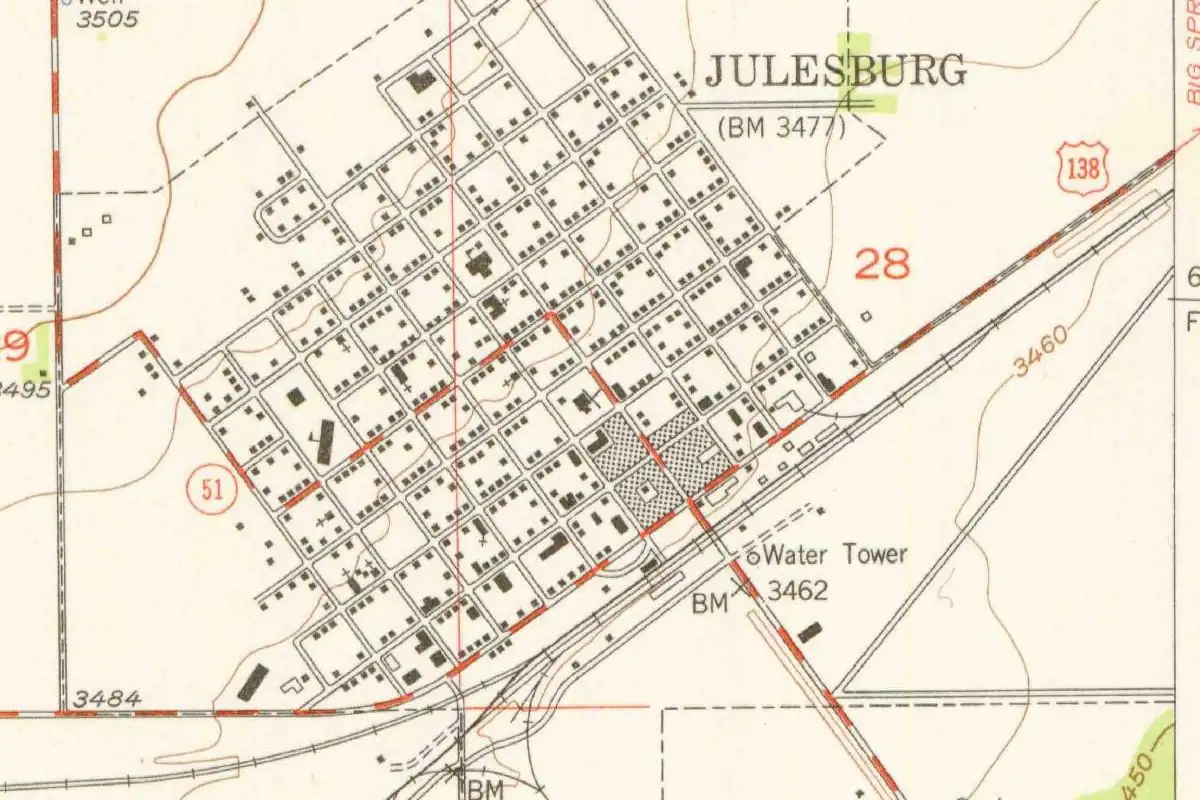
Julesburg, Colorado, took its name from a French-Canadian trader everyone called Jules, but the old books can’t agree on his last name. They also can’t agree on when he died, and the town that carries his name today is the fourth one to do it.
Twain’s “Julesburg”
Mark Twain came through on the overland stage, riding west with his brother, who had “just been appointed Secretary of Nevada Territory.” He told the story in Roughing It, published in 1872:
At noon on the fifth day out, we arrived at the “Crossing of the South Platte,” alias “Julesburg,” alias “Overland City,” four hundred and seventy miles from St. Joseph—the strangest, quaintest, funniest frontier town that our untraveled eyes had ever stared at and been astonished with.
That’s 470 miles, about 756 km. A few chapters later, Twain explains how the notorious Jack Slade got “the important post of overland division-agent at Julesburg, in place of Mr. Jules, removed.” Twain never gives Jules a last name. Neither, it turns out, did anyone in a way the others agreed with.
Beni, Benard or Burg?
Here’s what you get if you line up the sources on the man behind the name:
- Jules Burg. George Crofutt’s 1879 railroad guide says the old town “was named after Jules Burg, who was brutally assassinated,” and calls him “the person who gave his name to Julesburg.”
- Jules Benard. Henry Gannett, writing for the Geological Survey in 1905, says the town is “said to be named for Jules Benard, a frontiersman.”
- Jules Beni. The 1941 WPA guide to Colorado calls him “Jules Beni, the sullen bear-like French-Canadian station master,” and J. Frank Dawson (1954) wrote that the town was “named for Jules Beni, operator of a trading post.” The National Park Service uses Beni too.
“Burg” is also the last syllable of the town’s name, so treat it with some caution. Beni is the form the later sources here settled on. All of them agree on “Jules.”
A trading post at the crossing
The Park Service tells the story this way. In the late 1850s, Beni “established a trading post at the Upper Crossing of the South Platte River, where roads heading to Salt Lake City and Denver diverged from one another.” When the stage company of Russell, Majors and Waddell hired him as stationmaster there, the place “was already known as Julesburg—a nod to Beni’s influence.”
Things went bad after that. The company suspected him of being tied to the thieves stealing its stock and sent Slade to replace him. Beni shot Slade and left him for dead. Slade lived and had his revenge, and this is where the dates split. The Park Service puts Beni’s death in August 1861 and admits there are “many other versions” of how it happened. Crofutt’s guide says the two quarreled in 1861 but dates the killing to 1863, at the Cold Spring ranch on the North Platte.
Four Julesburgs
The town didn’t stay put either. The 1941 guide says the present Julesburg “is the only remaining town of four of the same name.” The first, the stage station, “was completely destroyed during an Indian raid in 1865.” A second grew up afterward and was abandoned in 1867, when a third appeared as a construction camp for the Union Pacific, at a siding later called Weir. That one earned the nickname “the wickedest little city east of the Rockies.”
The fourth and present town was “founded in 1881 when the Union Pacific Cutoff to Denver was projected.” That cutoff fits another old name. Dawson says the town was once known as Denver Junction, and the WPA guide ties the present town to the line for Denver. Julesburg’s row in the federal names system lists the town in Sedgwick County, with no history note.
Four towns, three last names and two death dates, and the only part that never changed was “Jules.”
Quick answers
Who was the Jules in Julesburg?
A French-Canadian trader and stage stationmaster known as Jules. Most later sources, including the WPA guide (1941), Dawson (1954) and the National Park Service, call him Jules Beni. Gannett (1905) wrote Benard and Crofutt (1879) wrote Burg.
Why are there four Julesburgs?
The town moved three times. The first stage station was destroyed in 1865, a second was abandoned in 1867 for a railroad construction camp, and the present town was founded in 1881 on the Union Pacific line to Denver, the WPA writers say.
What were Julesburg’s other names?
Twain knew it as Overland City and the “Crossing of the South Platte” in Roughing It (1872). Dawson (1954) adds Denver Junction.
Key dates
- 1861Jules Beni dies in August 1861, according to the National Park Service.
- 1865The first Julesburg is destroyed in a raid, the WPA guide says.
- 1867A third Julesburg springs up as a Union Pacific construction camp.
- 1872Mark Twain's Roughing It describes the "Crossing of the South Platte," alias Julesburg, alias Overland City.
- 1881The present town is founded as the Union Pacific plans its cutoff to Denver.
Getting there
Open Julesburg in Google Maps
Opens in a new tab. The pin is the center of Julesburg in the USGS place-name record.
The closest airports, Amtrak stations and intercity bus stops, measured in a straight line from the center of Julesburg.
Airports
- North Platte Regional/Lee Bird Field (LBF) 83 mi 133 km
- Scottsbluff/Western Nebraska Regional/Wm B Heilig Field (BFF) 92 mi 148 km
- Denver International (DEN) 149 mi 239 km
Amtrak trains
- Fort Morgan station (FMG) 96 mi 154 km
Intercity buses
- Express Arrow Ogallala 30 mi 48 km
- Greyhound Ogallala Lincoln Hwy 30 mi 48 km
- Bustang Outrider Bustang · Sterling 55 mi 89 km
Distances are as the crow flies, not by road. We don't list schedules or fares because they change; check with the airline, Amtrak or the bus company before you go. Official data (FAA commercial service airports (2025), FAA airport locations, Amtrak stations and Intercity Bus Atlas) from the FAA and the U.S. Bureau of Transportation Statistics, checked Nov 6, 2026.
Sponsored
Staying in Julesburg?
Compare hotels in Julesburg, Colorado, on Expedia.
See hotels in JulesburgWe may earn a commission if you buy through this link. It never changes what we write. Read our affiliate disclosure
Historical Sources & References
- Mark Twain, Roughing It (1872), chapters VI and X. The “Crossing of the South Platte,” alias “Julesburg,” alias “Overland City,” 470 miles from St. Joseph, and Slade “in place of Mr. Jules, removed.”
- George A. Crofutt, Crofutt’s New Overland Tourist and Pacific Coast Guide (1879), p. 41 and Annex No. 10. “Named after Jules Burg,” the 1861 quarrel with Slade and the killing in 1863 at the Cold Spring ranch.
- Henry Gannett, The Origin of Certain Place Names in the United States (1905), p. 171. “Said to be named for Jules Benard, a frontiersman.”
- Federal Writers’ Project, Colorado: A Guide to the Highest State (1941), pp. 208-209. The four towns, Jules Beni the “French-Canadian station master,” the raid of 1865, the construction camp of 1867 at Weir and the present town of 1881.
- J. Frank Dawson, Place Names in Colorado (1954). “Named for Jules Beni, operator of a trading post,” and the names Overland City and Denver Junction.
- National Park Service, “Jules Beni”. The trading post at the Upper Crossing in the late 1850s, the place “already known as Julesburg,” Slade and Beni’s death in August 1861.
- GNIS feature 202892 (U.S. Geological Survey). Julesburg’s row in the federal names system, Sedgwick County.
Spot something wrong, or know more? Tell us here. You can also email us or use our contact page. Corrections are noted here with their date, never made silently.