Estes Park, Colorado: Why a Mountain Valley Is a Park
Estes Park, Colorado, sounded like an English country estate to one 1870s visitor, but it’s a mountain valley named for Joel Estes, who found it in 1859. In the Colorado high country, a “park” didn’t have a fence or a gate. It was an open, grassy valley with the mountains all around it.
“What is Estes Park?”
Isabella Bird asked the question herself. The English traveler rode into the valley in the early 1870s and wrote home to her sister about it, and her letters came out as a book, A Lady’s Life in the Rocky Mountains, in 1879. “You will ask, ‘What is Estes Park?’” she wrote. To English ears the name, “with the quiet Midland Counties’ sound,” suggested “park palings,” a lodge, fallow deer and “a Queen Anne mansion.”
Then she answered it. Among the “striking peculiarities” of these mountains, she wrote, “are hundreds of high-lying valleys, large and small,” and the biggest were North Park, Middle Park, South Park and San Luis Park. Smaller ones were everywhere, “most of them unnamed, and others nicknamed by the hunters or trappers.” Estes Park, she wrote, “combines the beauties of all,” and it swapped each English piece for a Colorado one. Instead of a fence it had mountains up to 14,000 feet, instead of a lodge “two sentinel peaks of granite guarding the only feasible entrance,” and instead of a mansion “an unchinked log cabin.”
Samuel Bowles, who toured Colorado a few years earlier, said much the same in his 1869 book on its “parks and mountains.” Most of these parks, he wrote, were “little wide valleys around the heads of single streams,” tucked among the ranges and “well called NATURAL PARKS.” Farther north, in another stretch of the Rocky Mountains, fur trappers in Wyoming had their own word for that kind of valley: a hole, the word behind Jackson Hole.
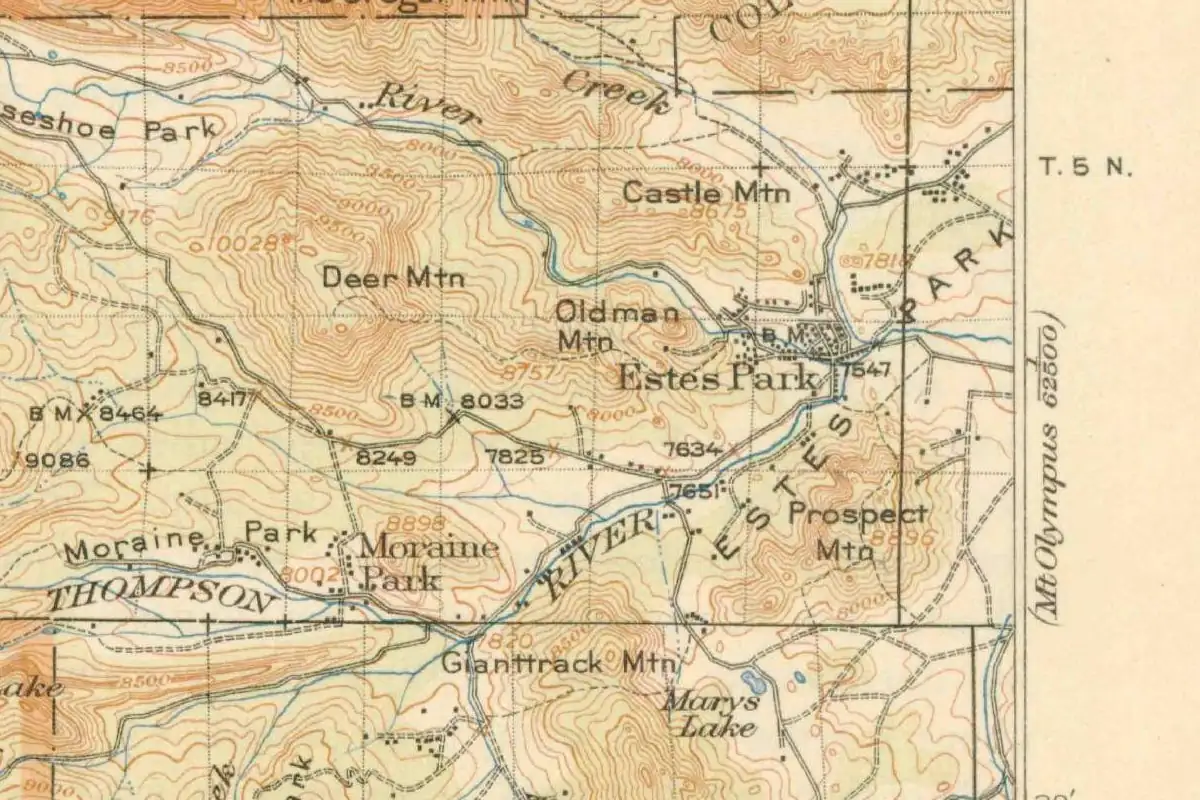
You can still see the old meaning on the map at the top of this page. The 1915 survey sheet prints the village of Estes Park in ordinary type and ESTES PARK in big spaced letters across the valley, with Moraine Park and Horseshoe Park off to the west. The federal place-names database keeps them apart too: one Estes Park is a populated place, and the other is listed as a flat.
Joel Estes comes over the ridge
The man in the name was a cattleman who lived at Fort Lupton, on the South Platte. In the fall of 1859, the year of the Colorado gold rush, Joel Estes and his son Milton followed an old Indian trail into the mountains looking for game. That’s how a 1971 National Park Service history of Rocky Mountain National Park tells it. After climbing a high ridge, Estes saw “for the first time the park that would someday bear his name,” and he reportedly said, “The very place I have been seeking. Here I will make my home.”
Enos Mills, whose history of the valley first came out in 1905, puts it the same way: “One autumn day while hunting, in 1859, he ascended Park Hill and from this had the wonderful view down into Estes Park.” Early in 1860, by Mills’s account, Joel and his wife moved in “with their effects upon two pack horses” and built a cabin on Willow Creek.
The day nobody can pin down
If you’re looking for an exact founding date, the sources won’t give you one. The Park Service history says plainly that “the date of discovery is in some doubt.” A 1921 Denver Post article put it at September 12, 1859, a pioneer named Emily Graham was quoted as saying October 12, and October 15 is “the commonly held date.”
The move is fuzzy too. A second Park Service study from the same year says Milton later remembered bringing the families in during 1863, but that “in all likelihood” some of them spent the winter of 1860-61 there. Mills even contradicts himself. He opens by saying Estes made “the first permanent settlement in 1860,” and a few pages later he says Griff Evans “founded the first permanent settlement” in 1867, “by coming to stay.”
A newspaperman’s thank-you
The name came from a guest. In 1864, William N. Byers, the editor of Denver’s Rocky Mountain News, came up with a party that tried and failed to climb Longs Peak, and the Estes family put them up. Byers “was impressed with the hospitality of the Estes family,” the 1971 history says, “and upon his return to Denver named the area ‘Estes Park’ in honor of his host.”
The other Park Service study, by F. Ross Holland Jr., says Byers wrote about the trip and the family in his paper, and that’s where he gave the place its name. Mills, decades earlier, also calls Byers the man “who named Estes Park.” Byers’s 1864 article itself wasn’t available to read for this story, so what you’re getting here is the historians’ account of it, not his own words.
The name stuck, the family didn’t
Holland sums it up in one line: “the name stuck, but the Estes family didn’t.” The winters wore Joel down. Mills says a deep snow fell early in the winter of 1865-66 and stayed cold all season, and the Esteses “began to long for warmer climes.” They sold out, for “Fifty dollars, a yearling steer, or a yoke of oxen,” Mills wrote, adding, “It is impossible to say which one of these is correct.” On April 15, 1866, the family left, and none of them came back. Joel Estes died in New Mexico in 1875.
So the family lived in the valley for about six years, and the name has outlasted them by more than a century and a half. If you stand in town today, you’re standing in Estes Park twice: the town, and the valley a newspaper editor named for his host.
Quick answers
Who is Estes Park named after?
Joel Estes, a cattleman who found the valley while hunting in the fall of 1859 and settled there with his family. Enos Mills’s history and two National Park Service studies all say so.
Why is it called a park?
Because in the Colorado mountains, a “park” meant an open valley ringed by peaks, not a fenced estate. Isabella Bird described “hundreds of high-lying valleys” like it, and Samuel Bowles called them “little wide valleys around the heads of single streams.”
When was Estes Park founded?
It depends on what you count. Joel Estes found the valley in the fall of 1859, on September 12, October 12 or October 15, depending on the account, and Mills says the family moved in early in 1860, though the same book credits Griff Evans with “the first permanent settlement” in 1867. The name dates from 1864.
Who named Estes Park?
William N. Byers, editor of the Rocky Mountain News, after the Estes family hosted his party in 1864, according to Mills and two National Park Service histories. His original article wasn’t available for this story.
Key dates
- 1859In the fall, Joel Estes and his son Milton come over a ridge while hunting and see the valley for the first time.
- 1860Early in the year, by Enos Mills's account, the Esteses move into the valley with two pack horses.
- 1864William N. Byers of the Rocky Mountain News stays with the family and names the valley Estes Park.
- 1866April 15: the Estes family leaves the valley for good.
- 1869Samuel Bowles's book explains Colorado's parks as little wide valleys around the heads of streams.
- 1875Joel Estes dies in New Mexico.
- 1879Isabella Bird's letters come out as a book, asking "What is Estes Park?"
Getting there
The closest airports, Amtrak stations and intercity bus stops, measured in a straight line from the center of Estes Park.
Airports
- Denver International (DEN) 57 mi 92 km
- Laramie Regional (LAR) 65 mi 105 km
Amtrak trains
- Granby station (GRA) 30 mi 48 km
- Fraser-Winter Park station (WIP) 34 mi 54 km
Intercity buses
- Colorado Department of Transportation Bustang · Estes Park Visitor Center under 1 mi 0.7 km
- Greyhound Harmony Transfer Centre 30 mi 47 km
- Bustang Outrider Bustang · Granby (Westbound) 30 mi 48 km
Distances are as the crow flies, not by road. We don't list schedules or fares because they change; check with the airline, Amtrak or the bus company before you go. Official data (FAA commercial service airports (2025), FAA airport locations, Amtrak stations and Intercity Bus Atlas) from the FAA and the U.S. Bureau of Transportation Statistics, checked Nov 1, 2026.
Historical Sources & References
- Enos A. Mills, The Story of Estes Park, 3rd ed. (1914; first published 1905). “Estes Park was named in honor of Joel Estes”; the 1859 view from Park Hill, the move with two pack horses early in 1860, the sale for “Fifty dollars, a yearling steer, or a yoke of oxen,” Joel’s death in New Mexico in 1875, Griff Evans in 1867, and Byers as the man “who named Estes Park.”
- Lloyd K. Musselman, Rocky Mountain National Park: Administrative History, 1915-1965 (NPS, 1971), chapter 1. The fall 1859 hunting trip from Fort Lupton; “the park that would someday bear his name”; Byers “named the area ‘Estes Park’ in honor of his host”; departure on April 15, 1866. Also online: the endnotes, on the disputed date of discovery.
- F. Ross Holland Jr., Rocky Mountain National Park: Historical Background Data (NPS, 1971), pp. 17-18. Milton Estes’s memory of moving in during 1863, the likely winter of 1860-61, Byers’s newspaper account, and “the name stuck, but the Estes family didn’t.”
- Isabella L. Bird, A Lady’s Life in the Rocky Mountains, 2nd ed. (1879), pp. 120-122. “What is Estes Park?” The English idea of a park against Colorado’s “hundreds of high-lying valleys.”
- Samuel Bowles, The Switzerland of America (1869), p. 42. Colorado’s parks as “little wide valleys around the heads of single streams,” “well called NATURAL PARKS.”
- GNIS feature 204674, Estes Park (U.S. Geological Survey). The federal record and coordinates for the town, in Larimer County.
- GNIS feature 177636, Estes Park (U.S. Geological Survey). A separate federal record for Estes Park as a flat, the valley floor.
Spot something wrong, or know more? Tell us here. You can also email us or use our contact page. Corrections are noted here with their date, never made silently.