Jackson, Wyoming: How Jackson Hole Got Its Name
Jackson, Wyoming, got its name secondhand: the town took it from Jackson Hole, a valley fur trappers named for one of their own, David E. Jackson. And the “hole” isn’t a pit. It’s what the trappers called a mountain valley, and this one is walled in on every side.
The trappers’ word for a valley
If you’ve ever wondered why a valley would be called a hole, Hiram Chittenden has the answer. In his 1902 history of the American fur trade, he wrote that “the ‘holes’ of the mountains, as they were called by the trappers,” were the open valleys where a mountain man could find water, grass, firewood and shelter. That’s where he pitched his camp and rested up.
The Rockies were dotted with them. Chittenden lists Gardner’s Hole, which tourists saw as they entered Yellowstone, Pierre’s Hole on the other side of Teton Pass, and a small valley at the head of the Hoback River called Jackson’s Little Hole. Of them all, he called Jackson Hole “one of the most celebrated.”
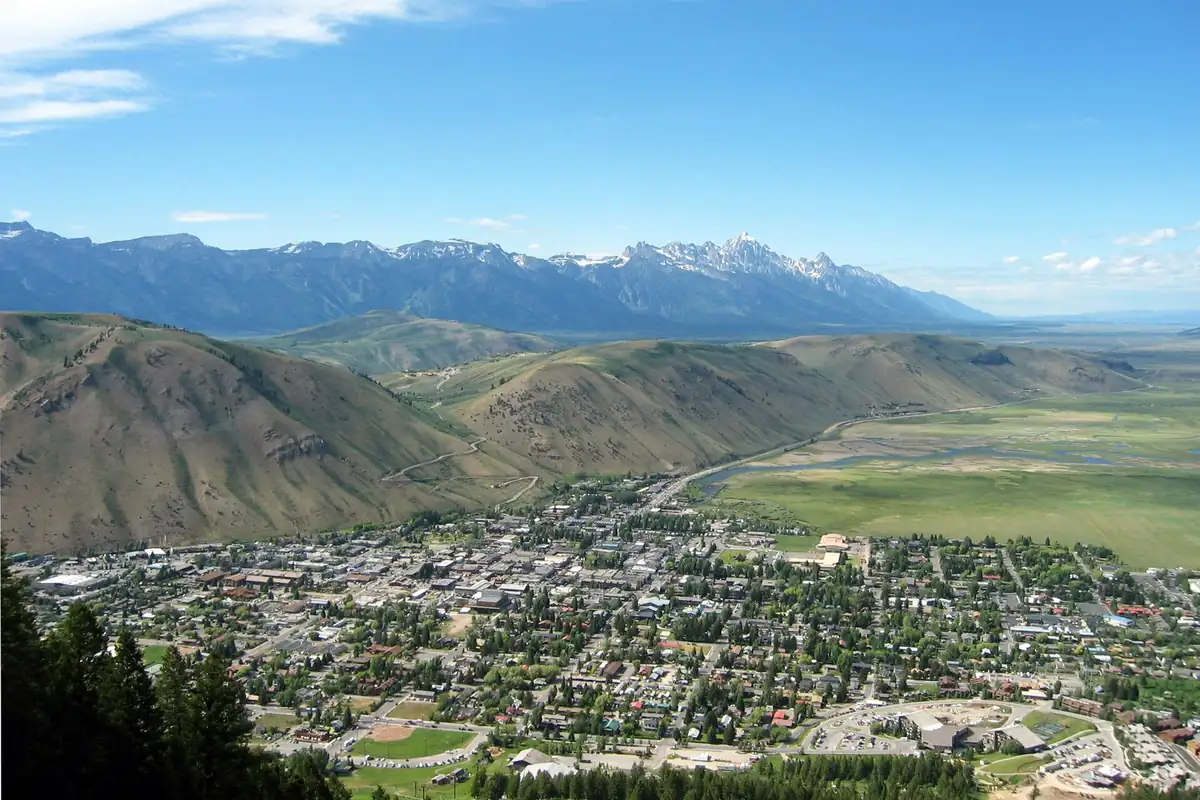
He also explained why it fit the word so well. Jackson Hole stretches more than 40 miles (64 km), from the north shore of Jackson Lake down past the mouth of the Little Gros Ventre River, and its floor is “extremely flat,” ringed by “some of the most rugged mountains on the continent.” There was “no easy way to get into it,” he wrote, and that probably made it safer from raids than valleys that were easier to reach.
Davey Jackson of Smith, Jackson and Sublette
The Jackson in the name was David E. Jackson, one of three partners in the fur company Smith, Jackson and Sublette. The other two were Jedediah Smith and William Sublette. Chittenden’s note on the valley says it was “named for David Jackson,” whose firm did business in the region from 1826 to 1830, and he gives Ferris as his source. The park study cited below leans on Warren A. Ferris’s Life in the Rockies for the same point.
The Park Service’s historic resource study for Grand Teton National Park says Jackson ran the partnership’s trapping operations in the field during those years and was “responsible in great part” for its profits. The lake at the north end of the valley carries his name too. Henry Gannett’s 1905 place-name book for the U.S. Geological Survey says Jackson Lake was “named for David Jackson, a noted mountaineer.”
Did William Sublette name it?
That’s the version you’ll hear most often, and the National Park Service tells it on its own website: Sublette “dubbed” the valley Davey Jackson’s Hole in 1829. Where the story comes from is less clear than it sounds.
The 1829 version
In 1829, Sublette came back from St. Louis with supplies, crossed into the valley and found Jackson there. Chittenden wrote that “it is most likely from this date that the name Jackson Hole came to be applied to the valley.” Notice he didn’t say who applied it. The park’s 1952 handbook went further and said “Capt. William Sublette named it” for his partner when he found him camped on the shore of Jackson’s Lake.
The 1828 version
The History of Wyoming edited by I. S. Bartlett in 1918 tells the same story a year earlier. Jackson spent the winter in the valley, it says, and when Sublette found him there in the spring of 1828, “he named the valley ‘Jackson’s Hole,’” and the lake “Jackson’s Lake,” in honor of his partner.
What the park’s historians think
The Park Service’s historic resource study is more careful than the park’s own handbook was. It points to a passage in Frances Fuller Victor’s 1870 book about the trapper Joe Meek, which says Sublette “fell in with Jackson, in the valley of Lewis Lake, called Jackson’s Hole.” That, the study says, “may be the source of the story that Sublette named Jackson Hole for Davey Jackson in 1829.”
But Jackson had already been trapping for four years, and the study figures he “probably knew this valley well by 1829.” It also calls the claim that he wintered there “doubtful.” Its conclusion is simple: the valley likely got its name from Jackson because of his role as a field manager for the company. So nobody questions who the valley is named for. The open question is who said it first, and none of these sources can show it.
From Jackson’s Hole to Jackson
The valley had carried its name for about 65 years by the time the town got it. The Town of Jackson’s official history says the town “was named in 1894 and incorporated as a municipality in 1914.” A 2014 history in the Jackson Hole News&Guide credits the choice to Margaret “Maggie” Simpson, who ran the post office at her ranch near Snow King Mountain. With the whole valley already called Jackson’s Hole, she picked the obvious name for it: Jackson.
The federal government signed off on all of it at once. The U.S. Geographic Board, the federal panel that ruled on place names, issued a single ruling for “Jackson; Hole (Valley), Lake, and Village,” then in Lincoln County, and added “(Not Teton.)” The federal place-name database lists a Board decision for the town dated 1908. Notice that the Board’s list drops the apostrophe. It wasn’t a fan of them in general: in the same list, a creek in Maryland is “Jacks,” “Not Jack nor Jack’s.”
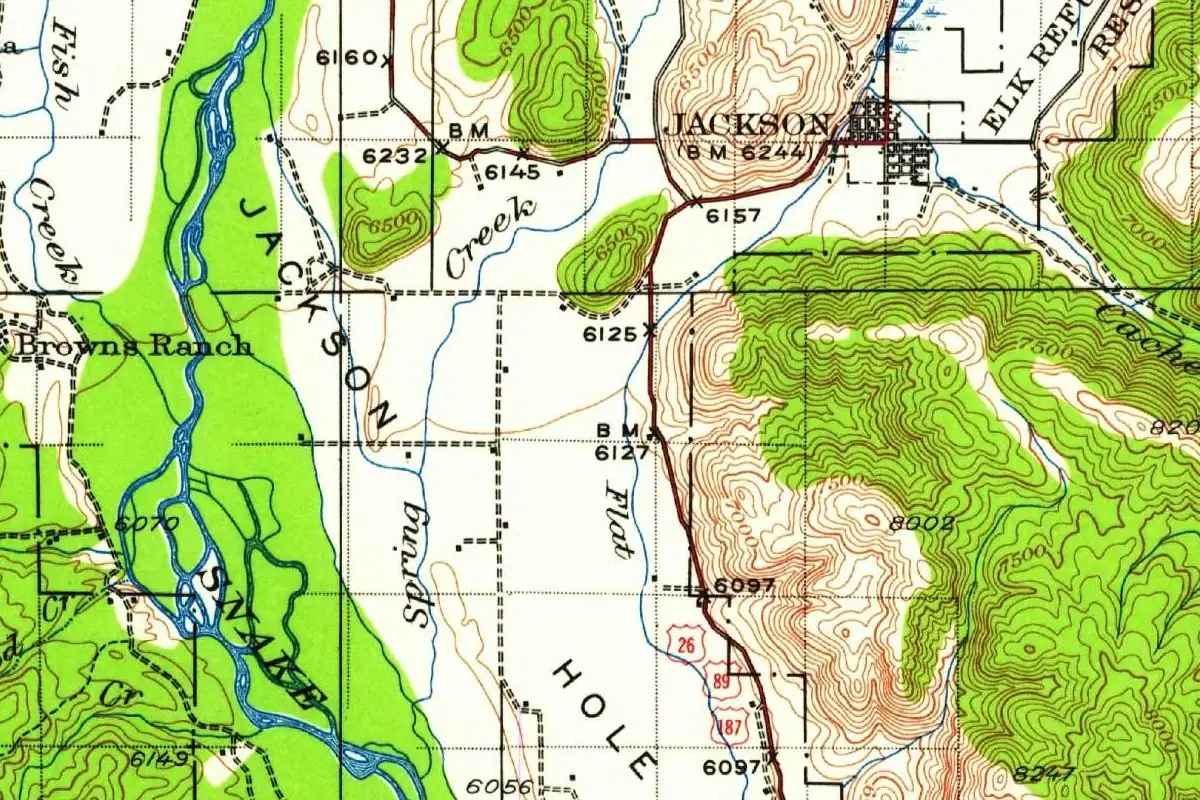
The town’s own website draws the line between the two names plainly: “Jackson Hole refers to the geographical feature of the valley beside the Teton Mountain Range.” So when you say you’re going to Jackson Hole, you’re naming the valley. The town in it is just Jackson, and on the 1931 map at the top of this page, you can see both labels at once.
There’s another Jackson on this site, and the two have nothing in common but the word. Jackson, Mississippi, honors General Andrew Jackson. This one goes back to a fur trapper whose name ended up on a lake, then a valley, then a town.
Quick answers
Who is Jackson Hole named after?
David E. Jackson, a partner in the fur company Smith, Jackson and Sublette, which worked this region from 1826 to 1830. Chittenden’s 1902 history and the National Park Service both say so.
Why is it called a “hole”?
Because that’s what fur trappers called a mountain valley. Chittenden wrote about the “holes” of the mountains, “as they were called by the trappers,” and Jackson Hole is a flat valley surrounded by rugged mountains.
Is Jackson the same as Jackson Hole?
No. Jackson Hole is the valley, and Jackson is the town inside it. The town’s official history says it was named in 1894, and a 2014 Jackson Hole News&Guide history says the postmistress took the name from the valley.
Did William Sublette name Jackson Hole?
Maybe. The National Park Service says he did in 1829, and a 1918 History of Wyoming puts it in 1828, but the park’s historic resource study says the story may come from an 1870 book about Joe Meek. It agrees the valley is likely named for Jackson either way.
Key dates
- 1826David E. Jackson's firm, Smith, Jackson and Sublette, starts four years of business in the region.
- 1828A 1918 History of Wyoming says Sublette found Jackson in the valley that spring and named it Jackson's Hole.
- 1829Sublette meets Jackson in the valley. Chittenden and the 1952 park handbook date the name from this meeting.
- 1870Frances Fuller Victor prints "the valley of Lewis Lake, called Jackson's Hole."
- 1894The town is named Jackson, by its own official account.
- 1914Jackson is incorporated as a town.
Getting there
The closest airports, Amtrak stations and intercity bus stops, measured in a straight line from the center of Jackson.
Airports
- Jackson Hole (JAC) 9 mi 14 km
- Idaho Falls Regional (IDA) 66 mi 106 km
Intercity buses
- Salt Lake Express Jackson (Downtown) 1 mi 2 km
Distances are as the crow flies, not by road. We don't list schedules or fares because they change; check with the airline, Amtrak or the bus company before you go. Official data (FAA commercial service airports (2025), FAA airport locations, Amtrak stations and Intercity Bus Atlas) from the FAA and the U.S. Bureau of Transportation Statistics, checked Oct 31, 2026.
Historical Sources & References
- Hiram Martin Chittenden, The American Fur Trade of the Far West, vol. 1 (1902), p. 289. Sublette finds Jackson in the valley in 1829, and “it is most likely from this date that the name Jackson Hole came to be applied to the valley.”
- Hiram Martin Chittenden, The American Fur Trade of the Far West, vol. 2 (1902), pp. 743-744, 746-747. The “holes” of the mountains “as they were called by the trappers”; Jackson Hole’s size, flat floor and ring of mountains; Jackson’s Little Hole; and the note “Named for David Jackson, of the firm of Smith, Jackson and Sublette, who did business in this region from 1826 to 1830. (Ferris.)”
- National Park Service, A Place Called Jackson Hole: The Historic Resource Study of Grand Teton National Park, chapter 3, “The Fur Trappers”. Jackson’s role in the field from 1826 to 1830; doubts about the wintering story; Victor’s 1870 passage as the possible source of the Sublette story; and the conclusion that the valley is likely named for Jackson.
- National Park Service, Grand Teton National Park, Wyoming (1952). The park handbook’s version: in 1829 “Capt. William Sublette named it” for his partner, found camped on the shore of Jackson’s Lake.
- National Park Service, Grand Teton National Park, “Cultural History”. The park’s current wording: the valley was “dubbed ‘Davey Jackson’s Hole’ in 1829 by William Sublette.”
- Frances Fuller Victor, The River of the West (1870), p. 58. Joe Meek’s account: Sublette “fell in with Jackson, in the valley of Lewis Lake, called Jackson’s Hole.”
- I. S. Bartlett, ed., History of Wyoming, vol. 1 (1918), p. 104. The 1828 version, with Sublette naming both “Jackson’s Hole” and “Jackson’s Lake.”
- Henry Gannett, The Origin of Certain Place Names in the United States (USGS, 1905), p. 167. Jackson Lake “named for David Jackson, a noted mountaineer.”
- Fifth Report of the United States Geographic Board, 1890 to 1920 (1921). The single ruling for “Jackson; Hole (Valley), Lake, and Village, Lincoln County, Wyo. (Not Teton.)” and, for comparison, Jacks Creek, Maryland, “Not Jack nor Jack’s.” Also online: Fourth Report (1916), with the same Jackson entry.
- Town of Jackson, “History”. The town “was named in 1894 and incorporated as a municipality in 1914,” and Jackson Hole as the name of the valley.
- Mike Koshmrl, “What’s with Jackson’s name?”, Jackson Hole News&Guide (2014). Postmistress Maggie Simpson and her choice of the name Jackson for the post office in 1894.
- GNIS feature 1604404 (U.S. Geological Survey). The federal record and coordinates for Jackson, in Teton County, with a Board decision dated 1908.
Spot something wrong, or know more? Tell us here. You can also email us or use our contact page. Corrections are noted here with their date, never made silently.