How Scottsbluff, Nebraska Got Its Name (A Fur Trader Who Never Made It Home)
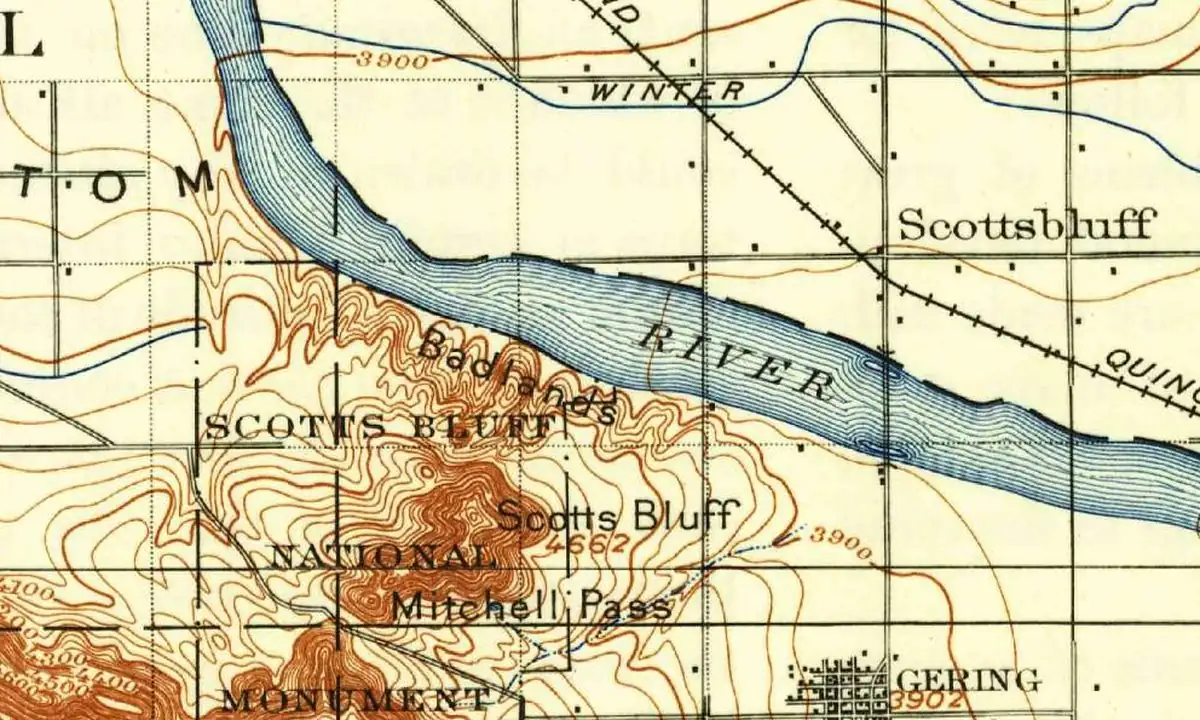
Scottsbluff, Nebraska, is named for the bluff next door, and the bluff is named for Hiram Scott, a fur trader who died near it around 1828. How he died is a famous story, but the details are shaky.
Named for a landmark
A 1925 study of Nebraska place names puts it simply: “The town is named from the ridge or bluff which in turn took its name from a noted mountaineer, Hiram Scott, whose body was found at the foot of the bluff.” The study calls the bluff “the most imposing of the elevations in the Platte valley.”
The bluff was famous long before the town. It was a landmark on the trails west, and the town only came along at the end of the 1800s. The U.S. Geological Survey’s record says Scottsbluff was founded in 1899 and incorporated as a city in 1900.
Watch the spelling. The town is one word, Scottsbluff. The bluff, the county and the national monument are two words, Scotts Bluff.
Who was Hiram Scott?
The National Park Service says he was most likely heading back to St. Louis from the 1828 fur traders’ rendezvous when he died near the bluff. The National Park Service’s handbook on the monument says a document dated October 16, 1827, kept by the Missouri Historical Society, lists him as a fur company employee owed wages, and the handbook says he was among the traders who came back to St. Louis that year. So he was a real man in the fur trade, not just a character in a story.
The story, and why to be careful
The usual story goes like this: Scott got very sick on the way back east, his companions left him behind, and his remains were found the next year near the bluff. Over the years the tale was retold many times, and it changed with each telling. The 1925 study points readers to two famous books that tell it, Edwin Bryant’s What I Saw in California and Washington Irving’s The Adventures of Captain Bonneville.
Here’s the catch. The Park Service handbook says William Sublette’s caravan found Scott’s skeleton in 1829, miles away from the spot where his companions said he had died. The accounts don’t agree on how he got sick, who left him or how he ended up where he was found. What seems solid is that Scott died in the area and that the bluff got his name. The dramatic details are better treated as legend.
Sources & further reading
- Lilian Linder Fitzpatrick, Nebraska Place-Names (University of Nebraska, 1925). A public-domain study of the state’s place names, county by county. The town named for the bluff, and the bluff for Hiram Scott; the pointers to Bryant and Irving.
- National Park Service, Scotts Bluff National Monument (Historical Handbook 28). The bluff as a landmark on the trails west; Scott in the October 16, 1827 record, and Sublette’s caravan finding his skeleton in 1829, miles from where he was said to have died.
- National Park Service, “Hiram Scott.” Most likely heading back from the 1828 rendezvous when he died near the bluff.
- Wikipedia, “Scotts Bluff National Monument.” The monument today.
- GNIS feature 833318 (U.S. Geological Survey). The federal record for Scottsbluff. Founded 1899; incorporated as a city in 1900.
Spot something wrong? Corrections are noted here with their date, never made silently.